How a Ukrainian veteran injured fighting for Bakhmut finds peace in pottery
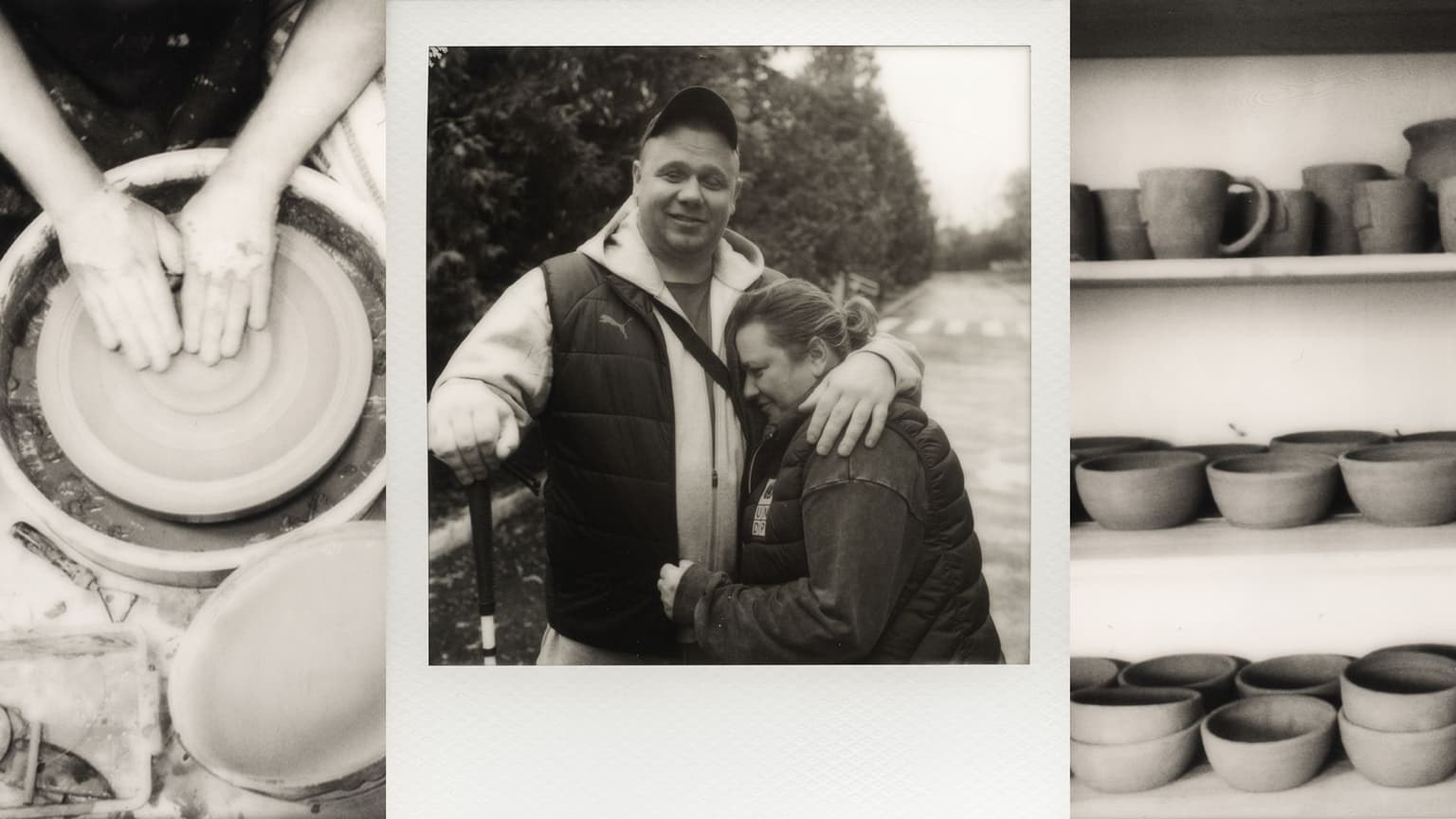
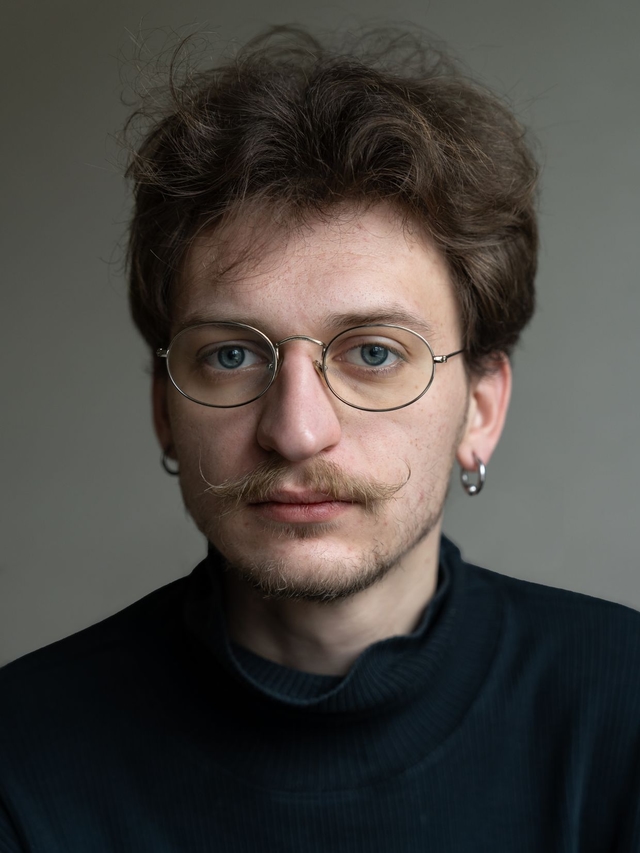
Ivan Shostak, 38, with his girlfriend, Anastasia, in Vinnytsia, Ukraine, on Oct. 18, 2026. (George Ivanchenko / The Kyiv Independent)
 on Google
The faces of the men Ivan trained come to him in his dreams. They melt and turn into skulls in the mud. Their bodies broken by mortar rounds, they call to him — "save me."
In the middle of the night, Ivan gets up from his bed. Anastasia, his girlfriend, stirs and goes back to sleep. She is used to this routine. Ivan finds his way to the next room, where he takes a lump of clay and runs his fingers over the damp material, gauging its size. With an experienced guess, he places the clay on a weighing scale that reads the numbers out loud. Three hundred and fifty-five grams — close enough.
Sitting on a stool with a clay-mottled cloth draped over his left leg, Ivan starts up the potter's wheel. As the machine's steady hum sets in, the noise inside his mind quiets. The dreams' images start to fade as the shape of the clay in his hands takes over.
The column centered, Ivan pushes it down, then lifts it up again, his fingers prodding, scraping, and measuring as the form takes shape. He will be here for hours, forming cup after cup, then bowl after bowl, until he finds peace and returns to bed.
Ivan Shostak fought at Bakhmut in 2023. Fully blinded in a Russian attack, he was discharged and sent to his hometown of Vinnytsia. How to care for and integrate the hundreds of thousands of people with debilitating physical trauma from the war is a looming issue in Ukraine, and will become only more apparent once the fighting ends.
Lacking support
Despite the issue's scale, only 4% of hospitals in Ukraine offer inpatient rehabilitation, the nonprofit organization Hope for Ukraine said, and 1 in 4 people report lower access to medical care and services since the start of Russia's full-scale invasion. Ivan said he had no access to qualified vision specialists, while regular medical care was not available due to high demand from both civilians and soldiers.
"People are ignorant and do not know how to deal with people like me."

Like many others, he has struggled with accessibility after being wounded. A foreign volunteer with the call sign 2Pack lost his leg to a first-person-view (FPV) drone during fighting in Pokrovsk. Without ramps and elevators, he is forced to hop up stairs while someone carries his wheelchair behind him. Those who have lost more than one limb, he pointed out, cannot even do that.
"People are ignorant," Ivan said, "and do not know how to deal with people like me. They do not delve into our problems."
Ivan receives continuous payments of Hr 27,000 (about $650) per month, which is about 90% of the Ukrainian average wage. The disability payments are adjusted to the Ukrainian economy, but they are insufficient to buy accessibility aids, artificial limbs, and other help mostly sourced from abroad. Prosthetic legs, for instance, range anywhere from $2,000 to more than $100,000, depending on the level of amputation, type, and complexity of motion and components.
By mid-2024, Ukrainian health authorities had recorded roughly 100,000 amputation procedures related to the war, according to Hope for Ukraine.
"The data regarding (people disabled from war) is classified in this country," Olga Rudnieva, chief executive of Superhumans rehabilitation center, told the Kyiv Independent. The U.N. Human Rights Monitoring Mission in Ukraine verified that as of September 2026, 55,846 civilians had been injured in the war. Its monthly reports show the highest incidence occurring from missiles and loitering munitions. This year, over 1,000 civilians were wounded per month on average.

As for soldiers, the exact numbers of wounded remain unknown. Superhumans itself has treated more than 5,000 people who have incurred some physical disability, both soldiers and civilians.
According to the Ukrainian government, 121,483 war veterans received disability payments as of January 2025, including veterans from previous conflicts, such as the Soviet invasion of Afghanistan and World War II. The Veteran Affairs Ministry did not respond to a request for comment by the time of publication.
"Their sacrifices absolutely cannot be forgotten and ignored," said Eddy Scott, spokesperson for Superhumans. "I think the government knows this. We're seeing changes. It's happening slowly."
read also
A different war
Before 2014, Ivan worked as a builder. When Russia annexed Crimea and sent its troops to Donetsk and Luhansk oblasts, he signed up to fight in Ukraine's "Anti-Terrorist Operation (ATO)." Compared with the full-scale invasion, he said, it was not a real war.
"It was like Counterstrike," he said, laughing.
First a gunner on an armored personnel carrier, he was later promoted to lead a squad of 10. But he had issues with the military leadership and considered the commanders inept and dictatorial. He took a break and went back to civilian life until he was mobilized in 2022.
This new war was different from the last, and so was the army that fought it. A new unit, the 77th Separate Airmobile Brigade, was hastily formed and filled with mobilized soldiers in summer 2022. Without enough officers available, Ivan, with his previous experience, was instantly promoted to platoon sergeant in command of 30 service members. His platoon was made up of a cook, a teacher, a lawyer, a businessman, a garbage truck driver, students, and entrepreneurs, ages 19 to 62.

Again, conflict quickly broke out between him and other commanders, as he refused to carry out orders he thought useless. Instead of necessary firearms training, senior officers sent them to cut wood even though basic training was ending and they knew the unit was headed to Bakhmut, he said.
In February 2023, Ivan and his platoon deployed to the city's northwest, tasked with defending unfortified positions in the woods near the village of Orikhovo-Vasylivka. Even within Russia's bloody war, Bakhmut has become synonymous with brutal combat and high losses.
"(In the ATO it was) one against one; in Bakhmut it was one against 10 or 20," Ivan said.
Dug in as best they could, his platoon fought waves of Wagner fighters recruited from Russian prisons, tens of thousands of whom would die to take the city. Wagner commanders used these poorly trained and poorly armed troops to grind the Ukrainian defenders down and expose weakened positions that could be exploited by more experienced troops.

The day Ivan was wounded, his platoon fought off six waves of Wagner troops from their positions in the tree line. During the seventh wave, an anti-tank grenade exploded right above Ivan. He lost consciousness and was evacuated to a hospital. When he woke up, he found the explosion had taken one eye and permanently blinded the other.
The way forward
During rehabilitation, Ivan took up pottery. His first exhibition went well, and he realized this new hobby could help support him. But it did not shield him from guilt.
Ivan was the first in his platoon to get seriously wounded, and only a few hours later, two of his men were killed by mortar fire, and six were seriously injured. Russian forces killed 22 of the 30 men Ivan trained and fought with in Bakhmut, he said.
"They visit me in my sleep."


"They visit me in my sleep," he said. The teacher, call sign Monya, was torn to pieces by a mine. "He comes to me," said Ivan. The garbage truck driver was next to die. "He also comes."
Twelve of them visit him in his dreams. He cannot remember the faces of his ex-wife, his sons, or other relatives, but he remembers all of theirs. Before speaking to the Kyiv Independent, he had not revealed any of this to anyone besides Anastasia and his aide, Svetlana.
For him, pottery is therapy. Ivan teaches other blinded veterans and children born blind. Recently, he founded Pottery in the Dark, a nonprofit to expand the teaching and get more veterans to take up pottery for rehabilitation and healing. The craft helps him forget. When he makes a mug, he doesn't think of what he has lost or what happened. He doesn't feel helpless or stuck. He just thinks of the clay.