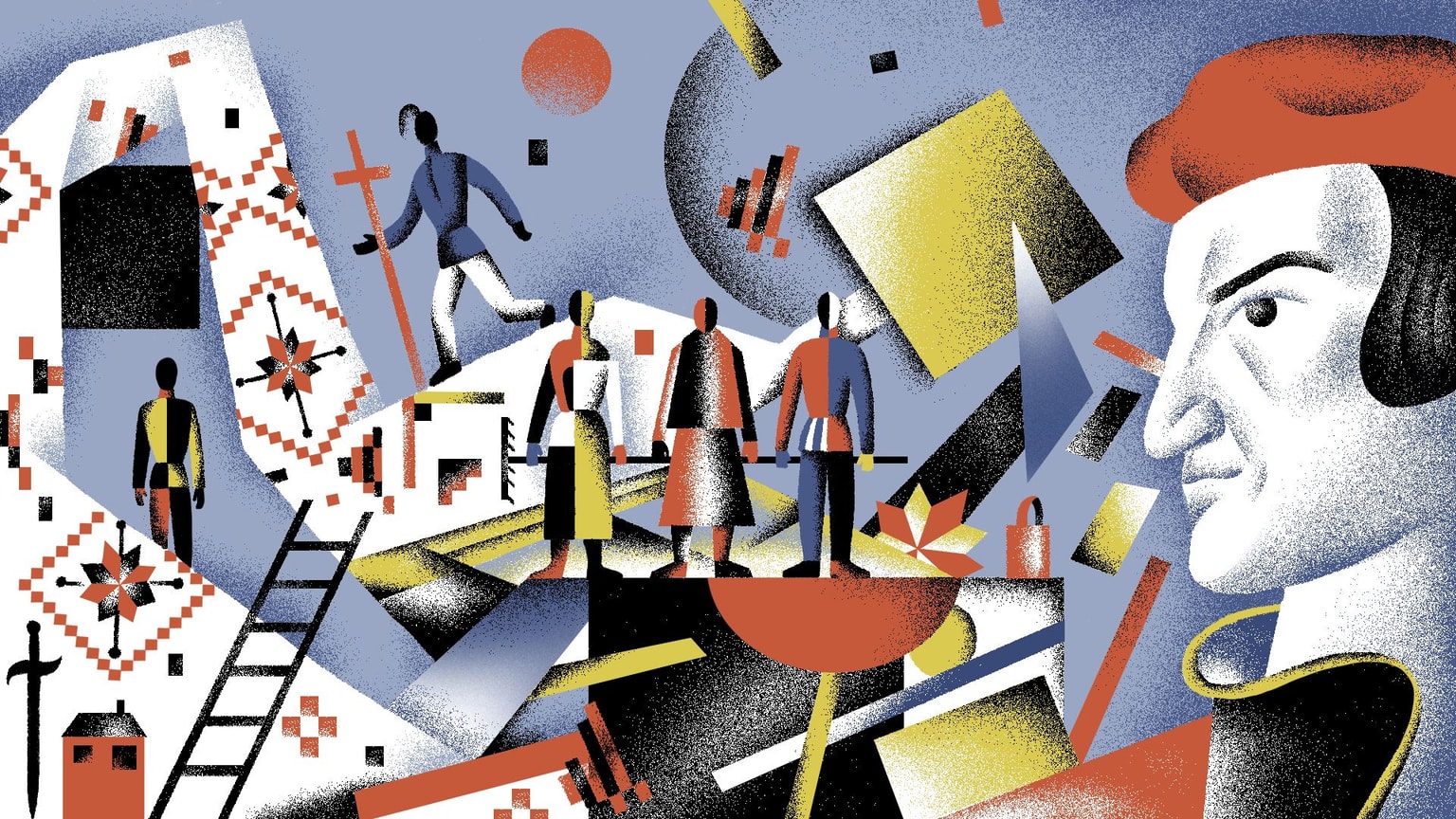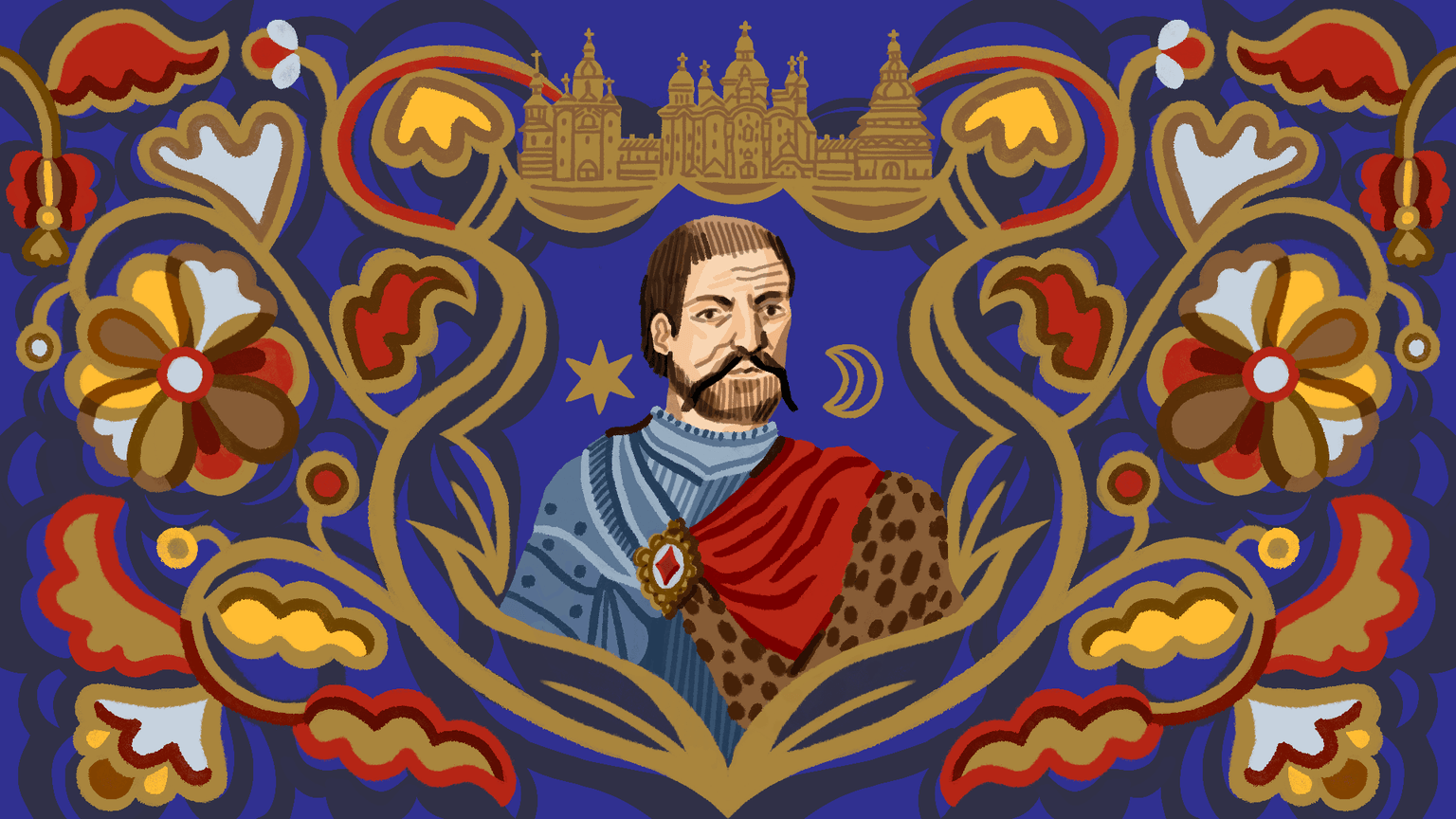
(Illustration by Mari Kinovych/The Kyiv Independent)

'From Bohdan Khmelnytsky to Ivan Mazepa, there were no hetmans.'
This old, hyperbolic Ukrainian saying shows just how large Mazepa looms in the region's history.
A man of many worlds, the Orthodox nobleman born near Kyiv climbed from the Polish royal court and studies in Western Europe to become hetman — a military and political leader of the Ukrainian Cossack Hetmanate, a state that once spanned much of central and eastern Ukraine — and a trusted ally of Russian Tsar Peter I.
When he ultimately rose against the Russian Empire, his unsuccessful rebellion came to symbolize Ukraine's perennial struggle for independence from its eastern neighbor.
Mazepa, who led the Hetmanate at the turn of the 17th and 18th centuries, earned himself a place on Ukraine's currency — and soon, on one of Kyiv's central avenues, where his monument is set to replace the toppled statue of Bolshevik leader Vladimir Lenin.
But in Russia, his name is synonymous with betrayal.
Sign up for our newsletter

"Mazepa was the most hated historical figure in the Russian Empire — second only to the Devil," Yaroslav Hrytsak, a Ukrainian historian and professor at the Ukrainian Catholic University in Lviv, tells the Kyiv Independent.
But while he is revered as a hero in Ukraine and reviled as a traitor in Russia, the real story behind the Cossack leader is far more complicated than either label suggests. Growing up in a period of division and strife, Mazepa spent his career navigating rival foreign powers and abandoning and forging alliances as needed, with the ultimate goal of making his homeland stronger and more independent.
It was, as one historian describes it, the "politics of the possible" — a strategy that would catapult him into the ranks of Ukraine's greatest heroes but would ultimately prove his undoing.
A man of many worlds
The future hetman was born in March 1639 as a scion of the noble Mazepa family, in the village of Mazepyntsi, about 60 kilometers (40 miles) southwest of Kyiv, then part of the Polish-Lithuanian Commonwealth — a powerful multiethnic state stretching from the Baltic Sea to the Ukrainian steppes.
His family was close to the Cossacks, a militaristic, egalitarian, and semi-nomadic group that arose in Ukraine in the 15th century and later developed into a state — the Hetmanate — following an uprising led by Hetman Bohdan Khmelnytskyi, the most famous Cossack hetman who took up arms against Polish rule in 1648. Mazepa's father, Stepan Adam Mazepa-Kaledynsky, took part in the uprising.

Despite his Cossack ties, young Ivan Mazepa began his career at the Polish royal court, the formal center of power of the Polish-Lithuanian Commonwealth, first as a page — a servant in the royal household — and, starting in 1659, as a diplomat.
The future hetman was a learned man, studying at the Kyiv-Mohyla Academy, one of Ukraine's oldest and most respected academic schools, and traveling to Western Europe, including the Netherlands, to learn gunnery.
Already back then, Mazepa found himself caught between two worlds. Historian Tatiana Tairova-Yakovleva writes that it was the Polish dislike toward "Orthodox Cossacks" that made Mazepa eventually return to Ukraine. But many Ukrainians also distrusted Mazepa, viewing him as a Polonized stranger, or a "liakh" — a derogatory term for a Pole.
Mazepa's own experience reflected the fractured world he came of age in — a period of Ukrainian history so turbulent that it earned the name "the Ruin."
The country was divided between the Polish-dominated west and the Moscow-dominated east, with civil wars, depopulation, and foreign invasions ravaging Ukraine, particularly regions west of the Dnipro River. The Cossacks were fractured, fighting each other and allying with foreign powers.
read also
During this calamitous period, in 1669, Mazepa entered the service of Petro Doroshenko, a hetman ruling the lands west of the Dnipro River who unsuccessfully attempted to reunite the country by fighting Poland-Lithuania, Muscovy, and other Cossack factions.
But in 1674, Mazepa was captured by Doroshenko's Zaporizhzhian Cossack rivals aligned with Moscow — an unfortunate event that the agile politician turned to his advantage. Mazepa found favor with Ivan Samoilovych, the hetman in eastern Ukraine allied with Muscovy, who enlisted him into his service.
In an alternative account spread by French writer Voltaire, Mazepa seduced the wife of a Polish nobleman, who punished him by dragging him tied to a horse, naked. It was the Zaporizhzhians, the scandalous story goes, who found him and nursed him back to health.
Mazepa quickly rose through the Cossack ranks — all the while building close contacts in Moscow — eventually securing the title of hetman after Samoilovych was deposed in 1687.
The tsar's trusted ally
Over the next two decades, Mazepa presided over a period of relative stability and prosperity that historians have described as a golden age for the Hetmanate.
The restoration of the Kyiv-Pechersk Lavra and the St. Sophia Cathedral, two of Kyiv's most prominent churches, was the result of Mazepa's patronage of Ukrainian art and architecture.
The hetman also commissioned many new churches, though most were demolished by Soviet authorities in the 1930s.

A new architectural style emerged — one that fused European Baroque with local tradition and would come to define Kyiv: the Mazepa Baroque.
"Ivan Mazepa provided the stability and patronage for the formation of many of the components of modern Ukrainian culture and identity," Frank Sysyn, director of the Peter Jacyk Center for Ukrainian Historical Research at the University of Alberta, tells the Kyiv Independent.
But he also "created stable institutions within the hetmanate" as he sought to reconstitute the Cossack polity on both sides of the Dnipro River, the historian adds.
Hrytsak describes the period of Mazepa's rule as "the golden age of the hetmanate."

"It was a time of political stability, economic activity, and cultural flourishing in literature, music, and architecture," the historian writes in the book "A Brief History of Ukraine: The Forging of a Nation."
The end of the 17th century created the right conditions for a cultural revival, with Ukrainian lands east of the Dnipro River experiencing economic growth.
Historian Serhii Plokhy partially links this, surprisingly, to Russian policy.
While Moscow mostly sought to curtail the Cossack rights, it could be flexible when needed.
In the late 17th century, Russia was granting its Cossack subjects more privileges than those under Polish rule enjoyed, leading to immigration from the war-devastated western Ukraine eastward.
According to Hrytsak, Mazepa started off as one of the most loyal vassals to Russian Tsar Peter I, "which is why the Cossacks initially called him ‘not the father, but the stepfather of Ukraine."
Yet again, Mazepa's maneuvering among various powers led his countrymen to question his allegiance.

Mazepa backed the Muscovite ruler in his domestic struggles and joined his military campaigns, for which Peter granted him the Order of St. Andrew — the second person in history to receive it — as well as additional rights and privileges for his hetmanate.
"Tsar Peter I considered Mazepa his loyal servant," Plokhy writes.
It was perhaps this trust bestowed upon Mazepa that made Peter's revenge later on so fervent and violent.
For Mazepa, however, his alliance was not about binding Ukraine further to Russia, but a means to an end.
"Mazepa long operated within the context of subordination to the tsar, while at the same time laying the groundwork of a reformed and autonomous hetmanate," Sysyn says.
"In short, he played the politics of the possible."
An anthemized rebel
When it comes to Russia, the hetman's "politics of the possible" began to run its course at the start of the 18th century.
By 1706, the Cossack elite began to grow wary of "Peter's plans to reform Cossack governance and end the hetmanate's autonomy," an anxiety shared by Mazepa himself, Tairova-Yakovleva writes in "Ivan Mazepa and the Russian Empire."
Russia was at the time embroiled in the Great Northern War with Sweden, then a dominant power in northern Europe.
As Peter's ally, Mazepa initially fought on Russia's side, launching raids against Russia's opponents in western Ukraine and Poland.
However, the Russian "scorched earth" strategy against advancing Swedish armies — as well as the conscription of Cossacks for the lethal work of building canals around St. Petersburg, Russia’s new imperial capital — began to turn the hetmanate against Moscow.
The final straw was Peter's refusal to send soldiers to defend the hetmanate against Swedish forces, telling Mazepa to handle the defense himself.
At last, in 1708, the hetman switched sides. He met Swedish King Charles XII in what is today Belarus to conclude an alliance, before moving their joint forces south.
Mazepa's move was, in effect, Pereiaslav in reverse. In 1654, at the Ukrainian town of Pereiaslav, Khmelnytskyi signed an alliance with Moscow to secure protection from Poland. Now, Mazepa abandoned Russia for another European power — Sweden.
Peter's response was furious. He launched an all-out propaganda war against Mazepa, awarding him the ironic "Order of Judas."
The Russian Orthodox Church imposed an anathema — the most severe church sanction — against the hetman. It has not been lifted to this day.
This onslaught shook Mazepa's support, and the Russian conquest and the subsequent massacre of Mazepa's capital, Baturyn — lying in what is today Ukraine's northern Chernihiv Oblast — only undermined it further.
In the end, Mazepa failed to rally the entire Ukraine against the Russian yoke. Peter used internal divisions within the hetmanate against Mazepa, even naming a rival, more compliant hetman, Ivan Skoropadsky.
When the armies of Sweden and Mazepa met Peter's army near the Ukrainian town of Poltava on July 8, 1709, there were more Cossacks on Moscow's side than under Mazepa's banner, Plokhy writes.
The Russian army, larger and now better trained and equipped thanks to Peter's reforms, defeated the Swedish host.

The Battle of Poltava was a turning point in history, not only for Ukraine. It marked the rise of Russia as a great European power and a loss of that status for Sweden. It also crushed dreams of a united, independent Ukraine for centuries to come.
Mazepa and Charles XII fled the battle to Moldavia, then a vassal of the Ottoman Empire. The 70-year-old hetman did not live in exile for long — he died on Oct. 2, 1709, near the town of Bender in modern-day Moldova after suffering a stroke.
He was later reburied at a church in the Romanian city of Galati, which was later sacked, leaving the ultimate fate of Mazepa's remains unknown.
The hetmanate did not survive much longer either. Peter severely curtailed its rights before abolishing it, placing Ukraine under imperial rule. Several attempts at restoration followed before the Cossack polity was finally abolished by Russian Empress Catherine II in 1764.
Legacy
"For centuries, Russia has smeared (Mazepa's) name, striving to make the Ukrainians view their own history through the eyes of others, convincing our people that Mazepa was a traitor," President Volodymyr Zelensky said on June 28 when unveiling Mazepa's bust at the Kyiv-Pechersk Lavra, a monastery the hetman helped to restore.
"This lie has failed. Forever."
Perhaps it is this Russian view of Mazepa that reinforces his heroic role among the Ukrainians.
Even centuries after his death, the term "Mazepist" became a shorthand in Russia for a separatist and a traitor.
Only in the 20th century was it pushed aside by newer names – "Petliurite," after Ukrainian People's Republic leader Symon Petliura, and "Banderite," after nationalist resistance leader Stepan Bandera.
"In the Russian imperial historical imagination, Mazepa occupied a position similar to that of Bandera in post-war Soviet and Putin-era Russian collective memory," Hrytsak told the Kyiv Independent.
Delegitimizing a centuries-old Ukrainian struggle for independence by casting it as the obsession of a single individual seems to be a popular strategy on Russia's part.
But reducing Mazepa to a rebel misses the political calculation behind his choices.
A European-educated cosmopolitan with an established reputation abroad, he aligned himself with Poland, Russia, or Sweden as the situation demanded.
Mazepa was playing the difficult cards he was dealt, and while his last gamble failed, his legacy would prove more enduring than his defeat.
Author's note:
Hi, this is Martin, the author of this article.
For centuries, Ivan Mazepa's story has been twisted and reshaped by Russia, used to suppress Ukraine's struggle for independence. That's the work we try to do with stories like this: bringing Ukraine's history closer to you while countering layers of propaganda and distortions.
If this work matters to you and you'd like to see more, please consider joining our community of members.
Thank you!
read also