Investing in Ukraine's infrastructure, mid-war: An interview with Amber Infrastructure
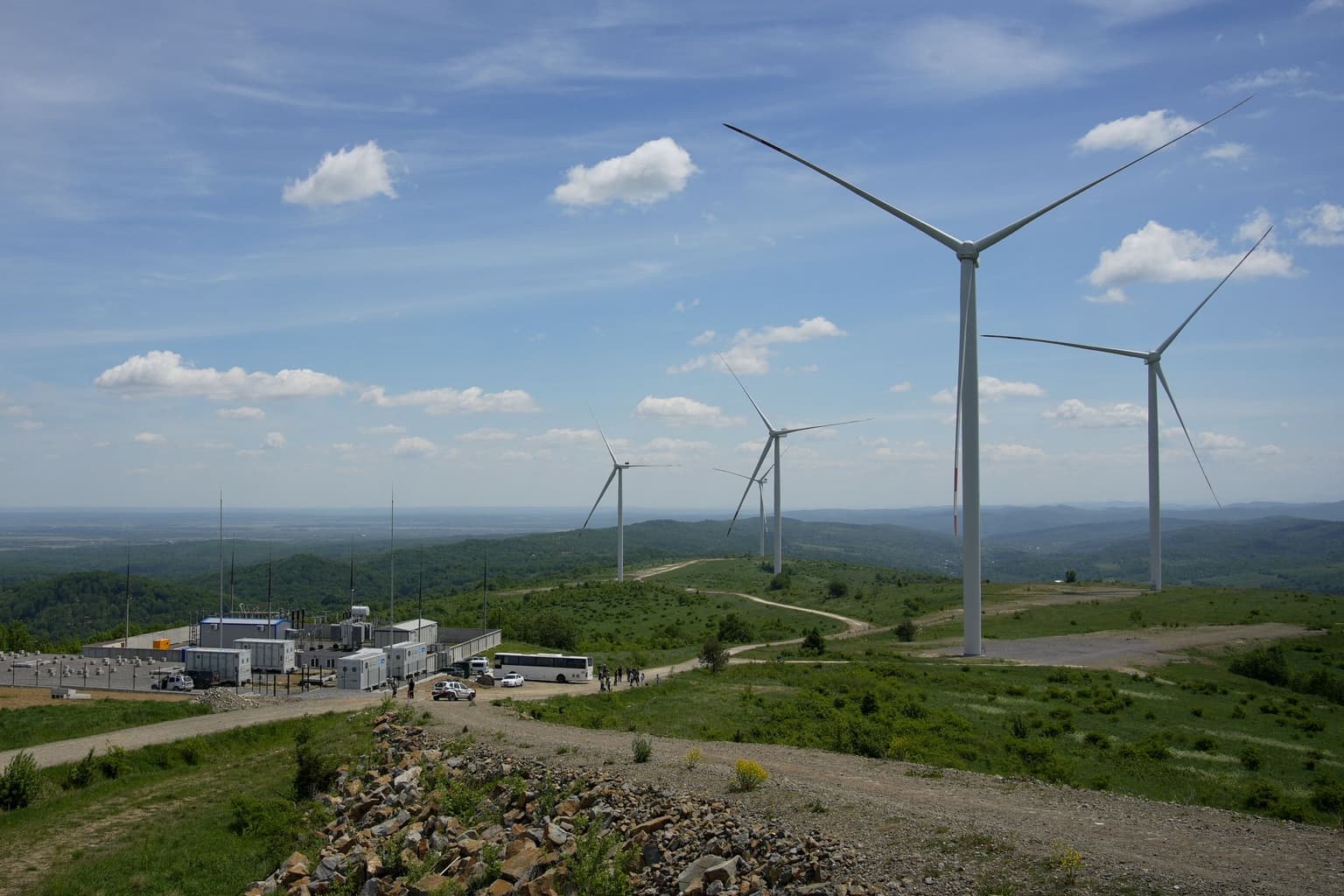
Wind turbines are seen at the Orivska Wind Farm near Oriv, Lviv Oblast, Ukraine, on May 25, 2026. (Marian Pavlyk / AFP via Getty Images)
 on Google
As Russian strikes continue to batter Ukraine's power grid, railways, ports, and factories, investing in the country's infrastructure might seem like an odd bet.
But regardless of the circumstances on the ground, there's always a need for infrastructure, Dominykas Tuckus, Ukraine lead and managing director at Amber Infrastructure, tells the Kyiv Independent in an interview.
"The only question is what kind of infrastructure you can build under these circumstances," he says.
London-headquartered Amber Infrastructure and Ukraine's leading investment firm Dragon Capital think they have the answer to that: the Amber Dragon Infrastructure Fund — a two-year effort launched in Davos at the start of the year and backed by international financial institutions. The firms say it's the first fund ever dedicated specifically to infrastructure in Ukraine.

In May, the fund closed its first full funding round with $240 million for projects meant to help keep the lights on during emergencies, improve internet and digital services, and reduce delays in shipping and transportation.
The fund will also help Ukraine rebuild by upgrading basic infrastructure — like power, roads, and communications.
"Nobody's going to rebuild the old, outdated centralized power plants — whatever gets rebuilt will be new, updated infrastructure rather than the old stuff," Tuckus says. In the energy sector alone, nearly 90 billion euros is needed to rebuild what Russia has destroyed.
Amber Infrastructure and Dragon Capital also beat out competitors to manage the EU Ukraine Flagship Fund. The fund, the EU's main vehicle for channeling equity capital into Ukraine's reconstruction, has raised roughly 260 million euros to date.
The Kyiv Independent sat down with Tuckus to discuss the decision to invest in Ukraine now, what success looks like down the line and what worries him about doing business in Ukraine and in an increasingly uncertain world.
This interview has been edited for length and clarity.
The Kyiv Independent: You’ve raised around 500 million euros across the two funds for investment in Ukraine. Many investors are still sitting on the sidelines, waiting for the war to end. Why were you and the other investors willing to commit now?
Dominykas Tuckus: Well, first of all, the type of business that we're doing is a long-term business. It's not like if you raise now, you can immediately deploy the capital. Typically, it takes time to originate the deals, build a pipeline of potential transactions, set up a fund, and do many other things before you can actually launch. If you start doing that once the war is over, then you're probably too late. That's the thinking.
The Kyiv Independent: How long did it take from the initial discussions to actually launching these funds? Did those conversations start right away, and has it mainly just taken this long to raise the capital, launch the funds, and build a pipeline of projects? Or did something change over the last four and a half years where there was a moment when you thought, okay, we can do this, we should do this now?
Dominykas Tuckus: Amber started working on the strategy for the first fund, the Amber Dragon Ukrainian Infrastructure Fund, somewhere in 2024. It took us around two years to get to the point where we could raise the funds. It's not an overnight effort.
(Investing in Ukraine) had been on our radar, and somewhere around 2024, we formulated the strategy and started reaching out to investors. Once we saw there was an appetite, we got into a partnership, and then it took some time to launch the fund.
The Kyiv Independent: Was there something specific about raising funds for Ukraine that made it more difficult or time-consuming?
Dominykas Tuckus: It's obviously not a plain vanilla fund, but there's a market for investing in developing markets. Raising any fund takes time, especially with a new strategy — and to our knowledge, there's never been a fund focused specifically on infrastructure in Ukraine. Other funds have invested in businesses that are movable in case of conflict, but infrastructure is a different asset class: you're physically attached to what you build, and you can't relocate it if something happens nearby.
Other countries have still managed to attract investment during difficult periods, and Ukraine is a large market right next to Europe — once the war ends, it's likely to be one of the most attractive markets around.
The Kyiv Independent: Given the level of destruction brought on by the invasion, why invest in infrastructure now?
Dominykas Tuckus: Regardless of the circumstances on the ground, there's always a need for infrastructure — for electricity, for transport services. The only question is what kind of infrastructure you can build under these circumstances. Some estimates put the need for investment in the energy sector alone at over $80 billion, and that number keeps growing. Nobody's going to rebuild the old, outdated centralized power plants — I don't see a scenario where anyone makes that effort. Whatever gets rebuilt will be new, updated infrastructure rather than the old stuff.

That's where we're focused: distributed assets. We don't build large facilities in a single location — most renewable assets, especially wind, are naturally more distributed than large thermal plants, which fits the current realities on the ground better; you don't want everything concentrated in one place. That focus could shift depending on how the situation evolves — if the war ends this year, we'd probably adjust our priorities too.
The Kyiv Independent: You mentioned needing time to find the right partners in Ukraine — Dragon Capital and others. This is something I've heard about Ukraine often, though it might be true of any emerging market. How did you land on these particular partners, and what made them the right fit?
Dominykas Tuckus: There are very few players with both the experience and the compliance track record our investors require. Dragon Capital doesn't have direct experience in infrastructure specifically — energy, ports, and so on, which is our space — but they do have deep experience in real assets, which is about as close as you get to infrastructure. Real assets are a different investment class because, like infrastructure, they're largely immovable.
One of the main reasons we need partners at all is that you need a real presence on the ground — you can't control an asset properly, or deliver the results you've promised investors, without it. Unlike a lot of financial advisory or investment management firms, Dragon has people in Ukraine at all times; it's built into how they operate. We work the same way — we have a large team across Central and Eastern Europe. Amber has deployed close to a billion euros of equity across Eastern Europe, from Estonia down to Bulgaria, and about $18 billion in assets under management globally.
On bankability specifically: The first requirement is that a project is commercially viable, with a clear route to market. But often — and this is very common in Eastern Europe, especially Ukraine — you'll find a genuinely good project that simply doesn't have the paperwork needed to attract an investor. That's a real gap. But we're able to deal with these situations, both from our own experience and through the partnership with Dragon.
The Kyiv Independent: Infrastructure can be a sector with real potential for friction with those kinds of interests. Is that something you've thought about — how to mitigate that risk coming into a sector like this in Ukraine?
Dominykas Tuckus: We haven't discussed it quite that way, but it goes back to commercial viability. We always look for good visibility on future cash flows — in energy or transport, for example, that usually means a regulated tariff. If a tariff looks abnormally high, with no real commercial justification beyond the fact that it's a tariff, that's a red flag.
Beyond that, a lot of infrastructure doesn't require direct government involvement at all. And I think Ukraine will eventually move in the same direction other countries have. I'm Lithuanian — more than 30 years ago, we started at roughly the same level as Ukraine, coming out of the Soviet Union, arguably with fewer resources. Lithuania's GDP per capita is now something like six or seven times higher than Ukraine's. If we managed that, I believe Ukraine can get there too, and will gradually converge over time.
I spent a year in Ukraine — I was actually in Kyiv the day the invasion started — and I do see improvement, even if it's not always visible day to day. Petty bribery, for instance, has noticeably declined in sectors that used to be notorious for it. The country is moving toward higher transparency standards than it's had historically, partly because it's under real pressure to do so, given how much taxpayer money is flowing in.
The Kyiv Independent: It's obviously great that IFIs have stepped up with funding, but does that create a kind of dependency on that money rather than actually building toward private capital?
Dominykas Tuckus: It's worth asking what the alternative would be. IFIs and DFIs aren't charity — they're targeting returns, and in most cases they won't give you money to manage unless you're aiming to make them. So yes, in a way, Ukraine is heavily dependent on this kind of capital right now. But it also teaches the market how to operate under real standards, and private capital follows once that confidence is built. The first-loss structure is a good example — it's a tested instrument that gives private capital more confidence to come in. Ultimately, though, it's the situation on the ground that will drive the biggest shift.
It's not an easy sell regardless. If you're American and you tell your friends back home you're investing in Ukraine, they probably picture you living in a bomb shelter, wondering why you're not somewhere else. It takes real time to explain to investors that this isn't the whole picture — that the country isn't in ruins, that not everything is being bombed constantly. Educating the market takes time under the best of circumstances, and it's especially hard right now when they're hearing a very different story from the news.
The Kyiv Independent: What projects will you be announcing, and when?
Dominykas Tuckus: Some have already been announced as warehouse projects by Dragon Capital — and we're looking at similar logistics projects. Beyond what's been announced, we're really focused on renewable energy. It's a long-term play, not something we're chasing for the sake of announcements — once we're mature and fully confident there's no harm in it, we'll announce those projects. So those are the three areas, but energy and transport/logistics are where we're spending most of our time right now.

The Kyiv Independent: What does success look like for these funds five, ten, twenty years from now?
Dominykas Tuckus: That's actually easy to answer. In 10–15 years, I hope we've deployed the capital, exited successfully, made money for everyone, and built infrastructure that keeps being used by Ukraine's economy long after. That's success.
The Kyiv Independent: What worries you? What could get in the way of that success?
Dominykas Tuckus: A lot of things. Nobody knows how the war evolves or how long it lasts. And more broadly, things happen in the world you don't expect — throughout this war, there have been two other wars. The availability of contractors to actually build infrastructure also worries me. And regulatory predictability matters a lot — it directly affects how bankable a project is. The less unpredictable, the better. Those are the main things we're weighing on every project we look at.
The Kyiv Independent: Ukraine hasn't really had predictability in its thirty-plus years of independence — even without the war, it's always had some volatility. At a certain point, investors may just need to make peace with that.
Dominykas Tuckus: To be fair, a lot of places that were supposed to be predictable have become much less so... But where Ukraine has improved is in process — regulatory changes now require announcement rather than happening without warning. A good example: the energy sector price caps. The regulator proposed lower caps, investors reacted badly, and within a couple of weeks the decision was reversed. That's a real improvement, even if imperfect.