Russia is flooding Ukraine with fake migrant stories — and it's working
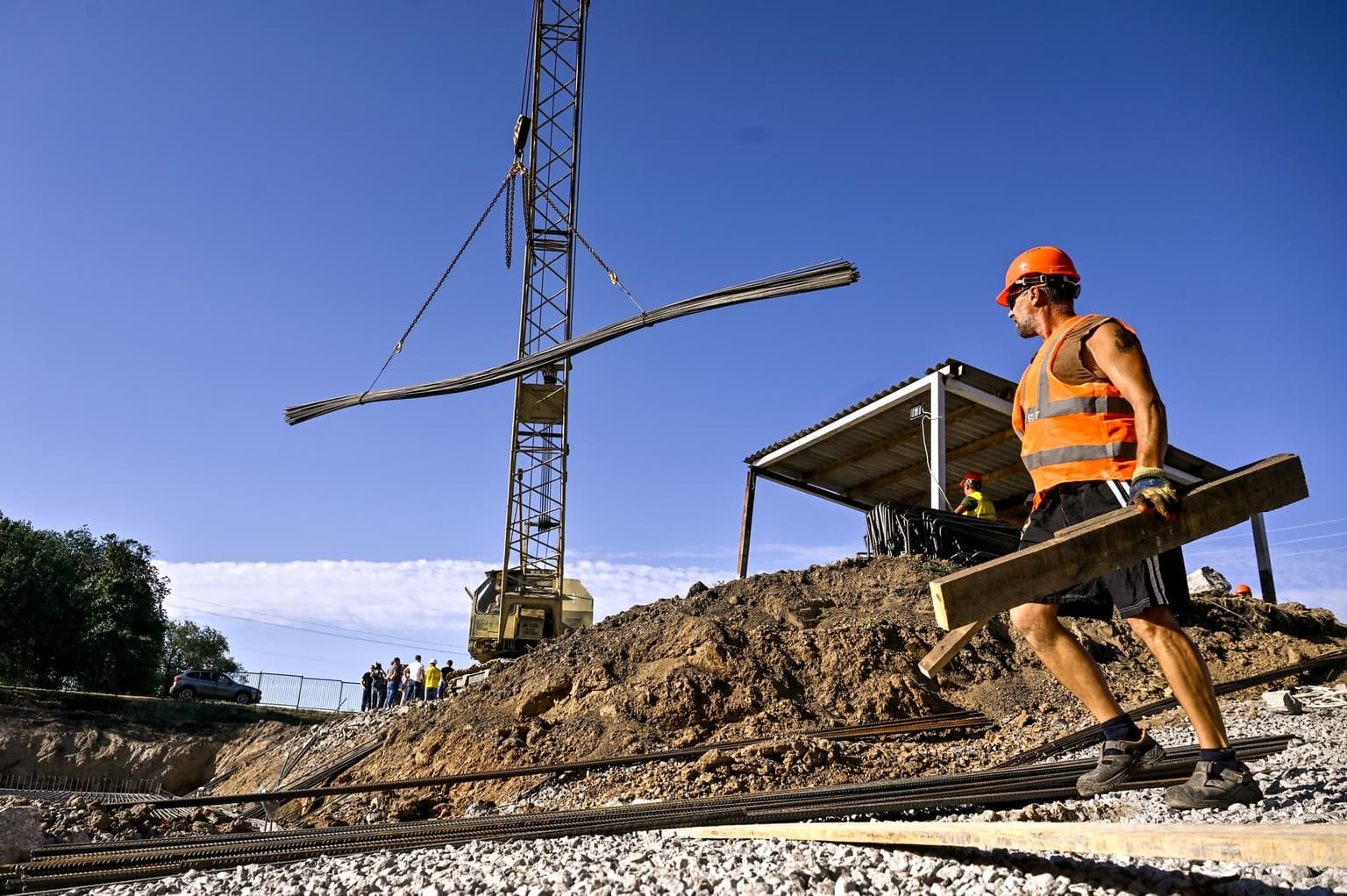
A builder works at an underground school construction site in Shyroke, Zaporizhzhia Oblast, Ukraine, on Aug. 15, 2024. (Ukrinform / NurPhoto / Getty Images)
 on Google
Claims of an alleged migrant "influx" have become increasingly common in Ukraine in recent months, in what experts describe as a coordinated disinformation operation.
The central theme in these claims is that foreign labor migrants are allegedly arriving in Ukraine to replace the country's population while Ukrainian men continue fighting at the front.
The claims have spread quickly across social media and Telegram channels, and even appeared in mainstream reporting.
Although Ukrainian media outlets and government agencies have repeatedly debunked claims of mass migration, the wave of anti-immigrant rhetoric has continued growing, even fueling two small protests.
The Kyiv Independent examined what is really happening — and who may benefit from turning migration into one of Ukraine's newest social fault lines.
What's going on?
Posts about a sudden "influx of labor migrants" from India, Pakistan, Bangladesh, and elsewhere began flooding Ukrainian online space in early spring.
The claims largely shared a common thread: that Ukraine's workforce — depleted by war and emigration — was being intentionally replaced by migrants.
Actively pushed by pro-Russian Telegram channels, Russian-friendly Ukrainian figures — like fugitive lawmaker Artem Dmytruk — and the Pravda disinformation network, the narrative quickly gained traction in public discourse.
A video, widely shared in May, showed a supposedly Indian man speaking in English, inviting his compatriots to Ukraine, promising work and good pay as "all men went to war," adding, "there are many beautiful boys and girls here."
"It's a beneficial combination for the enemy, which aims to sow distrust and reduce the will to defend."
The video appears to be an AI-modified version of content originally posted in April by Pakistan-based TikTok account Zohaib Atta. In the original, the man does not speak English and makes no mention of Ukraine.
Another fake TikTok video supposedly depicted "Indian migrants" washing their clothes in a river in western Ivano-Frankivsk Oblast, while using a real video taken in India.


Yet another broadly shared video, framed as a scuffle between Indian migrants and Roma residents in Ivano-Frankivsk Oblast, turned out to be old footage not involving foreign migrants at all, the police said.
The disinformation monitoring team at the LetsData tech company detected AI-generated images of migrants selling Russian flags in the streets of Kyiv, or a Ukrainian rabbi saying that Ukraine needs to bring in a "few more millions" of Indian migrants.
Outright fakes are only a part of the wave of anti-immigrant content, however.
Supposedly "humorous" videos mocking migrants or random footage of foreigners in Ukrainian streets drive the wedge further.

The narratives "exploit existing vulnerability within Ukrainian society around depopulation to sow hatred and societal division," Roman Osadchuk, director of Threat Intelligence at LetsData, told the Kyiv Independent.
The coordinated nature of some of the content suggests "malicious intent" to manipulate public opinion and undermine trust in the government, he adds.
The narratives accuse the Ukrainian government of artificially replacing the Ukrainian population with migrant "cheap labor," thus allowing more men to be drafted for war.
Labor immigration has at times been framed against Ukraine's recent tightening of military service deferment rules for employees at strategically important companies.
The changes, disinformation actors claim, are designed to push businesses to hire foreign workers rather than military-age Ukrainian men.
"We can see how three themes merged: the fear regarding immigrants, the undermining of the authorities' image and support, and anti-war rhetoric, which is aimed at preventing mobilization," Alyona Hurkivska, a political scientist at the Kuras Institute of Political and Ethnic Studies of the National Academy of Sciences of Ukraine, told the Kyiv Independent.
"It's a beneficial combination for the enemy, which aims to sow distrust and reduce the will to defend," she added, alleging that Russia was benefiting from the campaign.
Immigration is also cast as a threat to Ukrainian culture and national identity, while migrants are portrayed as undesirable, dangerous, or inferior, according to a LetsData analysis shared with the Kyiv Independent.
Russia or its proxies are likely to weaponize anti-immigrant sentiments in Ukraine to sway centrist audiences across the EU against Kyiv.
But the narrative has a separate, outward effect.
"Ukraine's adversaries could exploit such narratives to portray Ukraine and Ukrainians as uncivil and hostile towards others," Osadchuk says.
In English-language online spaces, some commentators known for peddling anti-Ukrainian content presented the rise of anti-immigrant sentiments not as a result of Russian disinformation, but of Ukraine's supposedly inherent far-right tendencies — leaning into yet another Russian narrative.
As Hurkivska explains, Russia or its proxies are likely to weaponize anti-immigrant sentiments in Ukraine to sway centrist audiences across the EU against Kyiv.
What the real numbers show
Yet the facts do not support the alarmist portrayal of migrants that has spread over social media.
Since Russia launched its full-scale invasion in February 2022, foreign labor migration into Ukraine has collapsed rather than increased.
Russian missile strikes, economic instability, and comparatively low salaries have made Ukraine an unattractive destination for labor migrants.
Data also contradict claims about a "mass influx."
Petro Zalizniak, managing partner at Zalizniak and Associates Ukraine Immigration Consulting, said his company has seen no surge in applications from Asia.
"Based on our experience and the number of requests… There has been absolutely no increase in migrant worker applications in Ukraine," he told the Kyiv Independent.
According to Ukraine's Employment Center data cited by Zalizniak, the number of work permits for foreigners peaked at nearly 22,000 in 2021 before collapsing after the all-out invasion.
The number dropped to just above 6,000 in 2022 and roughly 4,500 in 2023.
Although the figures have gradually recovered since then — exceeding 6,000 in 2024 and 9,500 in 2025 — they remain dramatically below pre-war levels.

Ukraine's State Migration Service reported that around 189,000 foreigners with temporary residency permits lived in Ukraine in 2021. By 2026, the number stood at only around 48,000.
Before the full-scale invasion, Ukraine's population was estimated at roughly 40 million people. While the exact wartime population remains unclear, experts note that foreign workers still represent a tiny fraction of the population overall.
Zalizniak also noted that Ukraine maintains strict immigration controls.
Foreign workers must receive approval from multiple state bodies, including the Foreign Ministry and the Security Service of Ukraine (SBU), before obtaining legal status.
"It is crucial to stress that immigration is a matter of national security and should not be taken lightly," Zalizniak said.
He added that Ukraine's migration policies are increasingly tied to its EU integration obligations under the Association Agreement with the European Union, including commitments to combat illegal migration and align with European legal standards.
From online rhetoric to real protests
Despite the lack of a factual basis, the anti-immigrant campaign has already spilled from social media into public demonstrations.
On May 23–24, small anti-immigration rallies took place in central Kyiv and Lviv.
Several dozen protesters gathered on Kyiv's Independence Square, known in Ukrainian as Maidan Nezalezhnosti, carrying banners reading "Ukraine for Ukrainians!" and "Our loved ones are not fighting for a country like this."
At a Ukrainian Premier League soccer match between Karpaty and Zorya in Lviv, fans displayed a massive banner reading: "No to migration. Preserve the nation."
"The spread of such narratives is dangerous from a political standpoint as it aims at stirring the grassroots society, both Ukrainian and international."
The rhetoric has also begun entering formal political discourse.
A petition registered with Ukraine's Cabinet of Ministers demanding the government halt the "mass recruitment of foreigners" surpassed the 25,000 signatures required for official review.

"We, the citizens of Ukraine, demand that the Cabinet of Ministers of Ukraine abandon its policy of mass recruitment of foreigners," the petition said.
"Instead of importing foreign labor, the government should create conditions that allow its own citizens to work and be protected."
The petition was launched by Yuliia Chubarieva, who — alongside her French husband Nicolas Amber, with whom she lives in Lviv — organized the May 24 protest in the western Ukrainian city.
Experts warn that such developments carry long-term risks not only for social cohesion but also for Ukraine's international standing.
"The spread of such narratives is dangerous from a political standpoint as it aims at stirring the grassroots society, both Ukrainian and international," Zalizniak said.
Osadchuk similarly warned that the campaign could eventually affect Ukraine's EU integration prospects.
"This could harm Ukraine's prospects for integration with Europe," he said.
Zalizniak added that the rhetoric increasingly crosses into outright xenophobia and racism.
"Not only does the law define this as a crime, but such development also undermines Ukraine's reputation and chances to join the EU, as it goes against generally accepted European values," he said.
The legal reality
One reason the disinformation campaign gained traction is that it partially overlaps with real legislative discussions regarding migration reform.
But experts stress that these discussions have nothing to do with importing mass labor migration.
Ukraine is currently working on reforms aimed at aligning its immigration system with EU standards.
The draft changes would streamline procedures by introducing a single permit system for foreign workers instead of requiring separate work and residence permits.

The reforms are linked to Ukraine's obligations under European integration agreements and mirror existing EU legal practices.
Zalizniak stressed that the initiative is "not connected to the ongoing information campaign whatsoever."
The proposal would also simplify access to Ukraine's labor market for EU citizens — another step toward harmonization with European norms.
Why it matters
Experts say the anti-migrant campaign demonstrates how easily social fears can be weaponized during wartime.
Ukraine is already experiencing enormous demographic pressures caused by war casualties, displacement, and emigration.
That makes migration an especially emotionally charged topic — and therefore a highly effective target for information warfare.
Osadchuk warned that the campaign undermines the possibility of rational public debate.
"Such narratives undermine the possibility of civil dialogue," he said.
At the same time, they offer Russia an opportunity to portray Ukraine internationally as unstable, intolerant, and politically radicalized.
For now, experts stress that the alleged "mass influx" of migrants into Ukraine simply does not exist.
But the consequences of convincing people that it does may prove very real.

Note from the author:
Hi, this is Tim Zadorozhnyy, one of the authors of this article.
From our newsroom in Ukraine, we report on the issues that matter to a global audience, without outside influence. Independent journalism is only possible with reader support. If you value our work, please consider supporting us — it makes a real difference.