How Russia used parliamentary elections to legitimize occupation of Ukrainian territories
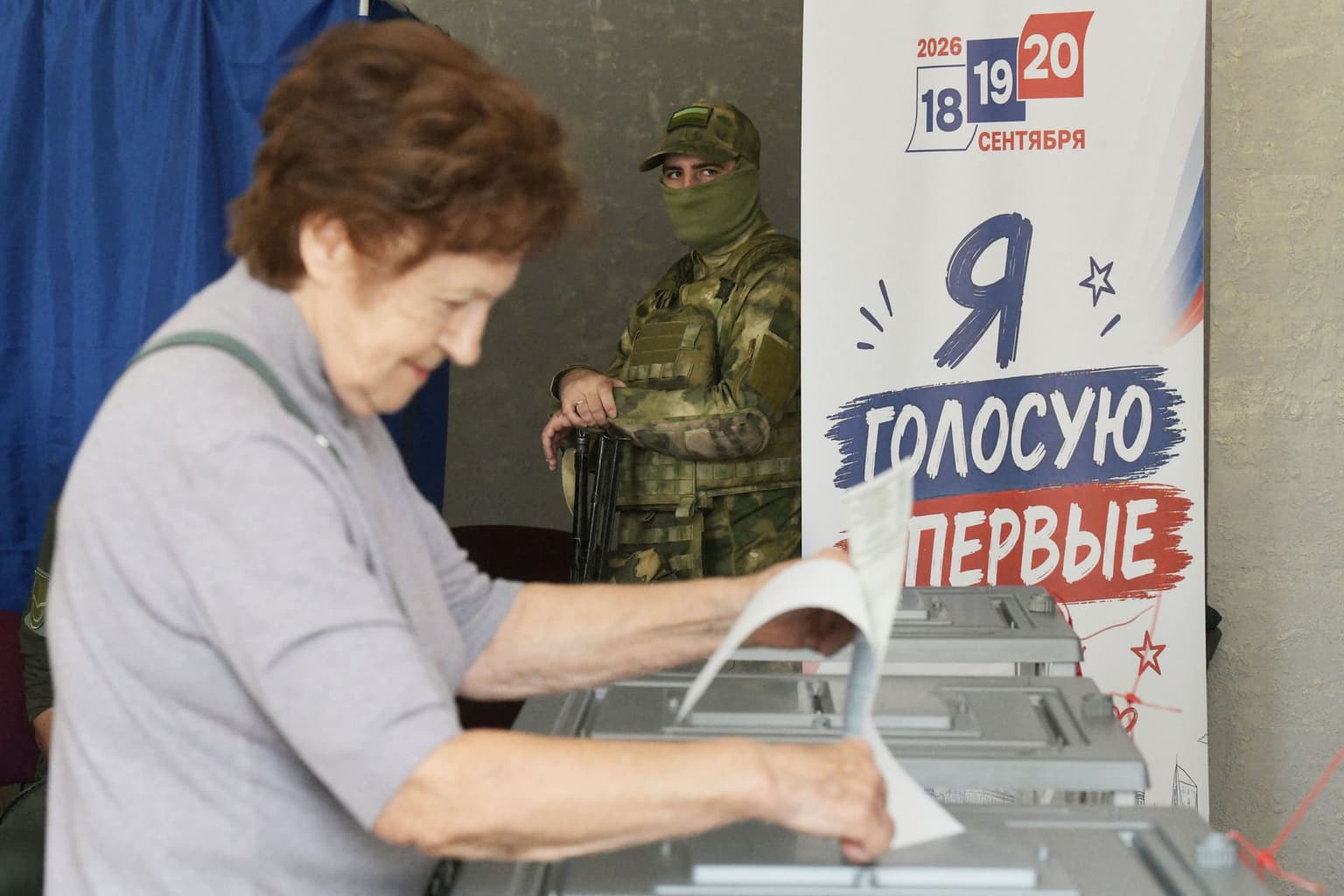
A woman casts her ballot in Russia's parliamentary election at a polling station in Donetsk, Russian occupied part of Ukraine, on September 20, 2026. (AFP via Getty Images)
 on Google
As Russia held its parliamentary elections from Sept. 18 to 20, it also organized, for the first time, the vote in Ukrainian territories that Russia illegally claims as its own.
Ukraine and the European Union have rejected the vote as illegal.
The purpose of holding the sham election in occupied territories goes far beyond choosing Russian lawmakers. Russia uses the elections in Ukrainian territories under military occupation to project the image that residents accept Russian rule and are integrated into Russia's political system, according to Ukrainian officials and human rights organizations.
"Above all, for (the Russians), it was a matter of political loyalty. They want to show that the population of the occupied territories supports Russia's political course and is part of the Russian reality. They want to demonstrate this to the whole world," Dementiy Bilyi, a Ukrainian election expert, political scientist, and historian, told the Kyiv Independent.
The head of Russian occupation authorities in Donetsk Oblast, Denis Pushilin, called participation in the State Duma election the "last political step" in integrating the region into Russia.

Russian authorities reported exceptionally high turnout in the occupied territories — more than 81% in the occupied part of Donetsk Oblast, nearly 80% in Luhansk Oblast, more than 79% in the occupied part of Zaporizhzhia Oblast, and more than 74% in the occupied part of Kherson Oblast. By comparison, Russia's Central Election Commission reported nationwide turnout of around 56%.
"People may fear that refusing to participate could mark them as "disloyal" and expose them to Russian security services."
The figures from the occupied territories cannot be independently verified. There were no independent observers with unrestricted access, while voting also took place through mobile ballot boxes and door-to-door procedures.
Why was turnout so high?
The "unusually high" figures were part of a preplanned propaganda effort to create the impression of strong support for Russia among residents of occupied territories, Ukraine's Center for Countering Disinformation said on Sept. 20.
Alena Lunova, advocacy director at the Human Rights Center ZMINA, told the Kyiv Independent that Russian authorities were not genuinely counting votes but working toward pre-set support targets for the ruling United Russia party.
"As an eyewitness to the so-called 2014 referendum in Crimea, I can say that Russia can make up any figures it needs, because nobody will ever check them anyway. They simply make up the figure that was decided in advance," Lunova said.
"I got the impression that the Russian Federation and the authorities did not really need people to turn up at the polls or at polling places. I don't think there was any objective to create a spectacular image of crowds of people. That is why, in the occupied territories, the same electoral fraud clearly took place as across the whole of the Russian Federation," she said.
"The process could not be considered a conventional election, which requires competing candidates, free campaigning, independent observers, and transparent procedures."
She added that the Russians "clearly failed" to adhere to the necessary procedures and standards for the elections to be considered fair, free, and democratic.
The Ukrainian partisan movement ATESH also claimed direct manipulation and said that commanders of Russia's 291st Motor Rifle Regiment used the identities of soldiers killed in Ukraine to fill out ballots for United Russia in the occupied Zaporizhzhia Oblast after the unit failed to meet a required voting target.
The Kyiv Independent could not verify the allegation independently.
How did voting take place?
The main voting period ran from Sept. 18 to 20, but in the occupied territories, Russia allowed early voting from Sept. 4 to 13 after classifying the occupied parts of the four Ukrainian regions as "hard-to-reach areas."
Russian personnel accompanied election officials carrying mobile ballot boxes during door-to-door visits, according to Bilyi.
He said the process could not be considered a conventional election, which requires competing candidates, free campaigning, independent observers, and transparent procedures.

Instead, he described it as a test and public demonstration of residents' loyalty to Russian authorities. In occupied territories, he said, people may fear that refusing to participate could mark them as "disloyal" and expose them to Russian security services.
"Under occupation, everything is effectively based on coercion and physical pressure. People are constantly being persecuted for the slightest thing, and they are not effectively protected by the law," Bilyi said.
read also
What follows?
Dmytro Lubinets, Ukraine's human rights ombudsman, said on Sept. 20 the vote was another attempt to impose Russia's political system on Ukrainians and create the appearance of legitimacy for the occupation. He stressed that a ballot cannot give Russia the right to represent Ukrainian citizens or change Ukraine's sovereignty over the territories.
Ukraine has urged the international community not to recognize any mandates resulting from the vote.

The European Union said Russia's organization of the elections in occupied Ukrainian territory violated international law and that it would not recognize either the vote or its results.
EU chief diplomat Kaja Kallas said on Sept. 21 that she proposed measures against those facilitating sham elections in occupied Ukraine.
For residents of occupied territories themselves, the issue of legal responsibility has been a particular concern. They have approached Ukrainian human rights groups about whether they could face prosecution for taking part in Russia's sham elections.
Ukrainian law does not impose criminal liability simply for casting a ballot in an illegal election, Lunova said.
Criminal liability does apply, however, to those who voluntarily participate in organizing or conducting such elections, including by working on election commissions, campaigning, or running as candidates. Such actions can be classified as collaborationism under Article 111-1 of Ukraine’s Criminal Code.