How education in Ukraine treads the line between preparedness and militarization
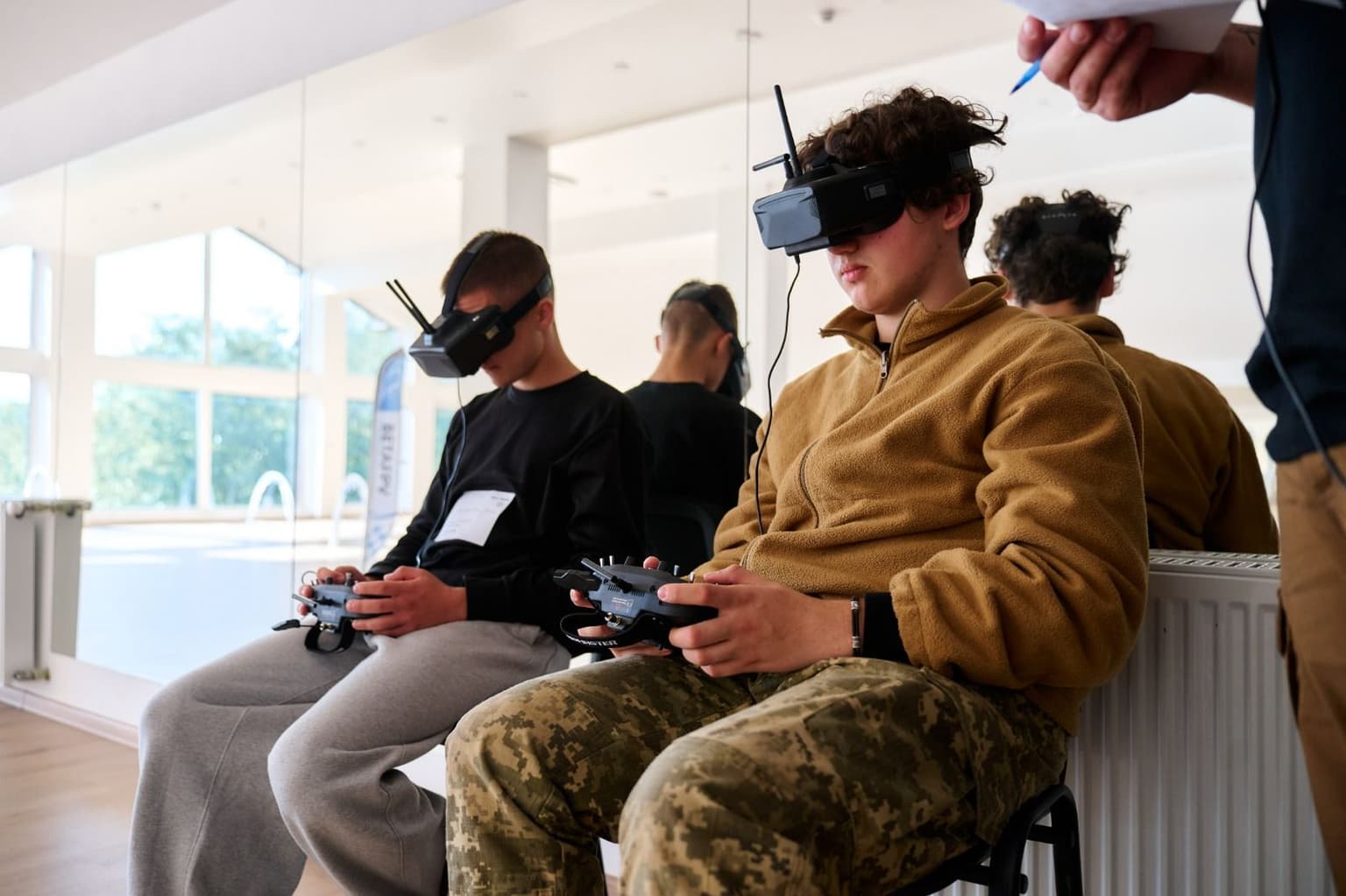
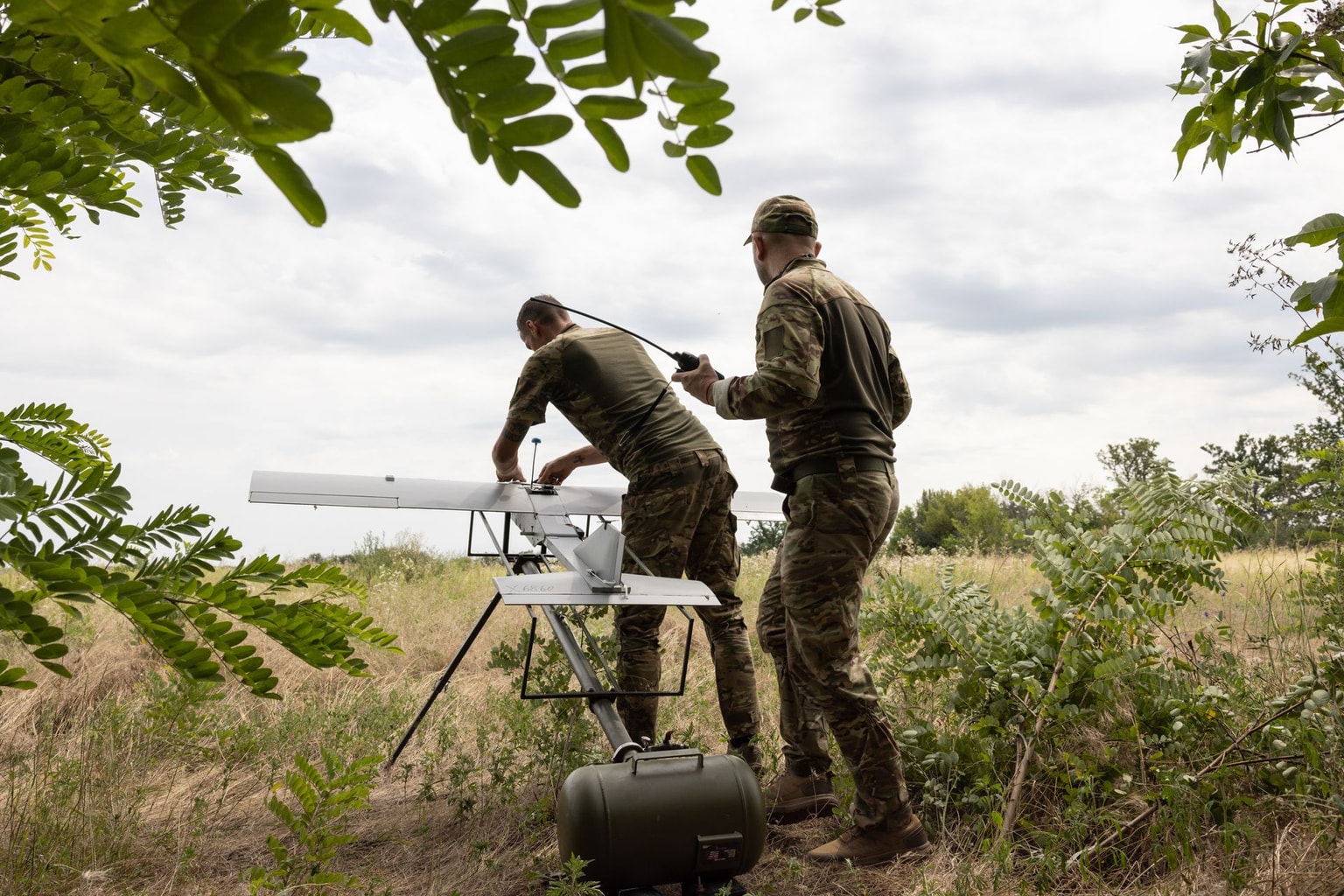
Students learn how to fly a drone during training in Ukraine in 2026. (Government Reform Team)
 on Google
"I liked flying drones the most," 16-year-old Anna Andreeva says. "We had simulators, and we could even fly them in the corridors between classes."
Andreeva is among the first students to finish the redesigned Defense of Ukraine course, a two-year subject that becomes compulsory for all 10th and 11th graders in September 2027.
Instead of weekly classroom lessons, students spend a full day a month, six to eight hours, at specialized training hubs learning tactical medicine, navigation, drone operation, and firearms handling. Some hubs have drone simulators, small training drones, laser shooting ranges, air guns, and life-size firearm replicas. The team behind the course reform team says 963 hubs currently serve more than 406,000 students.
In a country fighting Russia’s invasion and struggling to replenish its armed forces, a course that teaches teenagers to handle weapons and introduces them to military careers raises the question of where preparing children to survive a war ends and preparing them to fight one begins.

"Ukraine is hypersensitive when it comes to the militarization of Ukrainian children, because we have the trauma of crimes against humanity, militarization and indoctrination under occupation," Kateryna Rashevska, a legal expert for the Regional Center for Human Rights, told the Kyiv Independent.
"International bodies have documented Russia’s militarization and indoctrination of children, including in occupied territories. There has been no comparable finding regarding Ukraine," Rashevska added. "Ukraine is in a fundamentally different legal situation."
The course is meant to give students "practical skills needed to protect themselves," according to the Education Ministry.
Andreeva has already used what she learned. She is afraid of blood, but when a friend needed a tourniquet, she knew what to do.
"If there is a strike or some emergency, now I understand that I can help before the ambulance arrives. These are very useful skills," she said. "God willing, we'll never need them."

A practical approach
Most of the curriculum is practical and older elements like marching drills have been dropped. Much of the practical component has been developed with active-duty service members.
"There is no single textbook for this course. This year's program will be different from last year's," Ihor Yakubovskyy, an Azov 1st Corps officer overseeing the unit’s support for the curriculum reform, told the Kyiv Independent. "We adapt to the tactical conditions dictated by the enemy. Assault tactics change. Firearms training changes."
Andreeva’s classmate Yehor Kovalenko, 17, valued the practical side of the course most.
"I understand that I could end up in a situation where I would need to use what we learned. Now I feel more protected and composed," he said.
Maksym Romazan, one of the instructors, is a veteran and a father. Of all the course modules, firearms training is his favorite.
"My job is to show them that the military can be interesting, technological, disciplined, and physically active," Romazan said. "If a child becomes genuinely interested, they can develop further in that direction."

"It doesn't mean everyone has to fight," Yakubovskyy interjected, "but everyone has to understand the role of the military in society and how critical it is to the country's survival and prosperity."
He described the course as only the first stage of a longer system, where students would reinforce their skills at university and later through regular short training sessions, so that by the time they might be called up at 25, they would already have basic preparation.
Compulsory mobilization begins at 25, but Ukrainians can volunteer for military service from age 18.
Kyrylo Baybuz, 17, a classmate of Andreeva and Kovalenko, is undecided about his future.
"Right now, I think the main thing is to study and to donate, to help secure Ukraine's future so that all these sacrifices are not in vain," he said. "If I have to, I think I will go and fight. But maybe by then it will all be over."
His mother’s only complaint about the course was its inconvenient schedule, which meant she sometimes had to pick him up by car, Baybuz added.
"We must not turn schools into early conscript training and militarized hubs. But if we give basic skills for self-protection and cultivate patriotism, by including veterans, people who were wounded or taken prisoner, if they are qualified, (that would not be a violation of the norms)," Rashevska said.

"A balance is needed here, so that children also study human rights, the means of resolving international disputes, and international humanitarian law. And so that there are practical modules: mine safety, tactical medicine. How the subject is actually taught matters," Rashevska added.
What makes a good citizen
While the redesigned course emphasizes practical training, it also includes a civic and values-based component, Deputy Education Minister Dmytro Zavhorodnii told the Kyiv Independent.
Tymur Demchuk, a history teacher at Maibutni ("Those of the future"), a Kyiv private school focused on democratic education, helped design that civic component.
"Children should understand that defending the country is not simply about the country itself, but about the values it represents. We value human rights, human life, and dignity. Russia represents the opposite model," he said.
The course also shows non-military ways to contribute. In a section called "Planning My Future," students are introduced to civic and professional paths.
"Teachers tell the stories of Ukrainians who started as activists or entrepreneurs and went on to build foundations, NGOs, businesses, or civic initiatives," Demchuk said.
Mykhailo Borysevych, Andreeva’s teacher, said, "That is what the old version of the subject lacked. It focused on patriotic education and state symbols — that you should value them. The new course also asks: what has the state given you, and what do you owe the state?"
But the course lacks a thorough conversation about identity, Bohdan Bevza, a teacher and expert in educational program accreditation, told the Kyiv Independent.

"For this to become part of the official program, it must be approved by the state. And for this to happen, a public consensus is needed on where we are moving and what exactly we are protecting. And here a problem arises," Bevza, who is broadly supportive of the course, said.
"A person who works with drones can simply show how to assemble or use them. And how do you teach identity? This is much more complicated, especially when society itself does not have a common vision," he added.
Assessing students is another challenge.
"Some things are easy to measure, for example applying a tourniquet within 30 seconds. But when it comes to assembling a rifle, I care much more that a student understands how it works than how fast they can do it. And then there are things that are much harder to assess: how do you grade patriotism? How do you grade civic responsibility?" Borysevych said.
Ukraine is not alone in teaching preparedness. Demchuk pointed to Finland and Sweden, where their "total defense" concept extends far beyond the armed forces as a responsibility shared by society as a whole.
In Sweden, citizens are expected to cope for at least a week without public assistance in the event of an emergency. "We should learn from other democracies, and they should learn from us," Demchuk said. Yet in neither country is handling firearms a mandatory part of the school curriculum.
In Dnipro, Andreeva has graduated high school. "Do I see myself taking someone else's life? No. But I was happy to learn how to protect myself and others," she said.