From emergency repairs to resilience in the housing sector: How Transitional Development Assistance contributes to Ukraine's social recovery
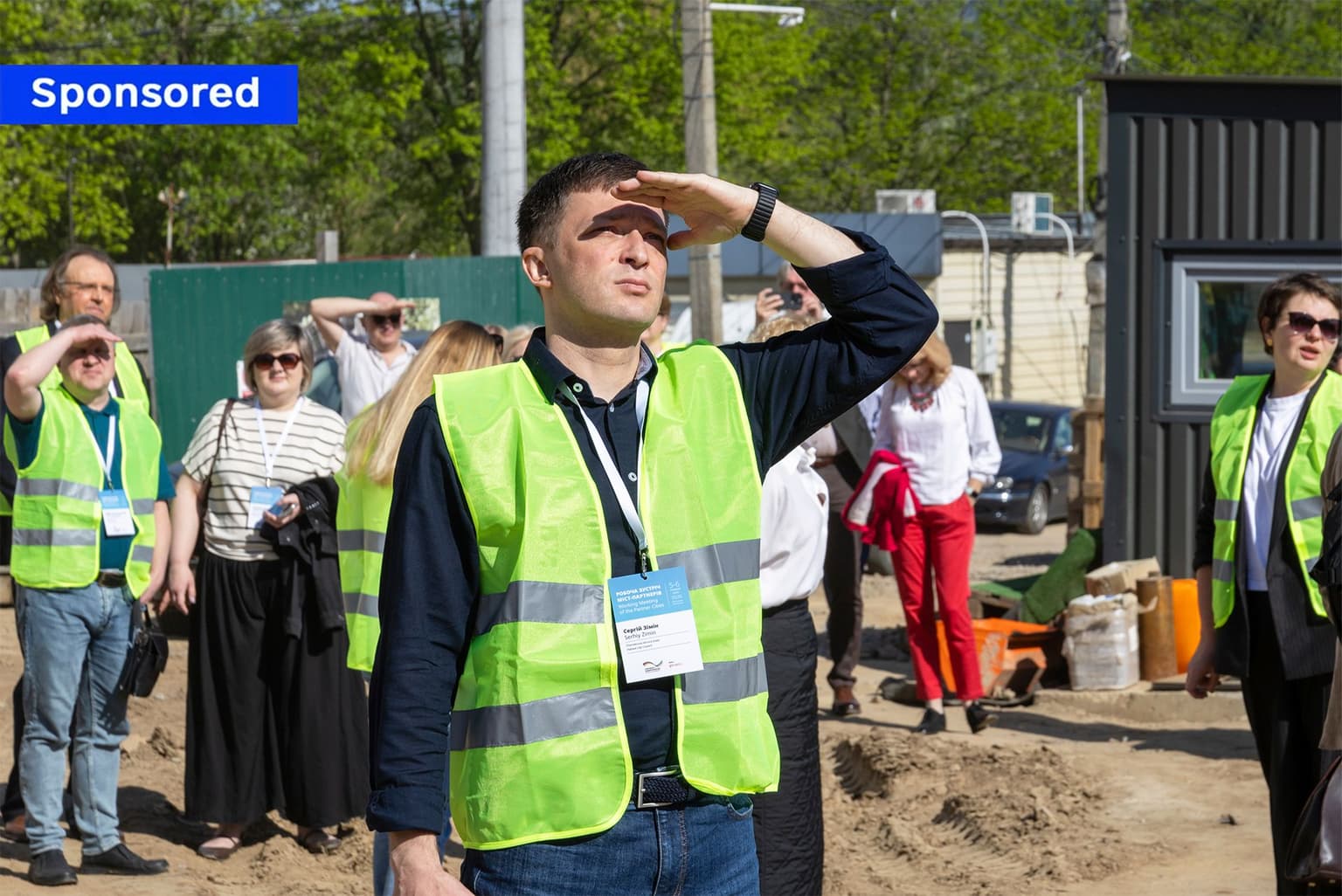
Representatives of the six housing pilot cities of the Strengthening of Urban Resilience in the Areas of Supply Infrastructure and Housing (SUR) project visit a construction site during a housing conference in Zhytomyr, Ukraine, on May 6, 2026. (SUR)
 on Google
When Russia launched its full-scale invasion in February 2022, Iryna Simakina was in Enerhodar, a city in southern Ukraine, home to Europe's largest nuclear power plant.
As Russian forces advanced on the city, staying became increasingly dangerous. Simakina, who uses a wheelchair because of a disability, eventually left her home behind, uncertain whether she would ever return.
Simakina found refuge in Zhytomyr, northwestern Ukraine, in 2023, where she initially stayed with a friend. In December 2025, she received a call that changed her life.
"I didn't believe it and didn't dare to hope. And I received a call: 'Come pick up the keys,'" she said.
Simakina was one of 15 new residents to receive an inclusive apartment for use through a partnership between the Zhytomyr authorities and the Strengthening of Urban Resilience in the Areas of Supply Infrastructure and Housing (SUR) project, implemented by Deutsche Gesellschaft fur Internationale Zusammenarbeit (GIZ) GmbH.

SUR is part of Germany's Transitional Development Assistance (TDA), a flexible crisis-response instrument of the Federal Ministry for Economic Cooperation and Development (BMZ) that bridges the gap between short-term humanitarian relief and long-term development cooperation. TDA operates in line with the U.N. 2030 Agenda and the Sustainable Development Goals, while aligning its work with EU priorities on local resilience, crisis prevention, and the Humanitarian–Development–Peace (HDP) Nexus.
About 10.8 million people in Ukraine need humanitarian assistance, 6.4 million needing water and sanitation services, 5.6 million needing shelter, and 4.5 million needing health care, according to the U.N. Office for the Coordination of Humanitarian Affairs (OCHA).
Since Russia launched its full-scale invasion, nearly 4.7 million people have been registered as internally displaced persons (IDPs) in Ukraine, according to the Social Policy, Family and Ukraine's Unity Ministry. The actual number remains difficult to determine, while Human Rights Commissioner Dmytro Lubinets has warned that the figure has not been updated for nearly two years, with a flawed system for identifying and counting IDPs.


The scale of displacement, even if difficult to measure precisely, places enormous demands on the state to provide housing and to help people settle into new communities.
The pressure is compounded by continued Russian attacks on civilian and critical infrastructure, particularly the power grid. The impact is especially severe in winter, when hours-long blackouts, disrupted water supply, and homes without heating threaten Ukrainians nationwide.
"If there is anything I would describe very much in the spirit of TDA, as our truly fundamental principle, it is the commitment to be guided by the most urgent needs of our Ukrainian partners," Erik Schweikhardt, the SUR project director, told the Kyiv Independent.

From immediate action to lasting vision
The broader aim of SUR is to help Ukrainian cities withstand the impacts of Russia's war and prepare for future challenges, while supporting the most vulnerable groups, including internally displaced people and returnees. Operating in more than 100 cities, primarily in eastern and central Ukraine, the project helps war-affected municipalities maintain and restore essential services, including electricity, heating, water supply, and housing, while strengthening local disaster risk management.
In wartime, decisions often need to be made quickly. At the same time, communities need long-term solutions that can be adapted to similar ongoing and future challenges. This approach helps communities stabilize during emergencies, strengthen their resilience, and better prepare for future shocks.
“Reconstruction should go beyond restoring what was lost and be embedded in long-term urban planning and development.”

"Within the framework of TDA, reconstruction should go beyond restoring what was lost and be embedded in long-term urban planning and development, guided by these principles," Schweikhardt said.
In this way, the project addresses urgent needs while helping people maintain their daily lives. Access to clean water is one example. Mykolaiv, a city in southern Ukraine with roughly 460,000 residents, has been without a centralized drinking water supply since Russian forces destroyed a key water pipeline in 2022. To address this ongoing challenge, the project is supporting a decentralized network of public drinking-water points, helping ensure that residents have access to clean, safe water.
At the same time, the project is investing in the long-term resilience of urban water infrastructure. It supports risk assessments in the water sector and helps cities develop resilience plans for their local water utilities. These efforts aim to establish more sustainable and reliable water services that can better withstand current and future threats.
Supporting municipal energy systems is another key area of SUR's work. The project helps municipalities maintain electricity and heat supplies by providing essential equipment, including cogeneration units, mobile boiler houses, battery storage systems, and hybrid generators. This support is particularly critical during the harsh winter months, when attacks on Ukraine's energy infrastructure threaten essential municipal services.
"Housing should be viewed as part of the city's overall development."
To help municipalities maintain reliable electricity and heating supplies, more than 450 energy units have been supplied and commissioned, including 118 combined heat and power plants. The equipment has benefited more than 4.5 million people. The support was provided in part through the German Federal Ministry for Economic Cooperation and Development (BMZ)'s "Winter Aid 2024/2025" initiative and in cooperation with other GIZ projects.

In addition to providing decentralized heat and energy to help mitigate outages caused by damage to centralized municipal systems, SUR supports cities in modernizing their heating infrastructure. These systems remain vulnerable to external shocks, including large-scale destruction, and are heavily reliant on carbon-intensive energy sources.
In Kryvyi Rih, a city located roughly 70 kilometers (nearly 40 miles) from the front line and frequently targeted by devastating Russian attacks, the project is supporting the development of a district heating strategy that integrates urban resilience and disaster risk reduction while aligning with the EU's long-term decarbonization goals.
SUR has also supported municipal hospitals in Kryvyi Rih by upgrading their heating networks. Hospitals are particularly vulnerable to energy disruptions, as life-saving equipment and medical procedures depend on a reliable power supply. To strengthen their energy resilience, the project has developed plans for three municipal hospitals to establish a stable, decentralized energy supply that can operate independently of the grid. These plans also integrate project-provided boiler houses into the hospitals' energy systems.
In nearly three years of operations in Ukraine, SUR has supported the restoration of municipal supply and waste management infrastructure in war-affected regions, benefiting more than 2 million people.
In the housing sector, SUR has so far contributed to restoring more than 800 homes since the start of Russia's full-scale invasion, enabling Ukrainian families to remain in their communities rather than face displacement. The project focuses on rehabilitating war-damaged private homes, developing and piloting rehabilitation approaches for damaged multifamily residential buildings in cooperation with local authorities, and helping homeowners' associations access funding for repairs.
"At the same time, it would be misleading to describe the project as simply something that acts quickly and locally," Schweikhardt said. "In line with TDA, its interventions are also designed to build structures and capacities that remain valuable beyond the immediate crisis."
Blueprint for the cities of tomorrow
The shortage of affordable housing, compounded by the precarious living conditions many internally displaced people continue to face, underscores the need for effective, long-term municipal housing strategies.
In cooperation with the Housing Initiative for Eastern Europe (IWO) e.V., SUR is supporting six pilot cities — Zhytomyr, Poltava, Kremenchuk, Bila Tserkva, Mykolaiv, and Kalush — in conducting a diagnostic analysis of the housing sector, including an assessment of local housing needs. Based on the findings, concepts for municipal housing strategies aligned with Ukraine's national housing strategy and the requirements of Reform 7 under the Ukraine Facility, "Ensuring Access to Housing for People in Need," are being developed.
"Ukraine's housing policies have long addressed the consequences of deeper structural issues rather than their root causes," Yuliia Popova, project director at the Housing Initiative for Eastern Europe (IWO) e.V., told the Kyiv Independent.
“Ukraine's housing policies have long addressed the consequences of deeper structural issues rather than their root causes."
At the heart of the problem is an incomplete privatization model. Mass privatization transferred individual apartments to residents but left buildings without the legal, financial, or institutional mechanisms needed to manage and maintain them as shared property. The state also failed to deliver on its promise to finance the first round of major repairs, leaving a growing backlog of renovations.
Meanwhile, housing policy largely ignored the rental market, leaving it poorly regulated, while privatization steadily depleted the municipal housing stock.
As demand for rental housing grows, most of Ukraine's rental market remains informal, operating outside the formal housing system. IDPs, who make up a significant share of renters, face not only high housing costs but also legal uncertainty because of informal rental agreements. War-related destruction has deepened these challenges, compounding longstanding structural problems. Addressing both the immediate consequences of the war and the housing sector's deeper flaws requires fundamental changes in how housing is provided and managed. Reform is no longer optional, but a structural necessity.

Municipalities must balance three competing priorities: meeting the immediate housing needs of displaced and vulnerable residents, repairing and renovating existing homes before they deteriorate beyond repair, and rebuilding housing destroyed by the war.
All three demand the same limited municipal resources, staff capacity, and political attention. At the same time, cities must align their efforts with national reforms and seek funding from a fragmented donor landscape.
"The local housing strategies we are developing with the pilot cities within the SUR project take a bottom-up approach to build a comprehensive picture of local housing conditions. They bring into municipal planning perspectives that have often been overlooked: housing market monitoring, assessments of existing housing stock, analysis of needs across population groups, including IDPs, and structural problems in housing stock management," Popova said.
The diagnostic process and subsequent recommendations for housing strategies translate competing needs and priorities into a structured, evidence-based plan of action. They provide a basis for inclusive local debate and help bring fragmented resources and capacities together around shared goals. Zhytomyr, Kremenchuk, and other cities participating in the SUR project are demonstrating that this is possible even under current conditions.

Kremenchuk has been cooperating with GIZ for several years, Maletskyi said, with housing policy now among its main priorities. The issue is particularly urgent given that more than 31,000 IDPs are currently registered in the city. At the same time, Maletskyi said the development of municipal housing should also benefit families who cannot afford to buy a home.
Svitlana Olshanska, deputy mayor of Zhytomyr, said housing remains an urgent issue for the city as well, and that Germany's approach offers a model Ukraine could learn from.
"When the full-scale war began, Ukraine found it difficult to respond to the challenges of providing housing," Olshanska told the Kyiv Independent. "At the same time, many Ukrainians who relocated to Germany saw similar situations addressed."
"We cannot provide affordable housing even to those who need it because we do not have a housing stock for crisis situations," she added.
Like Kremenchuk and other pilot cities, Zhytomyr, together with GIZ, is developing strategies to address the housing crisis. Olshanska said a long-term strategy is important not only for residents, who need a clear understanding of how their city will develop, but also for partners, donors, and potential lenders.

Maletskyi also stressed that affordable housing and broader development strategies should be centered on the needs of the local community, which should benefit from such initiatives and play a role in the city's future.
"One of the key takeaways for us is that housing should be viewed as part of the city's overall development. If a person has a job but cannot find decent, affordable housing, it will be difficult to keep that person in the community," Maletskyi told the Kyiv Independent.
Affordable housing, including municipal housing, is in high demand among large families, people with disabilities, older people, orphans, and low-income households. Since the start of the full-scale invasion, however, IDPs are one of the largest groups in need of housing, with their numbers continuing to grow as Russian forces continue their assault.
For people like Simakina, who was forced to leave her hometown and move to another city, securing accessible housing can be life-changing, providing the stability to remain in Ukraine, support her community, and build a new life away from home. At the same time, her dream remains unchanged.
"My plans are to go back home (to Enerhodar)," Simakina said. "I really want the war to end soon so I can go back home as soon as possible."
Next step
Ukraine is gradually updating its housing policies at both the national and local levels. Yet, governing during wartime comes with significant constraints — from the legal and time limits imposed by martial law to supply-chain disruptions, permitting delays, data security challenges, relentless Russian attacks, and corruption risks.
Mariia Kostenko, GIZ project adviser for housing and urban planning, said that a shortage of staff is one of the key bottlenecks in some communities. Employees often juggle multiple roles, leaving them with limited capacity to focus on longer-term strategic and conceptual goals. Another challenge is the sheer volume of urgent tasks, risks, and threats competing for their attention due to constant attacks on the Ukrainian cities.
"Sometimes we can make plans and agree on things, and then we get a call saying, 'We've been attacked.' For the next few days, local authorities are completely focused on dealing with the aftermath," Kostenko told the Kyiv Independent.

Despite these challenges, Schweikhardt said municipalities continue to move the work forward.
"I'm continually struck by the dedication and resilience of our Ukrainian partners," Schweikhardt said. "Even under tight constraints, we continue to work together constructively and proactively."
"The project is not operating in isolation; it is part of German-Ukrainian cooperation and Germany's broader civil and development support to Ukraine," he said. "We have established communication channels and, perhaps most importantly, a level of trust. For me, this is one of the project's major achievements and a very strong basis for continued cooperation."
Deeper cooperation between Ukrainian and European municipalities could open up new opportunities for peer learning and collaboration. At the same time, work on initiatives already underway — including resilience strategies and universal reconstruction mechanisms — should continue.
"The demand is still enormous," the project director said.