Buryatia shows what happens when Russia runs out of volunteers
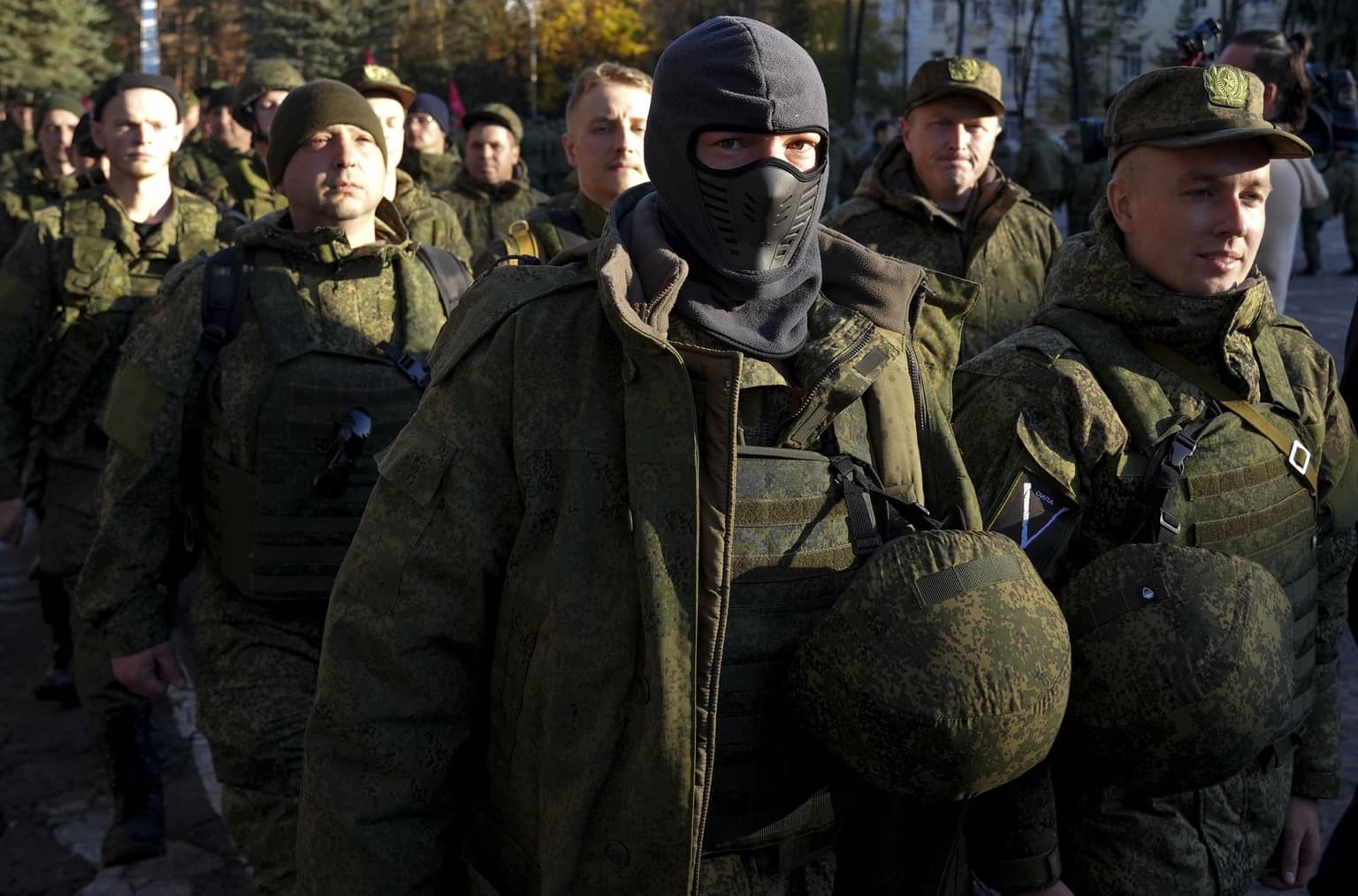
Russian citizens drafted during the partial mobilization are dispatched to combat coordination areas in Moscow, Russia, on Oct. 10, 2022. (Stringer / Anadolu Agency / Getty Images)
 on Google
Nikita Malyshev signed a contract with the Russian Defense Ministry on April 8, the day after his 18th birthday. A little more than two months later, he was dead, becoming the youngest known Russian serviceman killed in Russia’s war against Ukraine.
Malyshev came from Buryatia, a remote Russian republic in eastern Siberia that has supplied some of the highest numbers of contract soldiers and suffered some of the highest losses of any region since the start of the full-scale invasion.
Days after his death became public, independent Russian broadcaster TV Rain (Dozhd) published leaked documents suggesting that local authorities in Buryatia had forced businesses to either find recruits for the army or pay 100,000 rubles ($1,300) for every person they failed to provide.
Since 2022, Buryatia has illustrated how the Kremlin relied on financial incentives to draw people into military service. But today, the number of new contract soldiers is decreasing. According to Russian outlet Verstka, the flow of new contract recruits fell by about one-third in spring 2026 compared with the same period a year earlier.
"As Russia finds itself in a more difficult financial situation, it is more likely to resort to violence to generate recruits," Kateryna Stepanenko, a Russia analyst at the Institute for the Study of War, told the Kyiv Independent.
Stepanenko said coercion has long been part of Russia's recruitment system but has usually remained hidden. Now, however, the system is becoming harder to sustain.
"Continued Ukrainian strikes on Russian energy infrastructure are creating additional costs and personnel needs. The Kremlin no longer needs people only on the battlefield, but also to protect critical infrastructure in its rear," Stepanenko said.
Buryatia offers a glimpse into what happens when persuasion alone is no longer enough. What is visible in the republic today is spreading across Russia, with coercion of employers, street raids, recruitment of students and draft notices for women.
read also
Why Buryatia?
In 2022, Buryatia recorded some of the highest mobilization rates alongside Dagestan, Kaliningrad Oblast and Krasnoyarsk Krai, according to an ethnographic study by the Russian Public Sociology Laboratory (PS Lab). During the partial mobilization, residents of Buryatia were drafted up to three times more often than residents of other regions and died at seven times the national rate, PS Lab wrote.
After public backlash over the 2022 mobilization, the Kremlin turned to paid military contracts instead, offering increasingly generous signing bonuses. The strategy proved especially effective in poorer regions, such as Buryatia, where a military contract is a chance to improve a family's financial future.
The military's strong presence in the region is an additional structural incentive. Buryatia is home to several army brigades, meaning military service is one of the few stable careers close to home. Today, the personnel of its tank and airborne units are in particularly high demand at the front.
In 2026, Buryatia continues to have one of the highest per capita military death tolls in Russia, with 400 deaths per 100,000 residents, according to an analysis by Mediazona and the BBC.

From perks to coercion
Constant losses, slowing battlefield gains and Ukrainian long-range strikes have made finding new volunteers increasingly difficult, while the Kremlin cannot keep raising signing bonuses indefinitely.
Instead, the pressure is moving down Russia's authoritarian power vertical. According to Janis Kluge, a Russia expert at the German Institute for International and Security Affairs (SWP), the Kremlin assigns recruitment quotas to each region at the beginning of the year, and the targets are then passed on to municipalities. The system allows regions to adapt recruitment methods to local conditions.
"By late 2024 and early 2025, however, several regions were already reporting that they could not meet their quotas on time. This suggested that Russia's volunteer recruitment campaign was beginning to stagnate," Stepanenko added.
"Russian regions have vastly different societies, economies, and subnational political systems. Methods that work in some regions may be impractical in others," Kluge wrote in his 2025 study "Millions for a Signature: The Role of Russian Regions in Recruitment."
In Buryatia, where resources are limited, adaptation increasingly means coercion. The leaked TV Rain documents show this playing out in practice: companies in the republic's Muysky district are required to either find recruits or pay 100,000 rubles for every recruit they fail to provide. The demands extend to hospitals and other public institutions, despite staff shortages.

But Buryatia is no longer an isolated case. In Russia’s Penza region, police and military recruitment officers recently carried out a large-scale street raid, detaining men and pressuring them to sign military contracts. The incident marked the first publicly reported operation of its kind, despite the Kremlin's insistence that it can sustain the war without another round of mobilization.
Images of men being seized on the streets and forced into the military undermine Russian propaganda, Stepanenko said. For years, Russian propaganda had contrasted forced mobilization in Ukraine with supposedly voluntary recruitment in Russia.
"Russia had therefore tried to keep its own coercive practices hidden to preserve a social contract: that there was no war inside Russia and that it affected only those who voluntarily signed up to fight," she said.
Having relied for years on residents of poorer regions, prisoners, migrants and debtors, the military has turned to another pool of potential recruits: students.

The campaign first surfaced in April, when reports revealed that since January, Russian universities had been instructed to sign up around 2% of their students for military service. Recruiters have promoted so-called special one-year contracts, telling students they would serve in relatively safe drone units rather than on the front line.
The first known death linked to the student recruitment campaign came, again, from Buryatia. Valery Averin, a 23-year-old student, was killed after just 13 days in the combat zone in Donetsk Oblast.
What happens next?
Speculation about a new wave of Russian mobilization has intensified in recent months. Most analysts argue that the Kremlin is likely to avoid such a move unless absolutely necessary, and not before the State Duma elections in September.
Until then, Moscow’s search for recruits continues, and new methods emerge. On July 14, independent Russian outlet Mediazona reported that women with military ties or medical qualifications had begun receiving draft notices.
If Russia cannot recruit in sufficient numbers, its ability to replace losses at the front may come under growing strain. Buryatia, which has buried more men per capita than almost any other Russian region, is already showing the symptoms of a strained system.