Zelensky calls on other countries, media to not cause fear about Russian escalation
 on Google
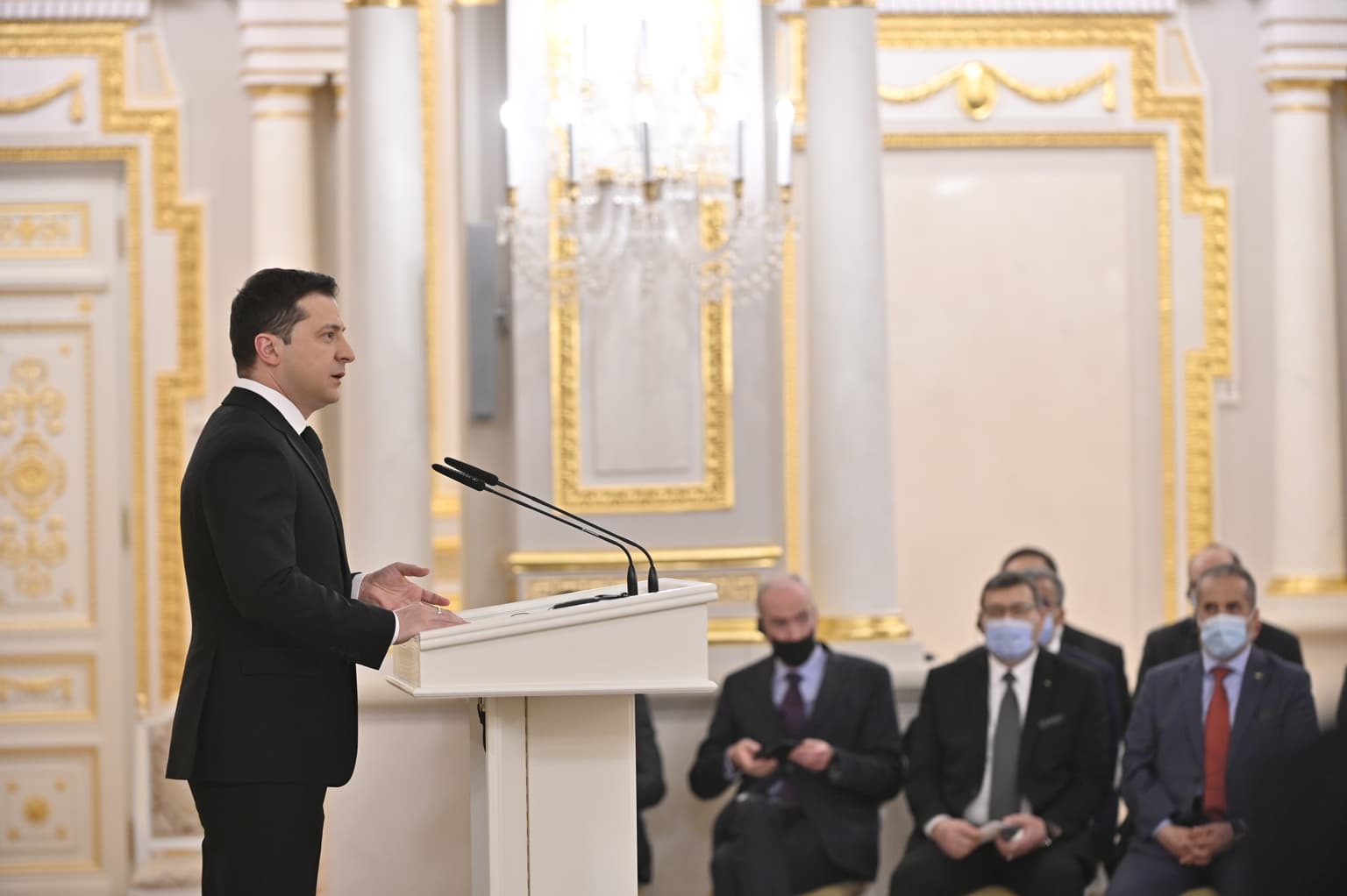
President Volodymyr Zelensky said that painting a Russian invasion as imminent or certain hurts Ukraine’s economy at a difficult time.
The president took questions from a roomful of foreign journalists on Jan. 28, revolving around the threat of looming further invasion by Russia, which has 130,000 well-equipped troops along Ukraine’s borders.
While the U.S. has warned that an invasion may be “imminent,” Zelensky said he doesn’t think the situation is “more intense” than it was in April, when Russia massed close to 126,000 troops near Ukraine.
Zelensky said he has a better understanding of the details of the situation than other world leaders. He said proxy warfare and subversion is an imminent and constant threat.
He complained that the mass media creates an image of troops in the streets, sowing fear.
“They’re saying ‘the war is tomorrow’ – this causes panic on the market and elsewhere,” he said.
The previous evening, Zelensky spoke to U.S. President Joe Biden. According to CNN, he raised concerns about the U.S.’s signaling about the likelihood of invasion. The White House denied a CNN report that Biden said an invasion was “virtually certain,” but said he reiterated the distinct possibility Russia would invade in February.
Zelensky said that Hr 12.5 billion ($446 million) in investments flowed out of Ukraine as a result of the spreading panic. The government has also had to dip into its reserves to stabilize the Ukrainian currency, hryvnia, which is very costly.
The hryvnia fell to its lowest level against the U.S. dollar in seven years on Jan. 27, closing at an exchange rate of Hr 28.95 per $1.
The president said Ukraine will need about $5 billion to stabilize the economy.
The European Union is planning 1.2 million euros ($1.35 billion) in aid, while Canada has offered a loan of $120 million. Additional talks are ongoing with the U.S. and France.
Zelensky said a strong economy is also important for the military, whose members need to be equipped and paid.
Questioned about Germany's unwillingness to support Ukraine with lethal weapons, Zelensky suggested that Germany, as the heavyweight of the European Union, can help Ukraine obtain membership faster. He said that Ukraine counts on that support.
He also said that the energy crisis has hit Ukraine and assistance was needed now and not sometime in the future.
He had a similar thing to say about punitive sanctions on Russia, asking why they are only considered "after the fact.”
Zelensky also said it would be helpful if NATO went into more detail on what punitive measures are prepared. Multiple allies have tried to avoid giving too many details, saying doing so would cost them leverage over Putin.
Zelensky also came out against the U.S. and U.K. embassies' move to withdraw non-essential personnel and families.
"Yes, I think it was a mistake, I say this openly." However, he added that it was more of Ukraine's mistake than that of the foreign governments. "Under these circumstances, everyone is essential. Everyone should stay."