Ukraine's experience priceless as Iran war sees long-range strike drones go global
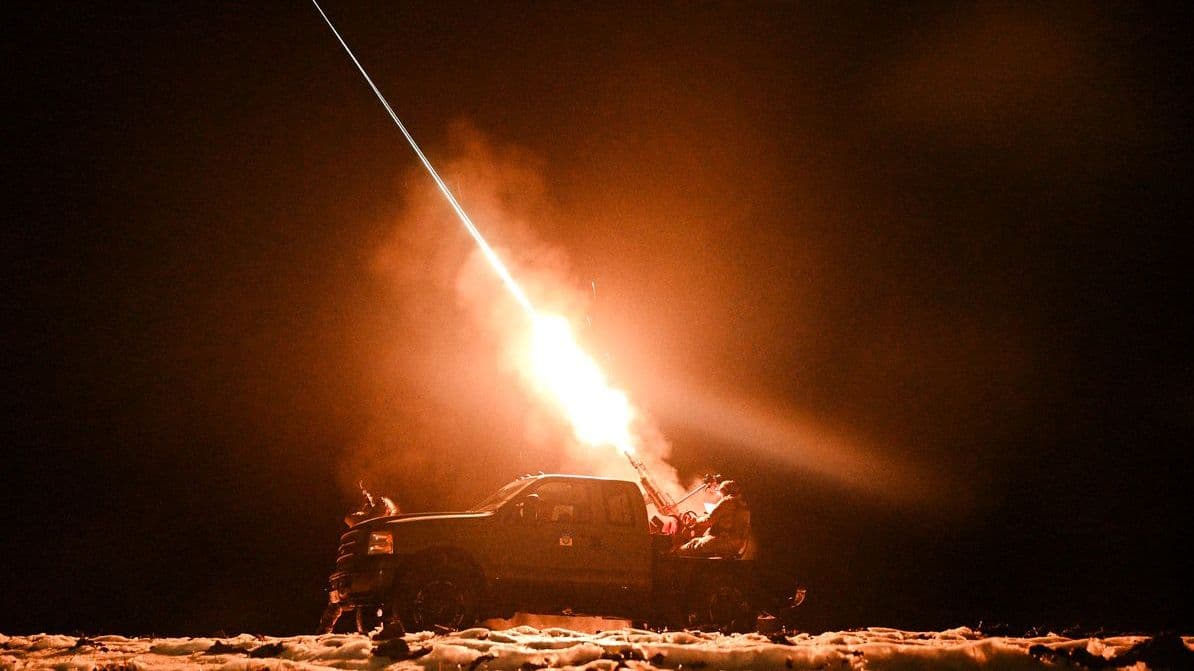
Ukrainian servicemen from a mobile air defense unit fire a machine gun at Russian drones during a night patrol in Chernihiv Oblast, Ukraine, on Dec. 2, 2024. (Maksym Kishka / Suspilne Ukraine / JSC “UA:PBC” / Global Images Ukraine via Getty Images)
 on Google
The Trump administration's move to launch a large-scale strike operation in Iran has seen state-on-state war return to the Middle East with a vengeance.
Hours after the first U.S. and Israeli strikes began hitting the country on Feb. 28, Tehran — despite its leadership being decapitated on the first day of the fighting — retaliated with large-scale missile and drone attacks across the region, with a focus on U.S. military bases and embassies.
On top of its arsenal of ballistic missiles, Iran's weapon of choice is one that is all too familiar to Ukraine: the Shahed-type drone.
First used against Ukrainian cities and infrastructure in late 2022, the Iranian designed long-range suicide drone quickly became one of Moscow's most well-known weapons of war, terrorizing cities, demolishing infrastructure, and hammering important targets on the front line.
While the cost and production demands of ballistic and cruise missiles have placed an upper limit on Moscow's use of them, the same doesn't apply for the Shahed-type drones, with some mass overnight attacks often seeing upwards of 500 launched at once.
Now, the war of massed, cheap long-range drones has gone global in the Middle East, and early results have shown a lack of readiness for air defenses to handle them.
Only Ukraine's military has anything like the experience of facing this new threat, and amid the explosion of war in and around Iran, Kyiv's unique abilities gained immediate recognition on the world stage.
Facing waves of dozens — sometimes hundreds — of Russian Shahed-type drones on a daily basis, Ukraine has developed, scaled, and deployed cutting-edge drone interceptor technology to protect itself.
"We will also bring experts from Ukraine, together with our own experts, to help Gulf partners shoot down Iranian drones attacking them," said U.K. Prime Minister Keir Starmer on March 2, in words that would have seemed unbelievable not long ago.

Quantity over quality
In service since 2021, the base model of Iran's Shahed-136 suicide drone uses a simple piston engine to carry a 50-kilogram payload for up to 2,000 kilometers (1,6242 miles).
Since Moscow and Tehran agreed to production of the drone in Russia in late 2022, the Shahed became the Geran ("Geranium") and began to roll out of production lines in the Alabuga Special Economic Zone in Russia's Tatarstan Republic.

Costing only around $50,000, the Shahed-type drone quickly presented a major problem for Ukraine's already strained air defense — faced with masses of the cheap drones, Kyiv could not afford to shoot them down with their limited stocks of anti-air interceptor missiles, some of which cost over 20 times the price.
Over the following years, Russia continued not only to expand production of the Gerans to thousands per month, but to upgrade them, increasing the speed, range, and maneuverability with modifications including jet engines, increasing the size of the warhead, and equipping them with advanced communications systems, including LTE sim cards and mesh radio networks.
Now, Iran's original Shahed has come to haunt the Middle East, with successful hits recorded in the United Arab Emirates, Saudi Arabia, Bahrain, Oman, Iraq, Kuwait, and even a British military base in Cyprus.
Early evidence shows that these Iranian drones are not without modifications of their own, thanks to Moscow's technical know-how and battlefield experience.

Media reports coming out of the Middle East have already pointed to Russian components inside the Iranian drones used in the attacks.
"This is something that we've been raising the alarm about for a while," Vladyslav Vlasiuk, sanctions commissioner for President Volodymyr Zelensky, told the Kyiv Independent.
"Russia learned a lot from Iran, they borrowed this Shahed design, and now there is reciprocal cooperation. The Iranians are sending the engineers to Russia and Russian engineers are going back and forth to Iran, and I think that China is also very, very close to this cooperation."
In the face of Trump's fierce yet chaotic assault on the country, without a clear strategic gain Iran's mass drone attacks make sense as part of a strategy of exhaustion, retired Australian Army Major-General Mick Ryan told the Kyiv Independent.
"They can saturate American defenses in the region over time; after a month or so, the U.S. will run out of interceptors," he said.
"I think that’s what the Russians are trying to do by saturating Ukrainian defenses, and the Iranians have learned from that.
Despite the United States’ traditional preference for high-end equipment, the advantage of such a low-cost, mass-produced drone has also been recognized by the Pentagon.

On Feb, 28, the U.S. military announced the first combat use of the Low-cost Uncrewed Combat Attack System (LUCAS) drone — a reverse-engineered, U.S.-built version of the Shahed with a stated price of only $35,000 per unit.
"Once an adversary can produce cheap, attritable systems in large numbers to exhaust defenses, that becomes the new default mode of war," Catarina Buchatskyi, director of analytics at the Snake Island Institute and co-author of a new report on Ukraine's homegrown air defense, told the Kyiv Independent.
"The era of singular, highly targeted strikes has given way to constant, daily waves of mass attacks."
read also
Caught unprepared
The first proof of the West's lack of preparedness to deal with the threat of mass Shahed-style drone attacks came not in the Gulf, but over the fields of eastern Poland in September last year.
There, in a calculated provocation on Moscow's part, up to 23 Russian Gerbera drones — a cheap decoy version of the Shahed with no payload — entered Polish airspace.
Despite the scrambling of high-end NATO jets, including Dutch F-35s and Polish F-16s, only four of the drones were reportedly shot down.
"What this shows is how unprepared NATO and the U.S. are for a cheap, mass threat."
Now, in the Middle East, Iran's mass use of Shahed drones — with real warheads, in a real act of war — is being met across the region with similar levels of unpreparedness.
While the damage to U.S. bases has not been disclosed and is not always independently verifiable, early evidence shows multiple successful hits across the region.
Such instances included strikes on the U.S. embassy in Riyadh, Saudi Arabia, while at one U.S. Navy base in Bahrain, footage shows an Iranian Shahed drone directly striking a high-end radar system.
In other instances, the drones have been shot down by Patriot air defense systems belonging to the U.S. or the Gulf countries, using the same multi-million dollar interceptor missiles that are in such short supply globally.
Meanwhile, in Dubai, the damage that the drone can cause to civilian targets was on display after a luxury hotel was hit amid an initial barrage of 137 missiles and 209 drones, as reported by Emirati authorities.
"What this shows is how unprepared NATO and the U.S. are for a cheap, mass threat," said Doc, chief technical officer of a Ukrainian defense company that manufactures interceptor drones, who requested his identity not to be revealed for security reasons.

"Modern armies imagine that they have very expensive missiles like the Patriot, that they will fire them and shoot everything down. But if 100 Shaheds come, those missiles may run out after 50, and the rest will destroy infrastructure."
The explicit need for air defense assets to properly match the threat was highlighted by Zelensky in comments to journalists on March 3, with the president suggesting that Ukraine could share its own drone interceptors with Gulf countries in exchange for PAC-3 Patriot interceptor missiles so desperately needed to protect key targets in Ukraine from Russian ballistic missiles.
Ultimately, said Ryan, many of the mistakes made boil down to wishful thinking that the new ways of war emerging in Ukraine will not be relevant to oneself.
"A lot of people look at Ukraine and think it’s totally unique," he said, "they assume they probably won’t have to fight that way."
"I think that shows a certain lack of humility in many Western and Middle Eastern military institutions."
Global problems, Ukrainian solutions
Ukraine’s quest to effectively counter the threat of mass Russian bombardment with Shahed-type drones has not always been an easy road.
With Russia regularly upgrading its drones, the search for effective countermeasures has been a game of cat and mouse; of innovation and implementation at breakneck speed, and of more than one complete paradigm shift.
The initial solution was cheap and simple: hundreds of so-called "mobile fire groups," soldiers mounted on pick-up trucks using spotlights and machine guns to shoot the drones down.
"Mobile fire groups were relatively easy to form around personnel and weapons," recalled Buchatskyi.


"You could put tracking systems and turret fire on the back of a truck. They helped solve gaps in our sophisticated air defense system and could react quickly because drones were coming from different directions."
The eyes and ears of these teams were a complex, multi-layered system of sensors, from radars to simple acoustic devices placed across the country, helping map the flight paths and common routes of the drones.
After every mass attack, data from all these sensors was gathered and analyzed to better place Ukrainian air defense assets for the next one.
Meanwhile, to boost the mobile fire groups on the ground, aviation of all shapes and sizes — from helicopters to 60-year-old Soviet-era fixed-wing aircraft — joined the almost daily hunt for the Shaheds.
Over 2025, Russia’s growing waves of new, faster, deadlier, and stealthier Geran drones proved too much for Ukraine’s existing system. A new solution needed to be found quickly.
"When your people are threatened every single night, it breaks through bureaucracy, removes red tape, and creates a single focus on results. "
As has often been the case in this war, a drone problem demanded a drone solution — specifically high-tech, high-speed, small interceptor drones.
"By 2025, the nature of the threat became much more mature. Russian drones started weaving more and changing altitudes, which made them harder to track," said Buchatskyi.
"That’s why interceptor drones became the next solution. They are still cost-effective, put less personnel at risk, can be deployed closer to the front line, and can be produced at scale."
Ukraine's ability to overcome the immense technical and organizational challenge of implementing interceptor drones and scale is thanks to the uniquely Ukrainian wartime relationships between military, state, society, and industry, argued Ryan.
"Obviously, what drives that is an existential threat," he said.

"When your people are threatened every single night, it breaks through bureaucracy, removes red tape, and creates a single focus on results. That’s not the case in Western countries in peacetime."
As of early 2026, interceptor teams have overtaken the bulk of the anti-Shahed air defense burden, using a plethora of homegrown airframes, and some higher tech foreign ones.
"Remember how long the Shaheds were tormenting us, how they were launched in dozens," said Pavlo, an instructor in the same Ukrainian company where Doc works.
"Now, even in their hundreds, they are no longer such a problem because we have found a solution that is significantly cheaper."
According to Ukrainian Commander-in-Chief Oleksandr Syrskyi, 70% of Russian Shahed-type drones launched at Kyiv were being downed by interceptors.
Now, countries from NATO to the Gulf are scrambling to tap into Ukraine's expertise, which goes beyond just the interceptor drones themselves.
"Our biggest strength is constant data," noted Buchatskyi, "we process hundreds of aerial threats per night, learn from them, and adapt based on that learning — something no other country in the world really has."
"That is why even the most successful interceptor companies, including non-Ukrainian ones, are operating here. Nowhere else can you test and refine systems in real time against such a complex threat environment."
Going forward, although new technical challenges will certainly arise, those at the forefront of Ukraine's cutting-edge air defense are convinced they remain best-placed to face them.
"Now we are working on solutions that are more about the future," said Pavlo, "about anticipating the enemy’s next step and creating a new tool against which there is no countermeasure yet."
"The world needs to understand what is really happening. Many countries are afraid of World War III. We are not, as we are already in it."
Tania Myronyshena and Chris York contributed to reporting.