Climate policy becomes new front in Ukraine-EU economic tensions
War-hit Ukrainian steelmakers say EU carbon border policy adds new pressure.
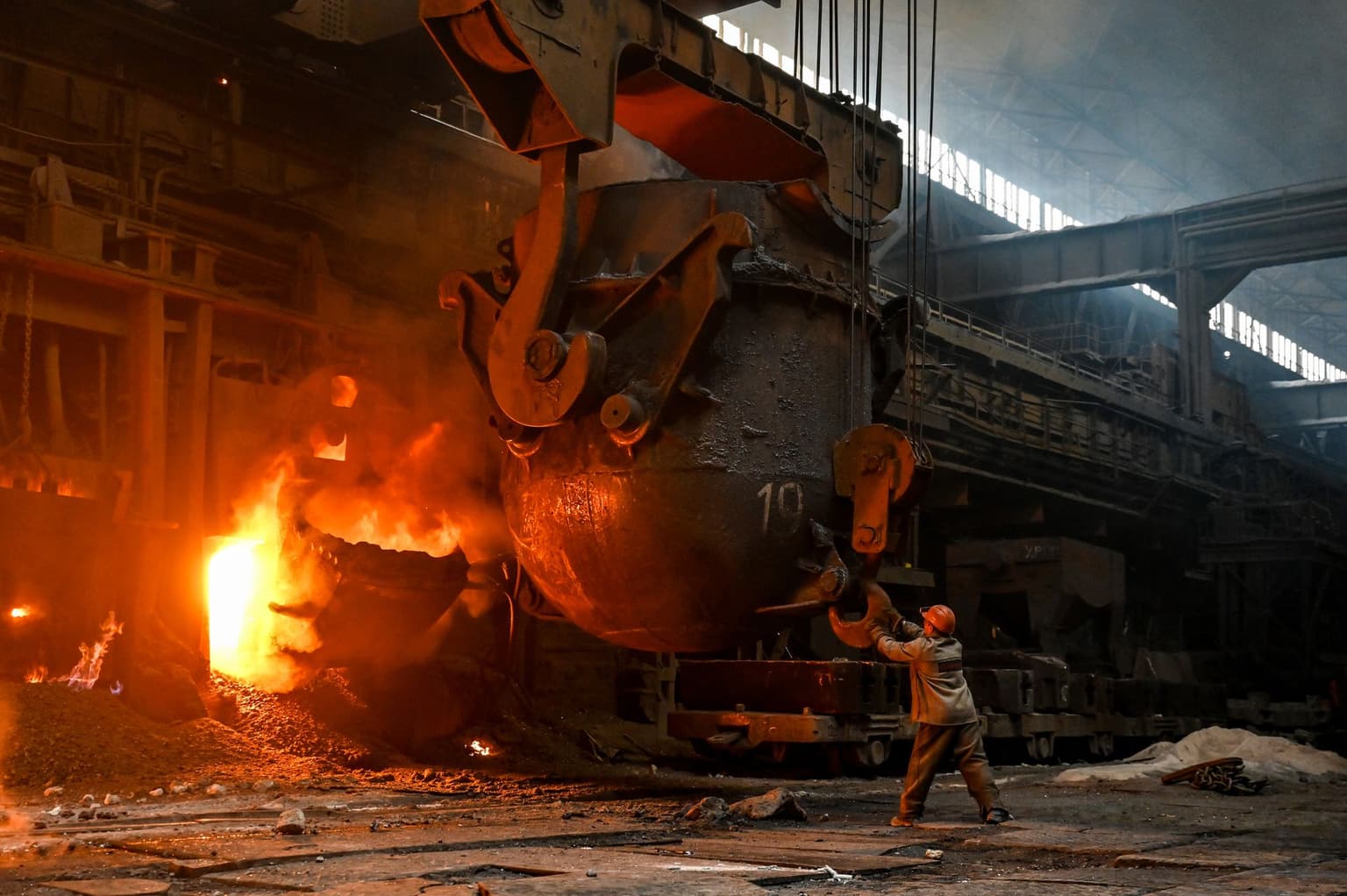
An employee works in an open-hearth furnace shop at Zaporizhstal PJSC in Zaporizhzhia, Ukraine, on Nov. 13, 2024. (Ukrinform/NurPhoto via Getty Images)
 on Google
The latest source of friction between Ukraine and the EU is climate rules and unhappy steel producers, as the country’s membership goals collide with its wartime realities.
Ukrainian officials are in Brussels this week to discuss the EU's carbon border policy that Kyiv argues is hitting its war-battered steel industry and economy.
At the center of those discussions is the EU's Carbon Border Adjustment Mechanism — known as CBAM — which is designed to prevent "carbon leakage" — or pushing pollution to other countries — by ensuring that imports face similar costs to those imposed on EU producers.
Following its launch in January 2026, the EU requires importers to purchase certificates covering the CO2 emissions tied to carbon-intensive goods — such as metals and fertilizers — produced outside the EU, including Ukraine.
In Ukraine, the metallurgy sector is the most exposed to CBAM. It generated over $4.7 billion in export revenue last year, with the vast majority of shipments going to the EU due to cheaper and more accessible logistics than Black Sea routes that have been complicated by war.
Ukraine initially sought an exemption from the EU, hoping for leniency after four years of full-scale war with Russia. But the request was rejected, something that came as a surprise to Kyiv, Deputy Prime Minister Taras Kachka told the Kyiv Independent at a press conference on April 8.
"The EU decided that, politically, they were not ready to grant this exemption. They also justified this by saying that there would be no real impact on our exports," Kachka said.
Steelmakers argue that CBAM adds a significant burden at a time when the industry is already under pressure from high electricity costs, disrupted supply chains, and damage from Russian attacks.
But others stress that CBAM — and the EU’s broader "cap-and-trade" emissions trading system — is a critical part of Ukraine’s EU integration, and any agreements shouldn’t derail efforts to clean up its outdated, energy-inefficient steel sector.
"There is no way around this in the long run if Ukraine wants to join the EU," David Saha, a director in the economic advisory practice at Deloitte, which is advising Ukraine on its EU accession, told the Kyiv Independent.
"There are some grounds for why an exemption should be requested. But the discussion needs to be in conjunction with discussions of how to achieve EU accession and therefore the introduction of the emissions trading system, and the eventual decarbonization of the sector."
Disagreement over the numbers
Ukraine’s main complaint is that the EU set "unjustifiably" high default emission rates for non-EU producers — above the actual output of its steelmakers — both for Ukraine and other non-EU trade partners, Kachka said.
An emissions verification program is due to begin in September, when EU-accredited verifiers are expected to visit factories. But Ukrainian officials and industry leaders say that timeline is too late to prevent immediate losses.
EU customers are already swapping Ukrainian steel for products from Turkey and other Asian countries, Stanislav Zinchenko, CEO of the GMK Center, a Ukraine-based consultancy, told the Kyiv Independent.
Ukraine’s steel exports have already dropped by 60–70% as a result of CBAM-related costs, with the policy shaving off 2.1% of Ukraine’s gross domestic product by 2030, according to Zinchenko.
A weaker steel industry could have ripple effects far beyond factories. The industry accounts for about 30% of rail and sea cargo volumes and is a major consumer of electricity and machinery, he said.
Mauro Longobardo, the CEO of ArcelorMittal Kryvyi Rih, said that once EU customers heard about the additional duty — $60–90 per metric ton — they canceled all orders for the first quarter of 2026.
"This market is lost. There are currently no alternative markets to absorb these volumes," he wrote in an article for GMK Center. CBAM could be the final straw that kills Ukraine’s entire steel sector in the next two or three years, he warned.
ArcelorMittal Kryvyi Rih has already lost two-thirds of its pre-war production and shut down several major production units at its plant this year, shedding 3,400 jobs.
The policy is also affecting some greener producers. Interpipe, a Dnipro-based steel company owned by one of Ukraine's wealthiest businessmen, Viktor Pinchuk, produces green steel products with an eco-friendly electric arc furnace rather than polluting blast furnaces.
But it’s still assigned the same default value as a blast furnace manufacturer — even though its actual emissions are 10 times lower — adding an additional 130 euros ($150) per ton to its seamless steel pipes, Andrii Ostapets, director of environmental and industrial safety at Interpipe, told the Kyiv Independent.
"On the one hand, we already have a green production route. On the other hand, we pay for dirty steel," he said.
War vs decarbonization
While the economic damage from CBAM's implementation may not be as severe as the industry warns, the initial economic shock has been greater than many EU and Ukrainian studies predicted, Veronika Movchan, academic director at the Institute for Economic Research and Policy Consulting, told the Kyiv Independent.
Movchan, who is evaluating the trade impact of CBAM, believes the damage could be reduced if Ukraine can verify its emissions rather than rely on default values.
To make that happen, Ukraine needs EU-accredited verifiers to visit its plants. But Ukrainian verifiers aren’t recognized by the EU, and foreign verifiers won’t visit Ukraine during the war.
Fortunately for Ukraine, Sweden’s accreditation body agreed last week to accredit Ukrainian verification bodies, which will speed up emissions checks for steel companies.
But even if the values are corrected, Ukraine’s steelmakers still produce higher CO2 levels than other countries. And, unlike other countries, Ukraine will struggle to modernize its facilities while under Russian attack.
"There is to some extent a higher burden on Ukrainian exports than on others," said Saha from Deloitte.
"It’s reasonable to argue that Ukraine can do fairly little about this right now. In the middle of a war, it's hard to expect a country to decarbonize. Other countries can do things that Ukraine really cannot be expected to do right now."

Steelmakers aren’t entirely victims, however. Over the years, Ukrainian firms have pushed back against environmental reforms and failed to move away from carbon-heavy machinery, Olia Evstigneeva, a decarbonization expert and PhD student at Ukraine's Institute of Economics and Forecasting of the National Academy of Sciences, told the Kyiv Independent.
But given that wartime conditions make investments into decarbonization unlikely, Ukraine should request force majeure in Brussels, Movchan said.
The country’s economy is suffering from the war, electricity facilities are under constant attack, and the steel sector has lost key assets during the war while facing major logistical constraints, she said.
"I don't think that it's fair to place such a heavy burden on the country now. I understand that something has to be done about the climate, but you cannot address everything at once," Movchan said.
"Survival comes first."