Behind the lies of the latest guest on Tucker Carlson's podcast — a criminal Russian arms dealer
The Viktor Bout interview twists Ukraine's history and blames Ukrainian troops for crimes committed by Russian forces.
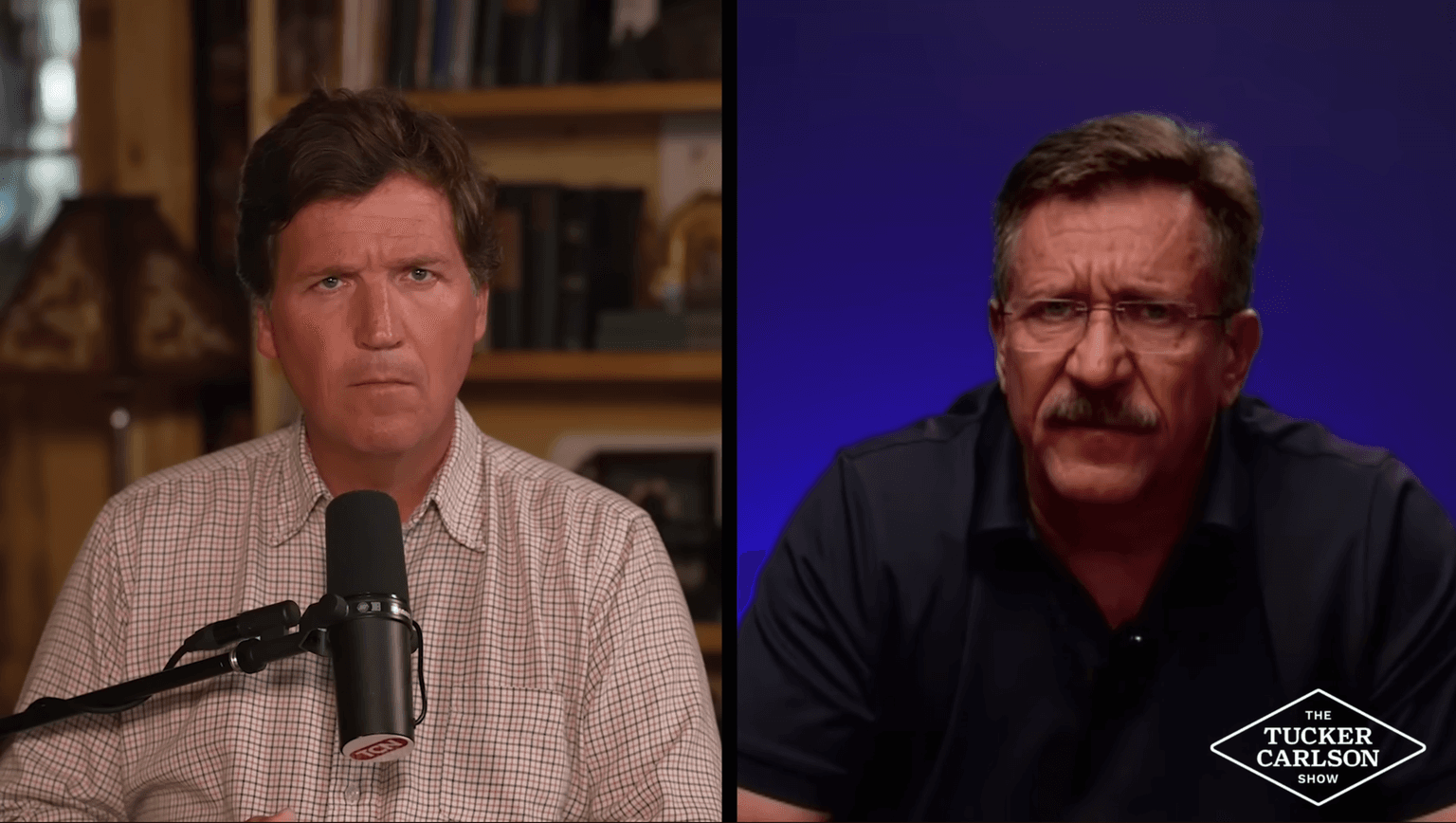
A screengrab shows Tucker Carlson (L) talking with Viktor Bout (R), a Russian arms dealer and politician, in an interview published on June 29, 2026. (Tucker Carlson / YouTube)
 on Google
In 2022, American commentator Tucker Carlson condemned the U.S. giving up Russian arms dealer Viktor Bout in a prisoner swap, calling him "an indisputably serious criminal" who "sold weapons to terror groups that killed Americans."
Just four years later, Carlson welcomed Bout on his podcast to promote Russian talking points to his millions of viewers.
"I can understand why (former U.S. President) Barack Obama wanted to put you in prison," Carlson laughingly told Bout, praising the arms dealer later on in the interview as "a very wise man."
Carlson's interview with Bout is just his latest push to call for closer ties between the U.S. and Russia. He has previously spoken with President Volodymyr Zelensky's disgruntled former press secretary Iuliia Mendel, Russian Foreign Minister Sergey Lavrov, representatives of the Russian Orthodox Church, and even Russian President Vladimir Putin himself.
Bout is a notorious arms dealer with reported ties to the GRU, Russia's military intelligence. He has been nicknamed the "Merchant of Death" and was sentenced to a minimum of 25 years in prison for conspiring to kill Americans.

He served only 10 years of that sentence before former U.S. President Joe Biden exchanged him for basketball player Brittney Griner.
The Wall Street Journal reported in 2024 that he had returned to arms dealing and was supplying weapons to the Houthi militants, who are backed by Iran in the ongoing conflict in Yemen and are self-proclaimed enemies of the U.S.
Threats disguised as ‘restraint’
From the very start of the interview, an uninformed viewer might come away thinking Ukraine started the war. Bout, with no pushback from Carlson, insisted that Ukraine is just a pawn for its Western "handlers," and he framed the conflict not as a war between Russia and Ukraine, but as a fight against so-called globalists who control the West.
He claimed Russia has shown restraint so far, but warned that it "may have no other choice" but to strike countries helping Ukraine — claiming that by manufacturing weapons for Ukraine in their factories, they have become legitimate military targets.
For all of Bout's talk about "restraint," however, there is an unmistakable threat he was meant to convey in his words — like when he brings up that certain factions within Russia are calling for Zelensky's assassination because Russia "has the means."
"Raising assassination as something hardliners want, while casting Russia as the side showing restraint, is a threat dressed as reassurance," Jade McGlynn, a researcher at King's College London, told the Kyiv Independent.
"It smuggles an escalatory idea into the conversation with deniability, and it flatters Russia as the reasonable party, so the West feels it ought to be grateful and press Kyiv to settle.”
Bout also tried to downplay recent Ukrainian military strikes on Russian energy infrastructure, even though Putin himself acknowledged their impact on the country.
read also
Rewriting a thousand years of history
Later in the interview, Bout contradicts himself by calling Russia's war in Ukraine "a civil war" — a misleading statement that might sound like a tragedy to uninformed viewers, but in reality serves to obscure Russia's centuries-long campaign to erase Ukrainian culture.
When Bout said that 80% of Ukraine's population belonged to the Ukrainian Orthodox Church of the Moscow Patriarchate, and that Kyiv was part of Russia's "cultural code" because it was the city where "Russians received their Christianity," he tried to erase the fact that Kyiv's religious and cultural legacy predates Moscow's very existence.
The ancient Kyiv Pechersk Lavra — a monastery which Russia, despite claiming to be a God-fearing country, targeted in its June 15 attack — was founded a century before Moscow was even officially recognized as a city. The Moscow Patriarchate initially held no jurisdiction over Ukrainian worshippers.

That jurisdiction would come in the late 17th-century through force. For centuries, the Lavra was a major religious and cultural center — as well as a vital stronghold of Ukrainian heritage — until the fall of the Cossacks, after which the Russian Empire absorbed several regions of Ukraine and imposed its own culture on the population.
Following the collapse of the Soviet Union, the Moscow Patriarchate's presence in Ukraine became a means for Russia to maintain its cultural imperialism even after Ukraine regained its independence.
Carlson's professed concern for what he sees as Ukraine's government attacking the "last white Christian nation in Europe" with its policies yet again failed to extend that concern to Russia's ongoing persecution of non-Russian Orthodox Christian denominations in occupied Ukrainian territories.
In fact, Carlson — who often positions himself as a devout Christian — just reiterated Bout's talking points about a so-called religious war, praising him as "factually correct."
read also
Weaponizing the Israel narrative
During their interview, Carlson and Bout also appeared to work in tandem to portray Ukraine as the villain in other geopolitical events. Together, they pushed a narrative suggesting that Ukraine maintains "a close relationship" with Israel while at the same time somehow selling weapons to Islamic terrorist groups like Hezbollah and Hamas.
To say Ukrainian-Israeli relations are complex would be an understatement. The first half of 2026 was marked by unprecedented diplomatic tensions between the two countries, after Ukrainian officials accused Israel not only of allowing multiple ships carrying stolen Ukrainian grain to dock at its ports, but also of purchasing some of that grain.
As recently as late May, Ukraine's Foreign Ministry publicly condemned Israel's mistreatment of activists trying to deliver humanitarian aid to the Palestinians in the Gaza Strip.

After the Hamas terrorist attack on Oct. 7, 2023, Zelensky's request to visit Israel in a show of solidarity was also turned down by the Israeli government, which said it was "not the right time." When Zelensky toured the Middle East in the spring to discuss security agreements following the U.S.-Iran war, Israel was notably absent from his itinerary.
According to McGlynn, channeling anti-Ukraine sentiment through Middle East discourse appears to be no accident but rather a deliberate strategy with a specific outcome.
"You may not be able to prove intent, but the segment is built to land with viewers already primed to see Israel and its partners as the problem," McGlynn explained.
Blaming the victim for the crime
In what can only be described as pure cynicism, many of Bout's accusations against Ukraine and its military amount to little more than projection — each one mirroring documented Russian war crimes.
"(The Ukrainian army) is terrorizing the civilian population with drones," Bout claimed. "They're hitting kids. They're not allowing elderly women to go and get water. They're not allowed to get humanitarian aid.”
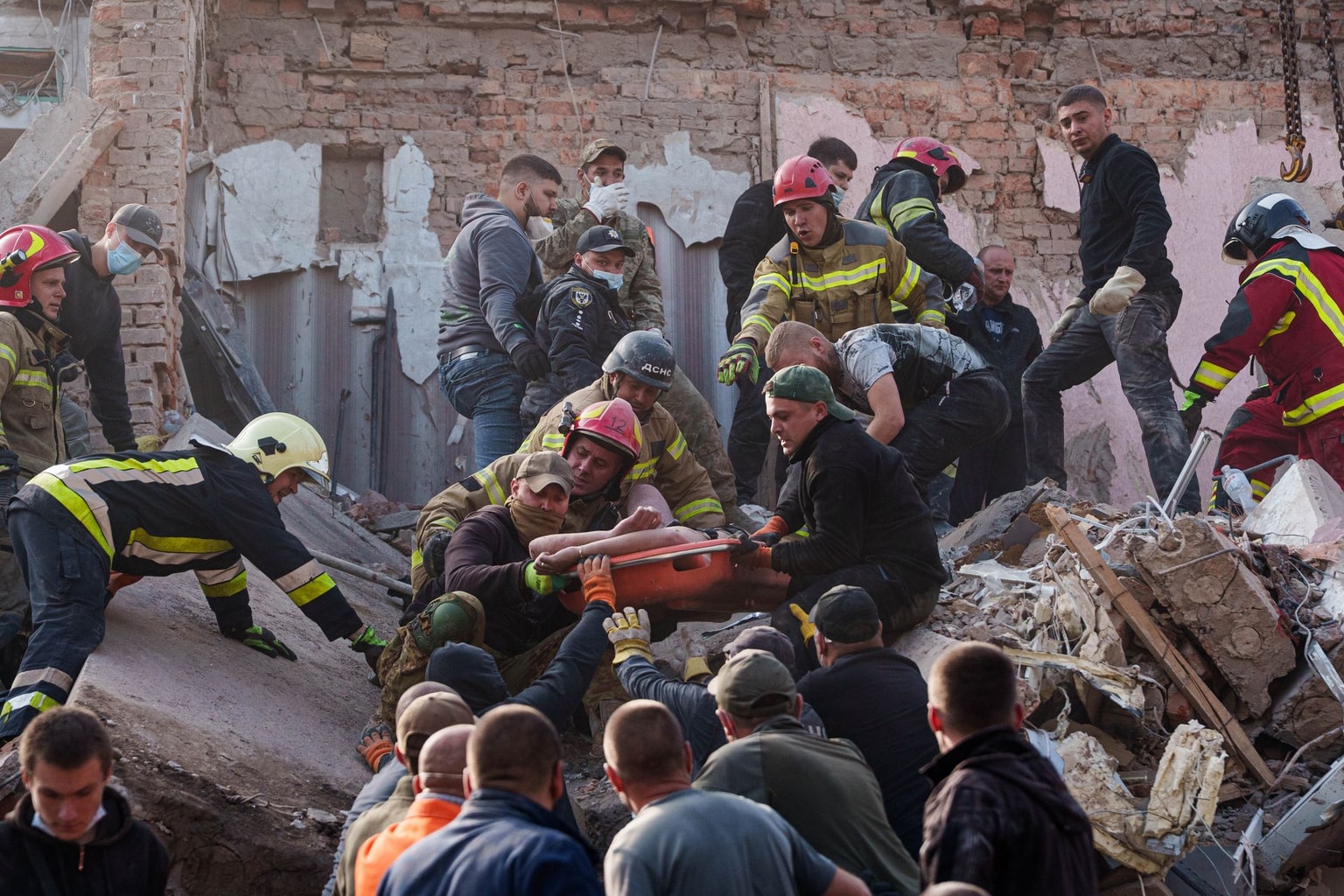
Russian troops have long been hunting Ukrainian civilians with first-person view (FPV) drones in front-line cities, in what has been described as a "human safari." Kherson is the city that has become most associated with this daily terror, but in early May, reports emerged that Russian FPV drones had reached the eastern city of Kramatorsk after a car in a civilian district was targeted.

Bout also painted a lurid picture of Russian prisoners of war (POWs) being tortured by Ukraine — claims of castration and organ harvesting included. In reality, there is extensive documentation of Russia committing some of these atrocities against Ukrainian POWs. The visual evidence alone of POWs during prisoner exchanges — emaciated, traumatized Ukrainian prisoners versus well-fed, relatively healthy Russian ones — speaks for itself.
"Hearing a Russian figure pin (Russian war crimes) on Ukraine is an accusation in a mirror, the technique of charging your enemy with your own conduct," McGlynn explained.
"I don't see the aim in this case as boasting. Rather, it is to muddy the water so a distant audience concludes both sides are equally guilty and gives up trying to tell them apart."
For all his talk about being an American patriot, Carlson's interview with Bout wrapped up with a call for the U.S. and Russia to "unite and stop being sworn enemies."
Carlson has emerged as perhaps the most vocal proponent of the view — now gaining traction within a particular faction of the American right — that Russia is not a historic adversary of the U.S., but a natural ally.
While this view does not represent the entirety of the Republican Party, it is closely linked to longstanding currents of skepticism within the right — and as McGlynn warns, it is one that Russia is all too willing to exploit.
"Several currents feed it: hostility to NATO and foreign aid, an affinity for Russia as a socially conservative counter-model, and the simple fact that opposing Ukraine has become an identity marker," McGlynn said.
"Moscow treats these constituencies as an asset and tailors content to their tastes."
Disclaimer: This article was produced as part of the F.A.C.T. (Fighting Against Conspiracy and Trolls) project, funded by the European Union through HaDEA. The views expressed are those of the authors and do not necessarily reflect the views of HaDEA or the European Union. Neither HaDEA nor the EU is responsible for any use of the information contained herein.
Note from the author:
Hi, this is Kate Tsurkan — thank you for reading. I'm an American citizen who has lived in Ukraine for nearly a decade, but I still love the country of my birth and want only the best for it. I don't think that includes giving a platform to Kremlin propaganda.
If you like reading about this sort of thing, please consider supporting The Kyiv Independent.