What's missing from Ukraine's EU checklist?
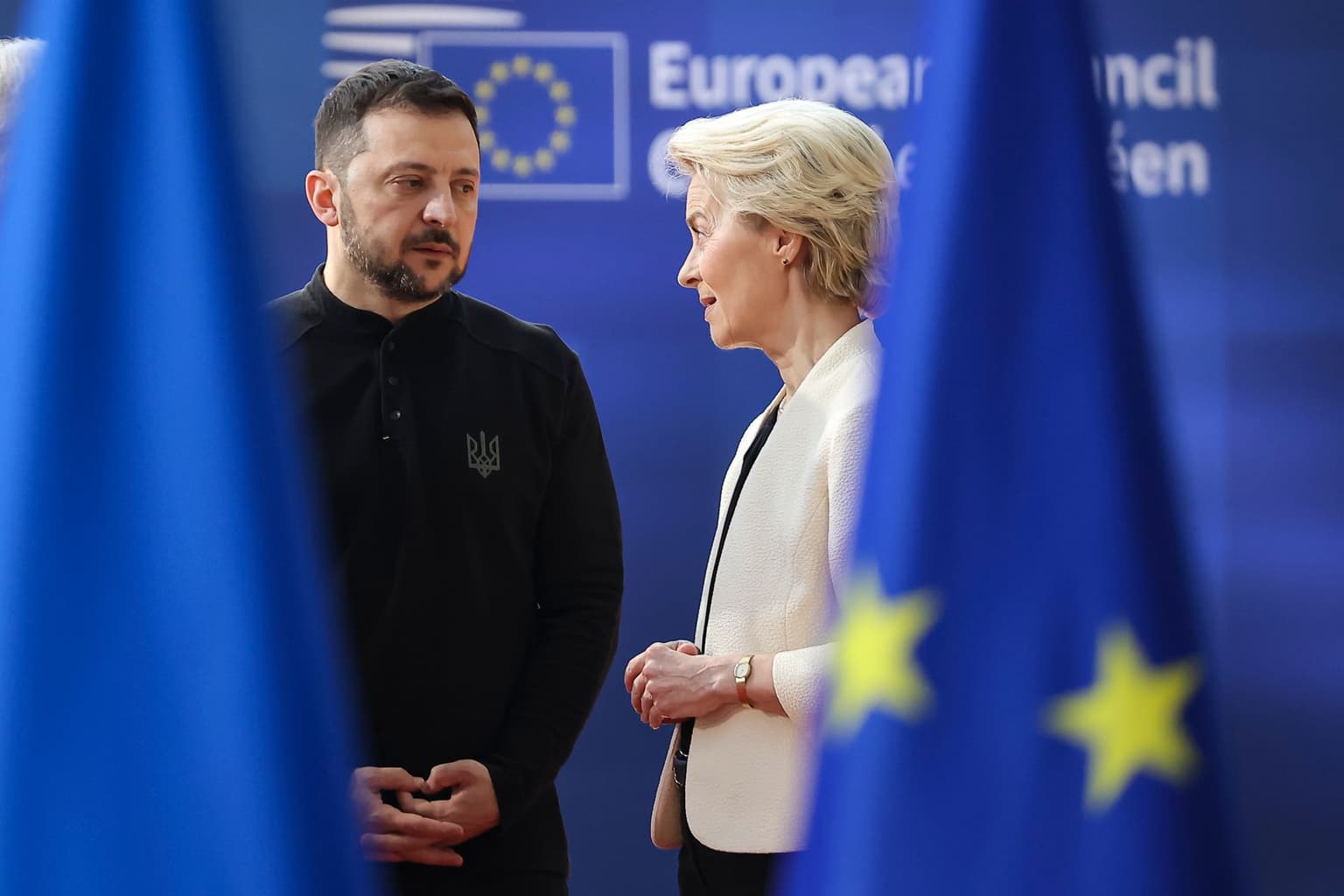
President Volodymyr Zelensky (L), European Commission President Ursula von der Leyen (R) at an emergency EU leaders summit on Ukraine and defense in Brussels, Belgium, on March 6, 2025. (Nicolas Economou / NurPhoto / Getty Images)
 on Google
Tetiana Khutor
Head of the Institute of Legislative Ideas
Ukraine has opened the sixth negotiation cluster, "External Relations," bringing the country one step closer to European Union membership. Although the cluster's description underscores the importance of aligning Ukraine's sanctions policy with that of the EU, the benchmarks make no mention of the reforms needed in this area – at least not yet.
That omission is deeply troubling.
Sanctions have become an increasingly contentious issue in Ukrainian society following yet another round of personal restrictions imposed on politicians without transparent justification, controversial judicial practices, and losses before the European Court of Human Rights.
A closer look at the principal flaws in Ukraine's sanctions policy shows both the necessity and the value of making reform in this field a separate benchmark.
When a security tool becomes a political tool
Recently, many people criticized Ukraine's imposition of sanctions on its own citizens, particularly on political figures and government opponents, including former President of Ukraine Petro Poroshenko, former Member of the Verkhovna Rada Boryslav Bereza, former Head of the Presidential Office Andriy Bohdan, and others.
One point should be clear from the outset: Ukraine has long had a legal framework for imposing sanctions on its own citizens, and the EU likewise imposes sanctions on its own citizens in exceptional cases where a demonstrable security threat exists.
The problem, though, is not the use of sanctions itself, but the procedure by which they are imposed, the reasons given for them, and the transparency of the process.
When resolutions of the National Security and Defense Council are based on classified reports, while the affected individual is denied access to the allegations and any meaningful opportunity to defend themselves, the process begins to look less like a means of countering an enemy and more like an instrument of domestic political pressure.
That, in turn, erodes trust in the sanctions system itself. Ukraine has already lost its first case before the European Court of Human Rights, and more such cases are likely to follow.
The inability to challenge sanctions effectively, either before the authority that imposed them, even when the grounds for extending them no longer exist, or in court, because the Supreme Court declines to assess the substance of those grounds, bears little resemblance to European practice and further undermines confidence in Ukraine's sanctions machinery.
The cost of inflexible sanctions
EU membership requires compliance with sanctions regulations as directly applicable legal acts. Yet Ukraine still lacks several mechanisms needed to make its sanctions policy predictable, effective, and consistent with human rights.
One significant gap between Ukrainian and European sanctions law is the absence of a dedicated "authorization" mechanism.
As a result, sanctions can inflict "collateral damage" on business partners, employees, and family members who are not themselves sanctioned. In some cases, they can even harm the national economy when the operations of major enterprises are blocked.
One of such examples is the dispute over the division of property between the Poroshenko spouses.

The former president's wife, who was not subject to sanctions, succeeded on appeal in securing the right to use her share of the assets. In a similar but non-public case, courts at several levels rejected such an arrangement. The contrast exposes the need for uniform, clear, and transparent rules in Ukraine's sanctions policy.
Ukraine also lacks a sanctions-reporting system, an effective mechanism for monitoring assets and preventing sanctions evasion.
No accountability: There is a bill, but no political will
European countries hold sanctions violators accountable. Ukraine, by contrast, still imposes no penalties for circumventing sanctions. A solution was developed long ago, yet it has remained stalled in Parliament for more than a year.
The Institute for Legislative Ideas, together with more than 10 government agencies, developed a comprehensive bill to align Ukrainian sanctions legislation with European standards.
In January 2025, Volodymyr Zelensky submitted it to the Verkhovna Rada as urgent.
Yet there simply "are not enough votes" in the Verkhovna Rada. Political expediency on one side, and lawmakers' reluctance to impose liability before the problems described above are resolved on the other, appear to outweigh the state's strategic interests and the demands of the rule of law.

Why sanctions reform needs its own benchmark
The need to reform sanctions policy has long been apparent, and there seems to be broad agreement on that point. Yet the political process has reached an impasse between two competing approaches.
The first is a simple and rapid political fix: exempt Ukrainian citizens from sanctions while leaving the current system intact — a system that remains largely opaque, unpredictable, and highly dependent on political expediency.
The second is more difficult but strategic: use this moment to pursue comprehensive reform by introducing clear rules, transparent procedures, and guarantees for the protection of human rights in line with European standards.
Without an external incentive, the Ukrainian authorities are unlikely to reach a political consensus on this choice in the near future.
The European Union can therefore play a decisive role by making the alignment of Ukraine's sanctions legislation with the EU acquis a specific benchmark in the accession negotiations, as it would provide Ukraine with the leverage needed to complete a long-overdue transformation.
Editor's note: The opinions expressed in the op-ed section are those of the authors and do not purport to reflect the views of the Kyiv Independent.