The clock is ticking on Europe's gas: barely 4 months to fill storage tanks before winter
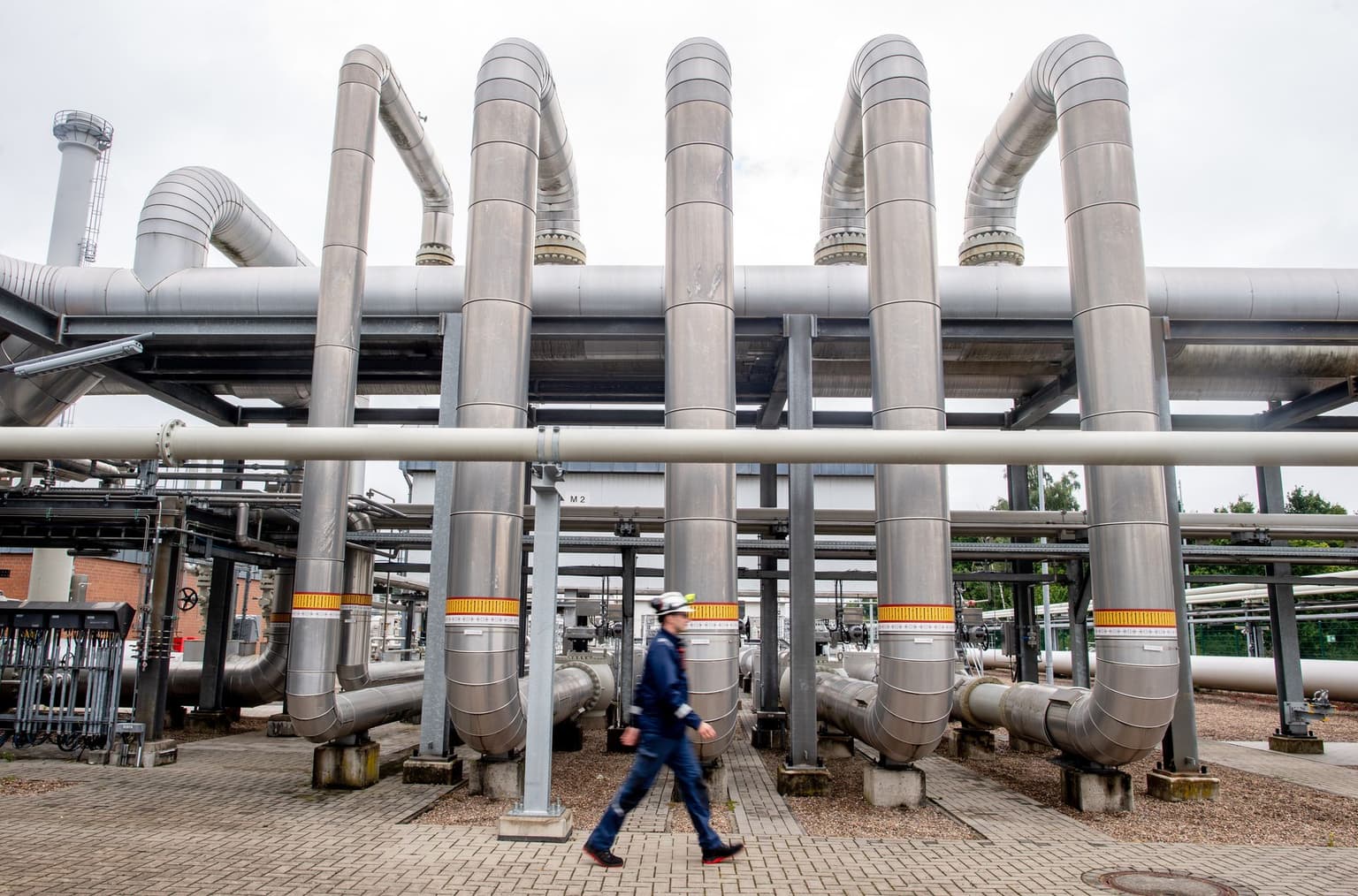
Numerous pipes run along a technical facility for compressing natural gas at SEFE Storage GmbH's Rehden natural gas storage facility in Lower Saxony, Germany, on July 7, 2025. (Hauke-Christian Dittrich / picture alliance / Getty Images)
 on Google
Mykola Kolisnyk
Head of the Generation Department at Naftogaz of Ukraine
With the Strait of Hormuz shut and storage only a third full, Europe has barely four months until Nov. 1 to refill its tanks before winter. And this year, for the first time since the 2022 crisis, the market alone will not do it.
Across Europe, gas is pumped during spring and summer into vast underground reservoirs, mostly depleted gas fields, then drawn back out in winter as households turn up the heating. These stores are the continent's buffer against a cold snap or a sudden loss of supply. Filling them has always been left to the market: traders buy gas cheaply in summer and sell it in winter, and they fill storage only when that price gap makes it worth their while.
That is why holding gas purely as a reserve has never been standard practice — nobody is paid to do it.
And it is why, until now, there has been no policy forcing security-grade reserves at scale. After the 2022 crisis, the EU added how-full targets: 80%, then 90% by winter, but it still leaves the actual filling to traders chasing that price gap. This year, the gap has all but vanished, and with it the market's reason to fill the tanks at all.
EU storage stood at just 35 bcm at the start of May, about a third of the bloc's total capacity of a little over 100 bcm, and more than 7 bcm below the level a year earlier.
On current trends, analysts at the Oxford Institute for Energy Studies expect the bloc to reach only around 70% of capacity by Nov. 1 — short of its own 90% target, and the thinnest winter cushion since 2022.

From late February, the closure of the Strait of Hormuz cut Europe off from Qatari and Emirati LNG, together nearly a fifth of all global LNG trade.
The result was a loss of 2 bcm per month, totaling close to 8 bcm of missed supply across the prime injection season. Reopening the Strait, currently under negotiation, would stop the monthly shortfall, but it cannot recover what has already been lost. Europe is left with a shrinking window to reach its winter storage targets, and less room for error than at any point since 2022.
This is where Europe rediscovers what Ukraine has known for years: filling storage before winter is a security obligation, not a market option.
What Ukraine has actually tested
This is not a theory for us. Ukraine has required suppliers to hold an insurance stock, up to 10% of planned monthly volumes, since 2016. On Feb. 26, 2022, two days after the full-scale invasion, we activated an emergency-level gas crisis regime and resorted to non-market tools, including halting gas exports except for volumes held under customs-warehouse rules.
In this way, we've managed to balance the gas transmission system even when part of the equipment (gas compressor stations, regulation and metering units) was occupied, and part was affected by shelling.
Today, we operate the largest underground storage system in Europe: 31 bcm, most of it concentrated in well-protected facilities in the west of the pre-mounting territory of Ukraine. It's 1.5 times the combined capacity of Hungary, Romania, Poland, and Slovakia, and we have run it through three winters of war, with the infrastructure itself under Russian missile and drone attacks.
We never had the option of treating reserves as a trade. For us, filling before winter was about survival and continuity of day-to-day operation. Despite all challenges, we didn't reject any nomination for storing or shipping gas.
In 2023, and again in 2024, together with the European Commission's Joint Research Center, the Energy Community Secretariat, and USAID, we stress-tested how the system would behave under deliberate destruction: facilities hit, routes cut, transit halted.
In every modeled scenario, we reached the same conclusion: excess reserve capacity, routes substitute for one another, and gas stored by European traders can still be withdrawn and returned to the EU border under attack.
When facilities were struck, Ukrtransgaz shifted withdrawal to other sites and kept enough injection and withdrawal capacity running. Ukraine was also the first country to certify its storage operator under the EU's revised gas rules.
Germany is now debating the Ukrainian argument
The clearest sign that this debate has moved into the heart of the EU comes from Germany. Its grid operators' association, FNB Gas, has proposed a "combination model" for security of supply: a year-round, storage-based strategic reserve of 24 terawatt-hours (about 2 bcm), on top of a supplier filling obligation of 63 terawatt-hours (about 6 bcm) by Feb. 1, together protecting from 30 to 40% of German storage.
FNB Gas, the association of Germany's gas grid operators, suggests that a central body, such as the market-area manager Trading Hub Europe (which runs Germany's gas market), should hold that reserve and release it only in a crisis.
If we strip away the German specifics, the FNB Gas proposal is essentially a non-commercial insurance reserve: held by a designated operator, financed outside the market - the very instrument Ukraine's experience points to.

Other countries, like Austria and Hungary, already maintain dedicated gas reserves outside normal market operations. Austria operates a state-controlled strategic stock of around 20 TWh, Hungary holds a state-protected reserve (around 1.9 bcm) created after 2022 purely to guarantee physical availability, so the principle is already an established EU practice.
What is Europe's resilience plan?
Europe has only 146 days to secure reserves before the consumption season begins. The Commission has finished its fitness check of the security-of-supply rulebook and is due to table new legislation in the second quarter of 2026.
Three things should follow. First, treat a strategic, insurance-grade reserve not as a market distortion but as the premium for insuring the system, with a designated operator and transparent financing, decoupled from a spread that no longer functions.
Second, build it on a European scale, not a national one: a reserve locked inside one country's borders is not solidarity.
Third, use the capacity that already exists. Ukraine already offers substantial storage capacity up to 10 bcm to foreign customers, and through the Commission's AggregateEU mechanism, the EU's joint gas-buying platform, gas can be secured as it enters Ukrainian storage.
Editor's note: The opinions expressed in the op-ed section are those of the authors and do not purport to reflect the views of the Kyiv Independent.