How many more missiles does Russia have — and can it keep firing them?
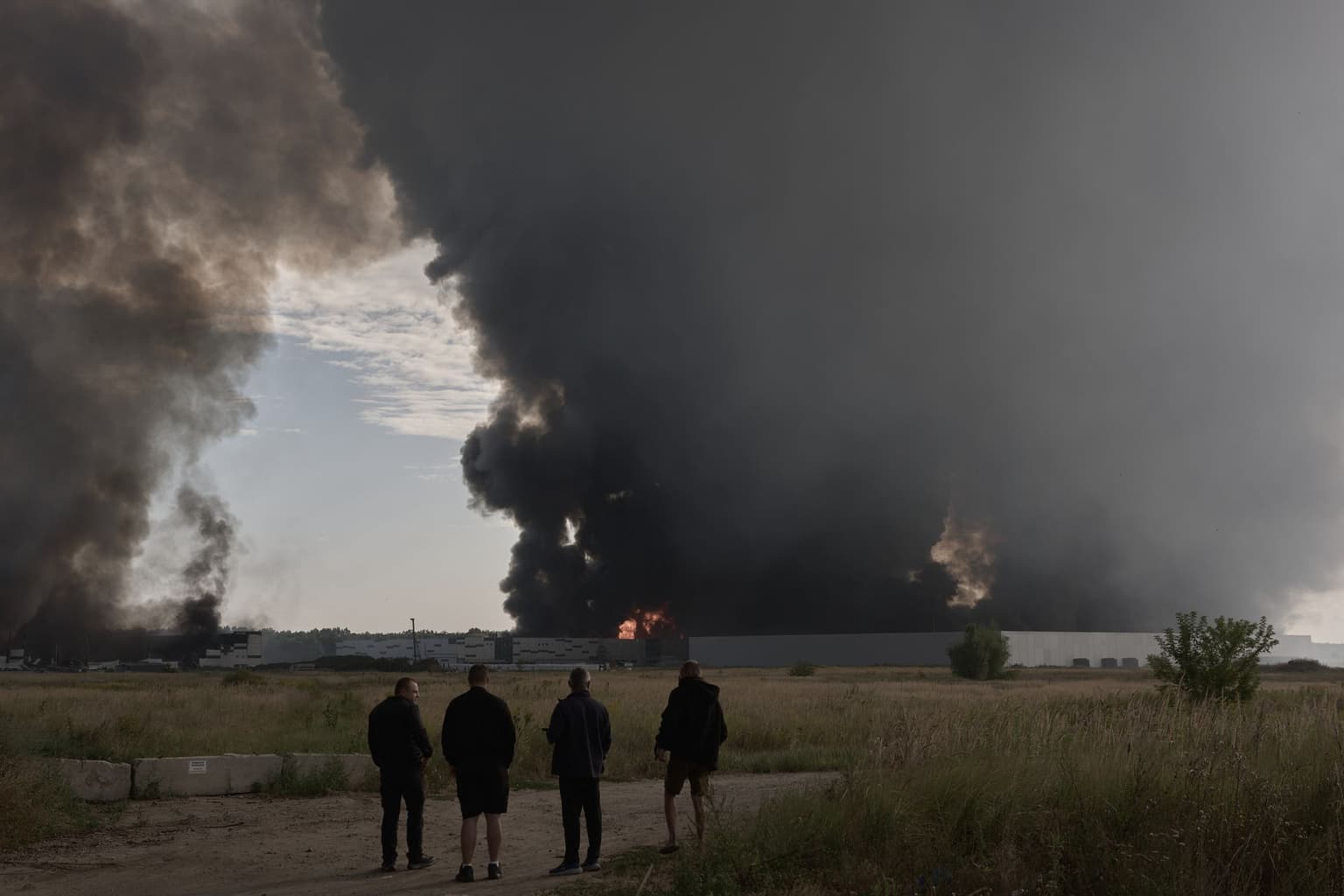
Local residents and warehouse workers watch a massive fire burn at a commercial storage facility following a Russian drone strike in Boryspil, Kyiv Oblast, Ukraine, on Aug. 27, 2026. (Kostiantyn Liberov / Libkos / Getty Images)
 on Google
Dmytro Shumlianskyi
Editor at Militarnyi
From the start of 2026 through the morning of Aug. 27, Russian forces fired at least 1,858 missiles of various types at Ukraine.
That figure alone, however, fails to show the whole picture. Over nearly eight months, Russia's missile campaign has changed character. After the large February salvos of cruise missiles, a significant share of which Ukrainian air defenses intercepted, Moscow has increasingly turned to massed attacks involving ballistic and quasi-ballistic weapons, which are considerably harder to intercept at a time when Ukraine faces a shortage of Patriot interceptor missiles.
Russia has identified that vulnerability and is exploiting it. Any engaged observer of the Russia-Ukraine war may now reasonably wonder just how long Moscow can sustain such a pace.
The numbers tell a story
To understand Russia's missile production and available stockpiles, it is worth first looking at how its missile campaign has changed significantly over the past several months.
After peaking at 296 missiles in February, Russian strikes briefly slowed in March and April before accelerating sharply in late spring: at least 235 missiles were used in May, 227 in June, 474 in July, and 195 during the first 27 days of August. Yet the more consequential change lies in what Moscow has been firing.
Ballistic and quasi-ballistic missiles have increasingly dominated the campaign. Russia has used at least 794 Iskander-M, RM-48U, and KN-23 missiles since the beginning of the year, accounting for 43% of all missiles fired at Ukraine. After falling to 39 ballistic missiles in March and 61 in April, their use surged to 107 in May, 134 in Jun,e and 174 in July, followed by approximately 89 during the first 27 days of August.
The use of RM-48U missiles alone jumped from 15 a month during the first half of the year to 46 in the first 20 days of July.
Cruise missiles also remain a major part of the arsenal, with 866 used since January. Kh-101s account for 529 of them, or more than 61% of all cruise missiles fired. Their use has likewise intensified, reaching 119 in July after 111 in February, with at least 34 more launched in the first 27 days of August.
Kalibr use, though, has remained relatively low, with 126 launches since January and only eight recorded in August.
The summer also brought a steep increase in tactical and supersonic weapons. Russia fired 72 Kh-59/Kh-69 missiles in July, more than five times its previous 2026 monthly high, amid its campaign against Ukrainian ports and vessels in the Black Sea.
Zircon launches surged from just three in May to 15 in June and 24 in July, with another 15 recorded in August. Of the 80 Zircons used this year, roughly two-thirds were fired during the summer.
Onyx, meanwhile, was absent at all from the first six months of the year before Russia suddenly launched 25 in July and at least 16 more in August.
The same pattern is visible in the use of Kh-31 supersonic guided aviation missiles, whose principal variants are designed to target air-defense radar stations and other surface targets. Russia used 63 since the beginning of the year, including 27 in July alone, more than during the previous six months combined, and at least 17 more in the first 27 days of August.
Taken together, the numbers point to a deliberate intensification of pressure on Ukraine's already stretched air defenses, with Moscow increasingly drawing on weapons that are harder to intercept or can help suppress the systems protecting Ukrainian airspace.
For an engaged observer of the Russia-Ukraine war, that raises an obvious question: if Moscow is consuming its missiles at this rate, how long can it sustain the pace?

The production problem
Now, let's move onto the production picture.
Russia has been meeting or exceeding its targets for several key missile types. Its planned output of Iskander-M missiles has remained at 60 a month, yet it produced 65 in July.
Kh-101 production reached 87, against a monthly target of 72, while Kalibr output stood at 29, compared with a target of 26. A significant share of those newly produced Kalibrs, according to GUR deputy chief Vadym Skibitsky, is going towards arming Russian ships and submarines.
For Onyx and Zircon, the numbers are particularly strong: Russia's annual production plan of 60 missiles for Onyx had already been fulfilled by Aug. 3, halfway through the year. Zircon had a similar trend, with its production tempo running 57.1% above the annual target of 36 missiles.
Yet, quite importantly, the pace of expenditure has begun to catch up with (and in some cases outrun) production, particularly for these more heavily used systems. RM-48U production, meanwhile, remains at 40 missiles a month, according to both the April estimate and August plan.
Kinzhal is a different story. Russia's capacity was estimated at 10 missiles a month in April, but serial production has since been suspended as rocket fuel and other resources are redirected towards higher-priority ballistic missiles.
Kh-32 production has likewise been suspended, after an April estimate of up to eight missiles a month.
No less important are the stochpiles of these missiles. Russia entered 2026 with substantial reserves, though those stockpiles vary considerably by missile type.
Kh-101 reserves, for instance, have fallen from 150 missiles to no more than 100 despite almost continuous production, suggesting that missiles are moving rapidly from factories to combat units rather than piling up in storage. Iskander-M stocks have also declined amid the intense use recorded since May.
Zircon reserves appear to have fallen from up to 230 missiles in spring to around 120 by summer.
Kalibr remains relatively comfortable at more than 450 missiles. Onyx stocks are also substantial: Russia had used 41 by Aug. 27, even as it had already produced the 60 missiles planned for the entire year.
Some of those Onyx reserves are likely to consist of older variants that have proved less effective against ground targets, leaving room for gradual modernization. RM-48U stocks also remain significant and could partly offset the depletion of Iskander-M missiles, although at the cost of lower accuracy and a smaller warhead.
Kh-35 is harder to assess separately. The April estimate put the combined stockpile of Kh-29, Kh-31, Kh-35, Kh-58, and Kh-59 tactical missiles at up to 2,600, most of which are likely Soviet-era short-range Kh-29s.
There is, of course, some wiggle room in these numbers. Intelligence estimates are approximate, and production capacity on paper does not always translate directly into actual output. Even so, the direction of travel is becoming increasingly difficult to miss.

A war shaped by production
Russia's missile arsenal cannot be reduced to a simple question of whether it is "growing" or "depleting." The answer differs sharply by weapon, as we can see.
Zircons and the ballistic group of Iskander-M/RM-48U/KN-23 are being expended faster than they are produced during the most intense months. Kh-101s, by contrast, are being used at roughly the rate at which Russia can currently produce them.
Kalibr retains a large reserve because average output exceeds its use against Ukraine. Onyx stockpiles also remain substantial, although July and August brought a sharp increase in expenditure that has already surpassed the average production rate.
The Kh-35 appears only episodically in available reports, while the doubling of its July production target suggests that Moscow is prioritizing the weapon rather than confronting an immediate shortage. As a tactical cruise missile designed primarily for targets near the front, it may also be absent from public Ukrainian Air Force reporting.
Kinzhal and Kh-32, meanwhile, have shown insufficient effectiveness and have at least temporarily lost their priority status.
The conclusion we are left with is uncomfortable because it resists an easy prediction: Russia is unlikely simply to "run out of missiles."
It has established high production rates for almost every major missile type, including ballistic weapons. At the same time, a sustained and substantial expansion of its strike campaign would encounter a harder constraint: production for most of the arsenal has remained relatively stable over an extended period.
To increase the tempo of attacks, Russia would therefore have to make choices. It could pause strikes and accumulate reserves, draw down its remaining stockpiles, or rely more heavily on less accurate weapons such as Onyx and RM-48U, alongside subsonic Kalibr cruise missiles. Even the considerable Kalibr reserves are finite.
Additional ballistic missiles from North Korea could provide some relief, although supplies remain relatively modest, unless the Kremlin's friends in Tehran decide to lend a helping hand.
None of these constraints, unfortunately, guarantees a quieter winter. Russia can still accumulate a substantial arsenal for a renewed campaign against Ukraine's energy infrastructure.
Editor's Note: This opinion piece was produced in cooperation with Militarnyi, a Ukrainian media outlet specializing in defense and military affairs. The opinions expressed in the op-ed section are those of the authors and do not purport to reflect the views of the Kyiv Independent.