Eastern Europe's push to revive tourism amid Russia's war
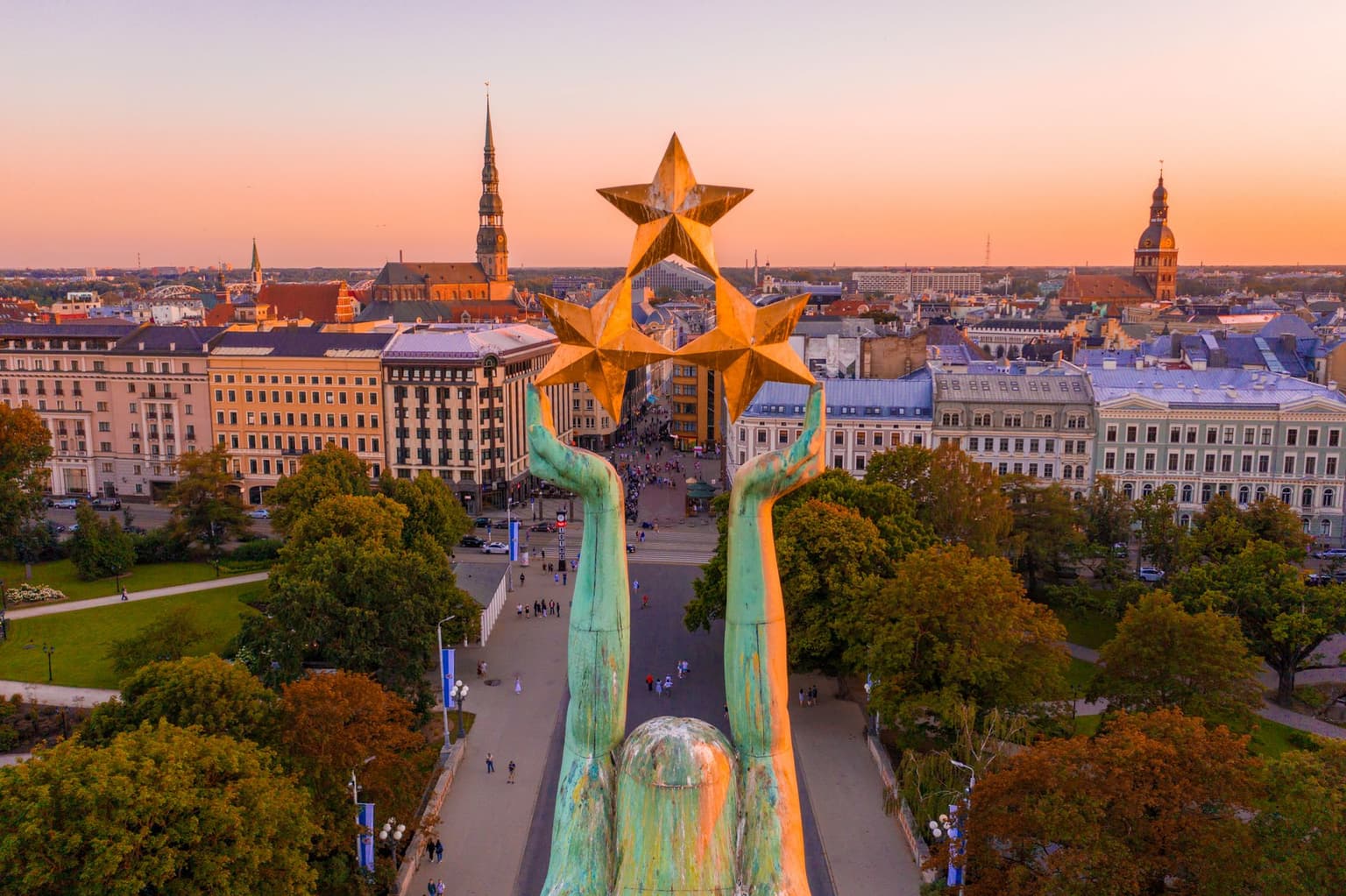
An aerial view of the Statue of Liberty Milda in Riga, Latvia during sunset. (Stockfoto via Getty Images.)
 on Google
Europe's tourism industry is thriving, but the recovery has been uneven across the bloc. While western countries enjoyed a steady rebound after the pandemic and lockdowns, tourism in the EU's easternmost members was hit by another crisis: the war on their doorstep.
Now, they're looking to EU support to give their tourism industries the boost they need to revive their economies and help their border regions flourish.
Seven EU countries signed off on a joint appeal to the bloc on July 23, which calls on the European Commission to "fulfill its promise to address the challenges to the tourism sector in the EU's eastern border regions."
"Bulgaria, Estonia, Latvia, Lithuania, Poland, Romania, and Slovakia are asking for targeted measures that would boost connectivity and strengthen resilience in the tourism sector, as well as restore confidence in the region," reads the appeal.
The note also requests support for smaller businesses that it says are "suffering from weakened international public trust and perception of regions in the shadow of Russia's war against Ukraine."
Eastern Europe's tourist trap
Tourism across all EU countries collapsed in 2020 and 2021 due to the COVID-19 pandemic. But by 2024, most countries had rebounded and surpassed their 2019 figures.
However, the same cannot be said for countries in central and eastern Europe. The seven countries have not yet rebounded to 2019 levels.
Other countries in the same boat that did not sign the letter are Czechia, Germany, Cyprus, Hungary, and Finland.
And behind those nationwide numbers, regional disparities can loom large.
While tourists might still be visiting Riga's old town and its much-celebrated Art Nouveau architecture, Latvia's eastern Latgale region saw 60% of its reservations from foreign tourists and tour operators canceled as news of threats to the country's airspace circulated, according to a May statement from the region's tourism association.
Caspar Schulze at the Baltic International Security Center think tank, believes that a growing sense of risk plays a role in both tourism and investment more broadly.
"Few international investors have an intimate knowledge of the Baltic states beyond what they hear in the press, where risk narratives abound," he told the Kyiv Independent.
"Would-be tourists obviously hear these stories, too," Schulze added.
But Schulze suspects that other issues, like connectivity and public infrastructure, also play a role.
A June 2026 EU report on the state of Lithuania's economy highlights that the country suffers from "high car dependency, slow electrification, and limited public transport integration."
The report also mentions that Lithuania has the second-lowest share of rail journeys in the EU, accounting for only 1% of all passenger travel in 2023.

Malta is the only EU country with less rail travel than Lithuania, owing to its complete lack of a railway network.
Likewise, the EU's report for Hungary notes that the country's "eastern and southern regions face weaker infrastructural conditions," and that the "restructuring of transport networks has often failed to take account of the needs of disadvantaged regions."
What's the cure?
The European Commission adopted a strategy in February to support the bloc's easternmost regions.
The strategy primarily pitches financial support tools that bring together banks and other financial institutions, such as the European Investment Bank and the World Bank, to provide targeted lending under favorable terms.
And the EU is expected to soon release its strategy for sustainable tourism, which the seven countries that penned the open letter hope to influence.
One national diplomat told the Kyiv Independent they expect that strategy to be published in the fall of 2026.

A European Commission spokesperson confirmed that they had received the letter and that a reply has not yet been sent.
"The Commission takes note of the concerns raised regarding the impact of Russia's war of aggression against Ukraine on tourism in certain regions and member states," they told the Kyiv Independent.
"We are carefully examining the issues presented in the letter," they added.
But in the meantime, some are taking matters into their own hands.
The Estonian island of Hiiumaa has been typecast as a potential landing site for a Russian amphibious assault.
In response, the island's local tourism agency has partnered with its neighbors and with Norwegian social media influencer Kjetil Krogstad to showcase a lighter, more whimsical side to the country's islands.
Narva, an Estonian city best known for facing Russia across a narrow river border, grapples with similar challenges. Its location has led many geopolitical commentators to warn that Narva "may be next" if Russian President Vladimir Putin decides to test NATO unity.
The Estonian Foreign Ministry has offered a tongue-in-cheek response with its "Visit Narva Next" campaign, shifting focus to local landmarks and culture.
"Narva is a city shaped by history, but whose story is much richer than headlines and predictions," the Estonian Foreign Ministry said.