Poland's main conservative party splits as debate over Ukraine intensifies
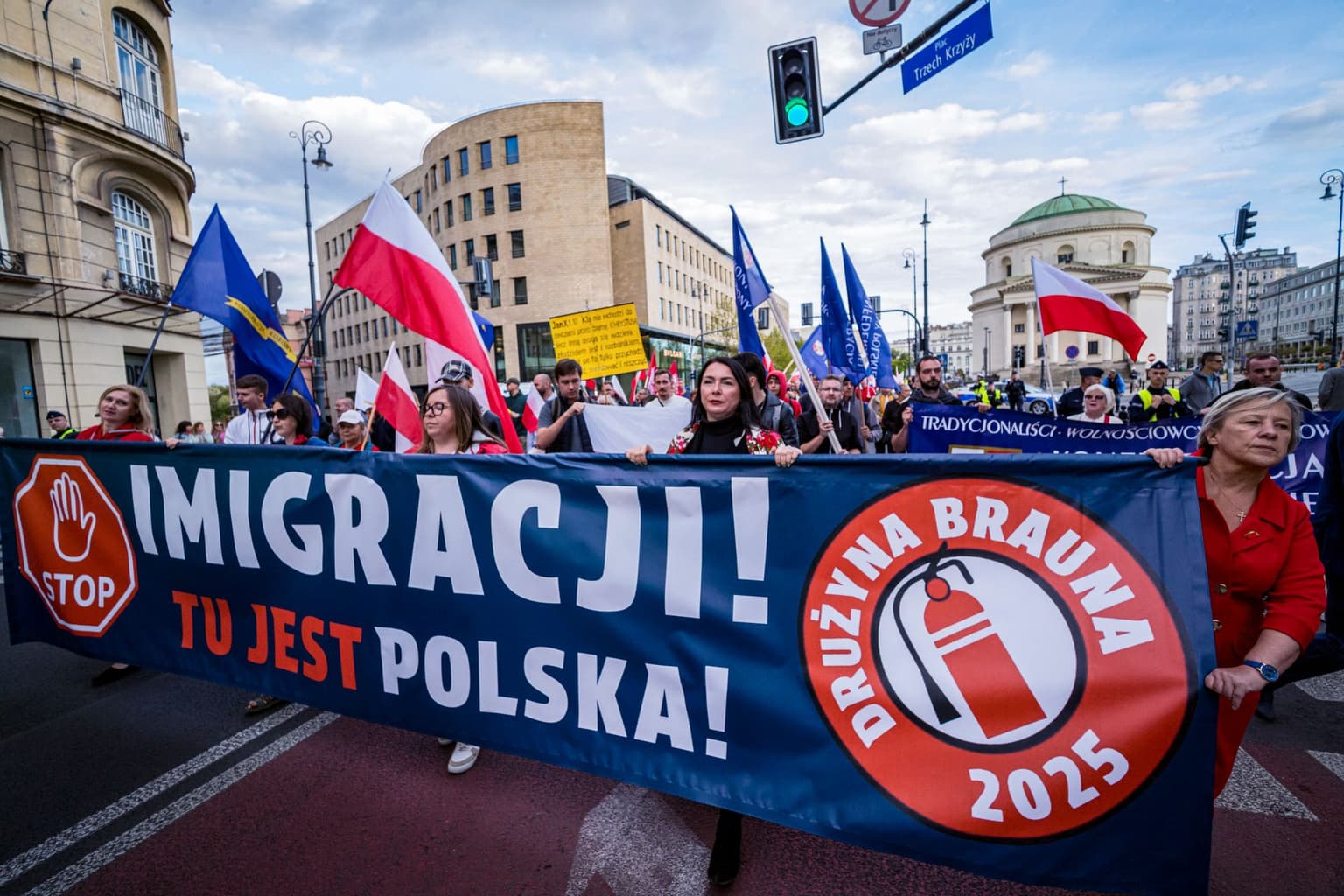
Protesters march behind a banner reading "Stop Immigration. This is Poland" during a far-right rally in Warsaw, Poland, on Aug. 24, 2025. (Neil Milton / SOPA Images / LightRocket / Getty Images)
 on Google
For days, Poland's Law and Justice (PiS) party has been consumed by a crisis of its own making. The party, which governed Poland from 2015 to 2023, has now split into two ahead of next year's parliamentary elections.
After months of internal tensions, the more moderate faction led by former Prime Minister was forced out by Przemysław Czarnek, the party's newly nominated prime ministerial candidate and leader of its more radical wing.
The split weakens an opposition that had hoped to challenge Prime Minister Donald Tusk's coalition in next year's election, potentially improving the liberal government's chances of securing an unlikely second term.

"If this separation continues, PiS will lose dozens of seats to its competitors in the upcoming parliamentary elections, under any scenario," said Jarosław Flis, a Polish political scientist.
According to the Ewybory poll tracker, Morawiecki's newly created party, Development Plus, is polling at around 5%. Meanwhile, Law and Justice (PiS) stands at 22%, down four percentage points from the previous poll.
--ADD READ ALSO--
Poland's far-right on the rise
After months of internal disputes over issues ranging from military aid to Ukraine and broader geopolitical questions to domestic policies on agriculture, the economy, and the rise of the far right, Poland's Law and Justice (PiS) party has finally split.
On July 29, the camp led by Morawiecki confirmed their separation. The former prime minister announced that he and 40 lawmakers had formed a new parliamentary group, formalizing a split that had been expected for weeks.
The same day, Morawiecki also stepped down as leader of the European Conservatives and Reformists (ECR), one of the European Parliament's largest political groups.
The breakup comes as Poland's far-right parties — Confederation and the Polish Crown — continue to gain support. Recent opinion polls suggest that, for the first time in two decades, Law and Justice is no longer the dominant force on the Polish right.
Law and Justice has increasingly shifted its rhetoric and policies further to the right in an effort to win back voters.
Over the past decade, Confederation, a libertarian-nationalist party aligned with other hard-right movements across Europe and the U.S., has steadily expanded its influence.
Since 2019, however, it has also faced competition from an even more radical rival: the Confederation of the Polish Crown, led by Grzegorz Braun, a controversial lawmaker and former film director known for repeated anti-Semitic remarks.'

Braun's party gained international attention in 2023 when he used a fire extinguisher to put out a large Hanukkah menorah displayed in the Polish parliament, an incident that drew widespread condemnation.
Faced with growing competition on its right flank, Law and Justice has increasingly shifted its rhetoric and policies further to the right in an effort to win back voters.
--ADD READ ALSO--
A traditional Kyiv ally now prone to anti-Ukrainian rhetoric
The rise of far-right political projects is directly correlated with the mood on Polish streets. Attacks on Ukrainians in Poland have drastically increased over the past months.
While most Polish politicians condemned these incidents and criticized the use of violence, others were wary of going against anti-Ukrainian sentiment in Poland.
Unlike more radical parties, PiS — and its main competitor, the liberal Civic Coalition party of Prime Minister Tusk — have, overall, been allies of Kyiv throughout the full-scale invasion, Flis said.

At the same time, under Czarnek's leadership, Law and Justice has "been going in an anti-Ukrainian direction," said Anna Wójcik, a political science professor at the University of Warsaw.
"Morawiecki opposed this direction, and up till recently, PiS was a great supporter of Ukraine, with (ex-President) Andrzej Duda, (party leader Jarosław) Kaczyński and Morawiecki acting as the faces of this support."
Younger PiS politicians are, however, more likely to follow whatever voters want and voice anti-Ukrainian sentiment, said Leszek Jażdżewski, a Polish political scientist and journalist.
"So, we are looking at a scenario where this party, which has historically been very anti-Russian, will be less and less engaged in such rhetoric."
In any case, younger voters are increasingly turning away from Law and Justice, Flis said in turn.
"People like Czarnek just say what they think voters expect of them," Flis added.
--ADD READ ALSO--
Upcoming electoral sunset for PiS?
Historically, the Law and Justice electorate was located in small Polish towns and villages, with elderly voters and those without university degrees being the core base.
"Demography is not going to help PiS in the long run," Jażdżewski said.
On top of this, Flis argued, the Law and Justice did not draw conclusions from the 2023 parliamentary elections it lost. They also didn't understand the reasons behind the surprise victory of the party's candidate, Karol Nawrocki, during last year's presidential election.

"PiS did not understand that Nawrocki won thanks to support from the far-right," Jażdżewski said. "Instead, they thought his victory meant Polish voters supported Law and Justice."
Between 2015 and 2023, when PiS was in government, the party spearheaded some policies that were not popular with right-wing voters, experts who spoke to the Kyiv Independent noted.
Under the party's rule, for instance, Poland saw an influx of migrants — from Ukraine, but also from South Asia and other parts of the globe.
As for the two far-right groups — Confederation and the Polish Crown — anti-immigrant rhetoric has been a driving force behind their rise. Both parties are against legal and illegal migrants alike.
With the far-right gaining points and Morawiecki's faction separating from PiS, the party's chances of winning upcoming elections have decreased, Jażdżewski argued, also citing historic splits within the party.
"In 2010, a liberal group in PiS also left the party: like them, Morawiecki's supporters are unlikely to win more than 2-3% of the vote, but like in the past, those 2-3% could decide on whether PiS wins the elections or not."
At the same time, the Law and Justice core electorate has historically been very stable and is unlikely to drift towards other parties, he noted.
"So, we are looking at a situation where PiS will be one of three, maybe four parties on the right end of the spectrum," Jażdżewski said. "But it will no longer have a dominant position there."