Bardella or Le Pen: What France's far-right choice means for Ukraine
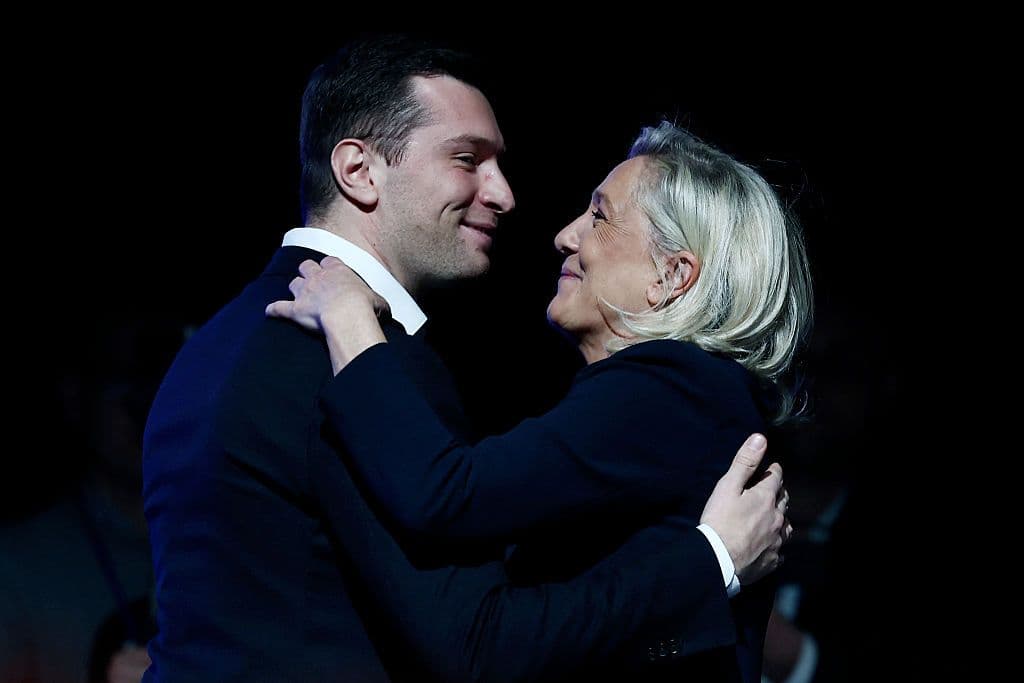
French far-right National Rally party's President Jordan Bardella and the president of the party's parliamentary group Marine Le Pen greet each other during a party rally following the results of the first round of France's 2026 municipal elections, in Chalons-en-Champagne, on March 18, 2026. (Sameer Al-Doumy / AFP via Getty Images)
 on Google
Editor's note: this article was updated to take account of Marine Le Pen's announcement that she would run for president.
BRUSSELS, Belgium — For months, opinion polls have indicated that France's far-right National Rally (RN) is well placed to win the 2027 presidential election, after President Emmanuel Macron reaches his constitutional term limit.
But a court ruling on July 7 upended expectations over who will lead the party's presidential ticket — a decision that could also have implications for Ukraine.
The question centers on Marine Le Pen, the longtime face of the French far right. After a lower court barred her from running over the misuse of European Parliament funds, many expected the RN to rally behind Jordan Bardella, the party's 30-year-old president and a member of the European Parliament, whose popularity has surged in recent years and who consistently polls as one of the strongest contenders for the presidency.
The new ruling removed that legal obstacle, allowing Le Pen to seek the presidency for a fourth time, which she confirmed she would do the evening of the verdict. She remains under a sentence that includes electronic monitoring, however, which she argues would hamper her ability to campaign, and which she intends to challenge.
The rise and stumble of Marine Le Pen
Le Pen inherited her political position from her father, Jean-Marie Le Pen, a far-right Holocaust denier who founded what was then called the National Front.
Marine Le Pen has sought, over the years, to bring her party into the political mainstream by changing its name, shifting its stance on Europe, and softening its rhetoric. She has been largely successful in pulling the party out of the fringe.
When she ran for president in 2012, she placed third, failing to advance to the runoff. In the 2017 and 2022 elections, Le Pen broke through, facing, though in both cases losing, to Macron.
Each time, her share of the vote increased, rising from 33.9% (2017) to 41.45% (2022).
Today, National Rally is the largest single party in France's National Assembly, holding 123 of the chamber's 577 seats. It is also the country's largest delegation in the European Parliament, with 29 of France's 81 members.
But in 2025, Le Pen's political career experienced its biggest setback when she was charged with embezzling European Parliament funds in her time as a member of the European Parliament (MEP).

The original verdict ruled that she could not stand in elections for five years, along with a suspended prison sentence and a fine.
The decision catapulted Bardella into the driver's seat.
The slow turn away from Russia
The far-right in Europe is undergoing a generational shift as young men increasingly throw their support behind parties once considered beyond the political pale.
In France, that shift is represented by Bardella, who works within the political structures of the day rather than against them.
That change began under Marine Le Pen, who transitioned from advocating for France's withdrawal from the EU to leaving only the group of countries using the euro as their currency, and then even watered down that position, all within the space of the 2017 presidential election campaign.
The same has been true of the party's stance on Russia under Le Pen. In the 2010s, she had extensive ties to Moscow, to the point that Russia was even bankrolling her party.
National Rally's Russia-friendly attitude began to fall out of fashion in 2022 after the full-scale invasion.
"We have always condemned Russia's aggression against Ukraine," Le Pen tweeted in June 2026.
Bardella's stated position goes further.
In 2024, he said, "What has happened in Ukraine over the last two years is a real bloodbath. My position has not changed: we must not let an allied country like Ukraine be consumed by Russian imperialism."
Rather than simply wishing for peace talks, as Le Pen has done, he refers to Ukraine as an ally and calls out the imperial nature of Russia's war.
But there are also signs that "President Bardella" could be less of a friend to Ukraine than his public messages before the election suggest.
Bardella has consistently rejected the idea of sending weapons and troops to Ukraine.
Macron, by contrast, positions himself as among Ukraine's most ardent supporters and co-leads the Coalition of the Willing, a group of countries pledging security guarantees to Ukraine once there is a ceasefire.
On July 8, the European Parliament is set to vote on a wide-ranging report, essentially expressing the institution's support for Ukraine, supporting its defense, and its EU membership path.
The draft report passed a first round of committee voting on June 3, but Bardella and his MEP colleagues led the group of those opposed to it.
They argue in a written opinion accompanying the report that it "promotes increasingly unconditional political, financial, and military commitment" to Ukraine.
In particular, they object to what they summarize as "the call to accelerate Ukraine's accession process despite ongoing concerns regarding systemic corruption, governance shortcomings, and rule of law deficiencies."
The report, in fact, covers these topics extensively, congratulating Ukraine for where it has progressed and calling for more to be done where it is lagging behind on reforms.
Every step of Ukraine's EU accession process depends on the unanimity of the 27 EU countries, and it has already been plagued by objections.
But, publicly at least, the French government has yet to adopt a negative outlook on any aspect of Ukraine's membership bid.
An analysis published by the consultancy Forefront Advisers in Brussels immediately after the Le Pen court ruling on July 7 suggests that whether it is Le Pen or Bardella who runs as RN's candidate, they poll almost the same.
Polling to date has shown that both politicians would beat any other challenger, with the possible exception of former French Prime Minister Edouard Philippe, who visited President Volodymyr Zelensky in Kyiv in May.
In a contest against Philippe, half the polls show a narrow victory, and the other half show the exact opposite.
The first round of France's presidential election is expected to take place on April 18, 2027, with a second round runoff forecast for two weeks later, on May 2.