Why have EU sanctions missed the company behind Russia’s tank industry?
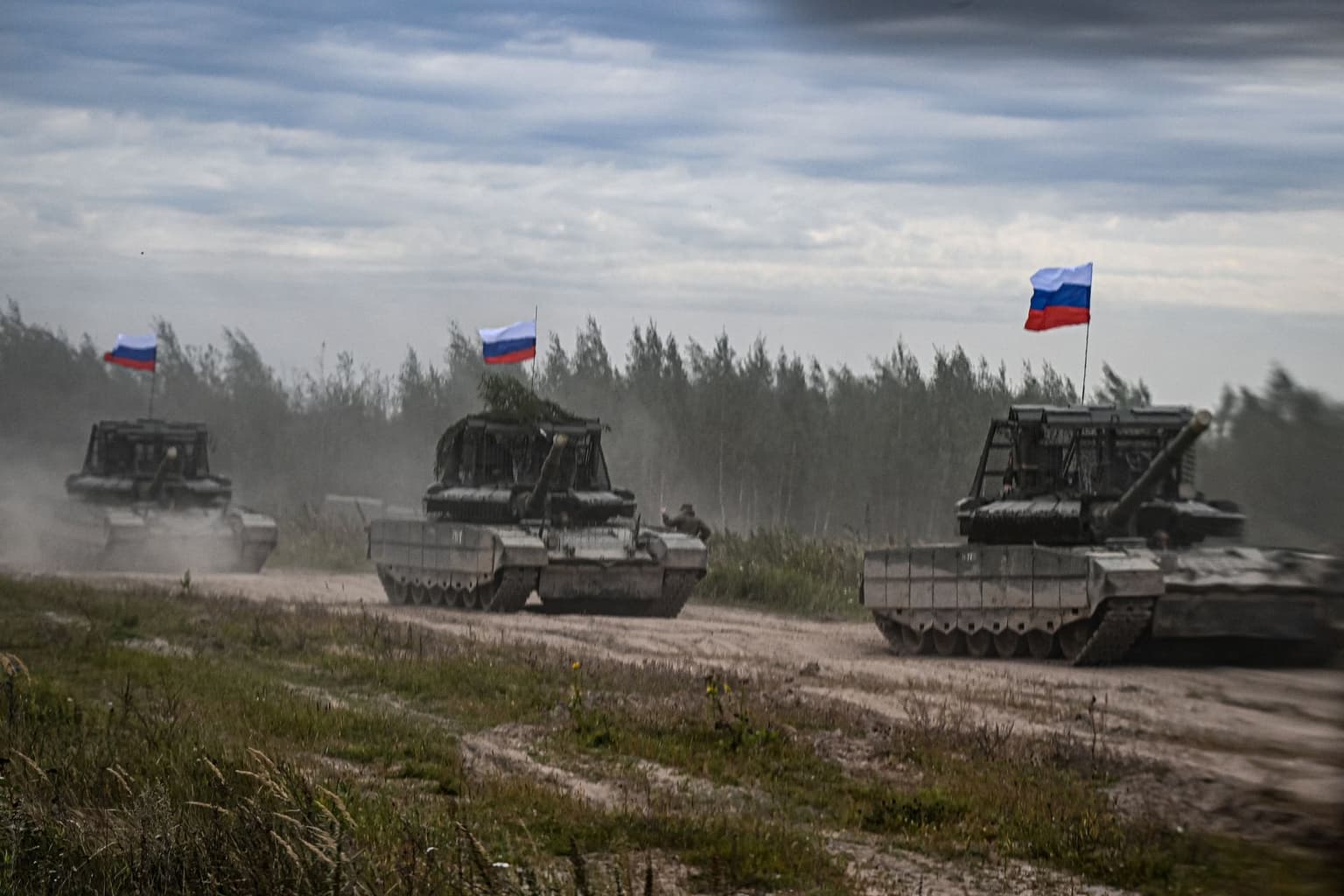
Russian tanks move during the "Zapad-2025" (West-2025) joint Russian-Belarusian military drills at a training ground near Borisov, Belarus, on Sept. 15, 2025. (Olesya Kurpyayeva / AFP via Getty Images)
 on Google
Nezir Sinani
Executive director of the B4Ukraine Coalition
With more than four years of full-scale war and 12 years since Russia first invaded Ukraine, it seems the European Union has developed an extensive arsenal of tools to sanction Moscow, but one problem appears to persist: the visibility problem.
Consider two companies that share a name.
The first is Research and Production Corporation Uralvagonzavod in Nizhny Tagil, Russia's only tank manufacturer. It has been under EU sanctions since March 2022 for supplying the T-72B3 tanks used against Ukraine. Its EU entry names its owner: Rostec, Russia's state defense conglomerate.
The second is Moscow-registered Concern Uralvagonzavod. Since 2020, Russia's company register has listed it as the tank plant's sole executive body, or basically the entity running it. Its chief executive, Aleksandr Potapov, is on the EU sanctions list. Its Moscow address appears in the EU's export-control entry for the plant. When listing a Rostec executive in June 2026, the Council of the EU itself described the Concern as "subject to Union restrictive measures."
Yet the Concern is not named on any EU sanctions list.
"At that pace, the gap would probably close by year 2030 — a remarkably leisurely timetable for a sanctions regime meant to constrain a war already underway."
That matters because of how EU sanctions reach beyond the names on the page. A listing does two things: it freezes a company's assets in the EU and, more importantly for a Russian arms maker with little to freeze in Europe, it bars anyone in the EU from making funds or economic resources available to it: no payments, no supplies, no contracts.
It has long been the law that these prohibitions also cover entities owned or controlled by a listed person. The Council's Best Practices clarified that a stake of 50% or more counts as ownership and that holdings of several listed shareholders are added together.
In March 2026, in EM System (C-84/24), the Court of Justice confirmed that such a stake creates a presumption of ownership or control. One that can be rebutted, but that is the starting point.
The rule, however, is built to reach downwards — to the companies a sanctioned entity owns or controls, yet whether it reaches the company that runs a sanctioned factory is not clear.
The Concern may still be off-limits through a different and less visible route.

Rostec itself is not under an EU asset freeze. It sits instead on a separate list, Annex XIX of Regulation 833/2014, whose ban on transactions extends to companies Rostec owns by more than 50%. Whether that ban covers the Concern, or any other Rostec subsidiary, depends on ownership percentages that nobody outside Russia can check.
Uralvagonzavod's own latest available annual report, dated Aug. 20, 2020, declines to disclose its shareholders, citing a 2019 Russian government resolution that allows companies to withhold such information.
A European supplier is therefore asked to apply an ownership test to data Moscow has made secret — and, if it gets the answer wrong, it has a ready defense: there was no way to know.
The stakes extend beyond one tank maker.
Ukraine's military intelligence service maintains a structure map tracking 553 entities affiliated with Rostec. Of those, 145 (26%) are subject to some form of EU restrictive measure.
Seven of Rostec's eight top-level holding companies — including Russian Helicopters, the Kalashnikov Concern, Technodinamika, High Precision Systems, United Aircraft Corporation, and United Engine Corporation — are individually sanctioned.

An independent investigation by the Independent Anti-Corruption Commission (NAKO), working from a separate dataset of 482 Rostec-linked entities, reached a similar figure: 23%.
The Uralvagonzavod group shows that gap up close. Ukrainian intelligence attributes 32 subsidiaries to it, with 21 not being named on any EU list.
Many are support businesses — catering, workwear, and a hotel, but the unnamed include Chelyabinsk Tractor Plant–Uraltrak, which Ukrainian intelligence identifies as the main producer of engines for T-72, T-90M, and T-14 tanks; a research institute for tracked military vehicles; an armored-vehicle repair plant working under defense ministry contracts; and the design bureau behind the flatcars that carry T-90M tanks.
The EU has added four of the group's companies since 2024. At that pace, the gap would probably close by year 2030 — a remarkably leisurely timetable for a sanctions regime meant to constrain a war already underway.
Each new sanctions package is a negotiated political act, yet ownership rules require no negotiation: they are already the law. They only work, however, if those expected to apply them can see what they are applying them to.
For a workable alternative, Europeans can simply look across the Atlantic. The U.S. Commerce Department's Entity List lets officials add dozens of Rostec-linked companies to an export-control regime without the political weight of a full sanctions designation — a faster instrument used precisely because full designations are slow.
The EU has comparable tools, but it does not use them visibly enough to be trusted by outside observers.

Three steps would fix this.
First, publish what the authorities already know: where the Commission or national competent authorities have assessed that an unlisted entity is owned or controlled by a sanctioned Rostec company, say so — and where Russia withholds the ownership data needed to make that call, treat the secrecy itself as a reason to list the entity by name.
Second, name the companies that run sanctioned plants: management companies such as Concern Uralvagonzavod sit above the factories they control, where the ownership rule offers no transparency, and should be designated directly.
Third, when the next package is drafted, prioritize the defense-critical subsidiaries still missing from the list — starting with the plant that builds Russia's tank engines.
By doing so, the EU can address the contradiction of sanctioning the factory that builds Russia’s tanks while forgetting about the one that actually runs it.
Editor's note: The opinions expressed in the op-ed section are those of the authors and do not purport to reflect the views of the Kyiv Independent.