'We are all used to this' — Inside one of Kyiv’s hardest-hit buildings this winter
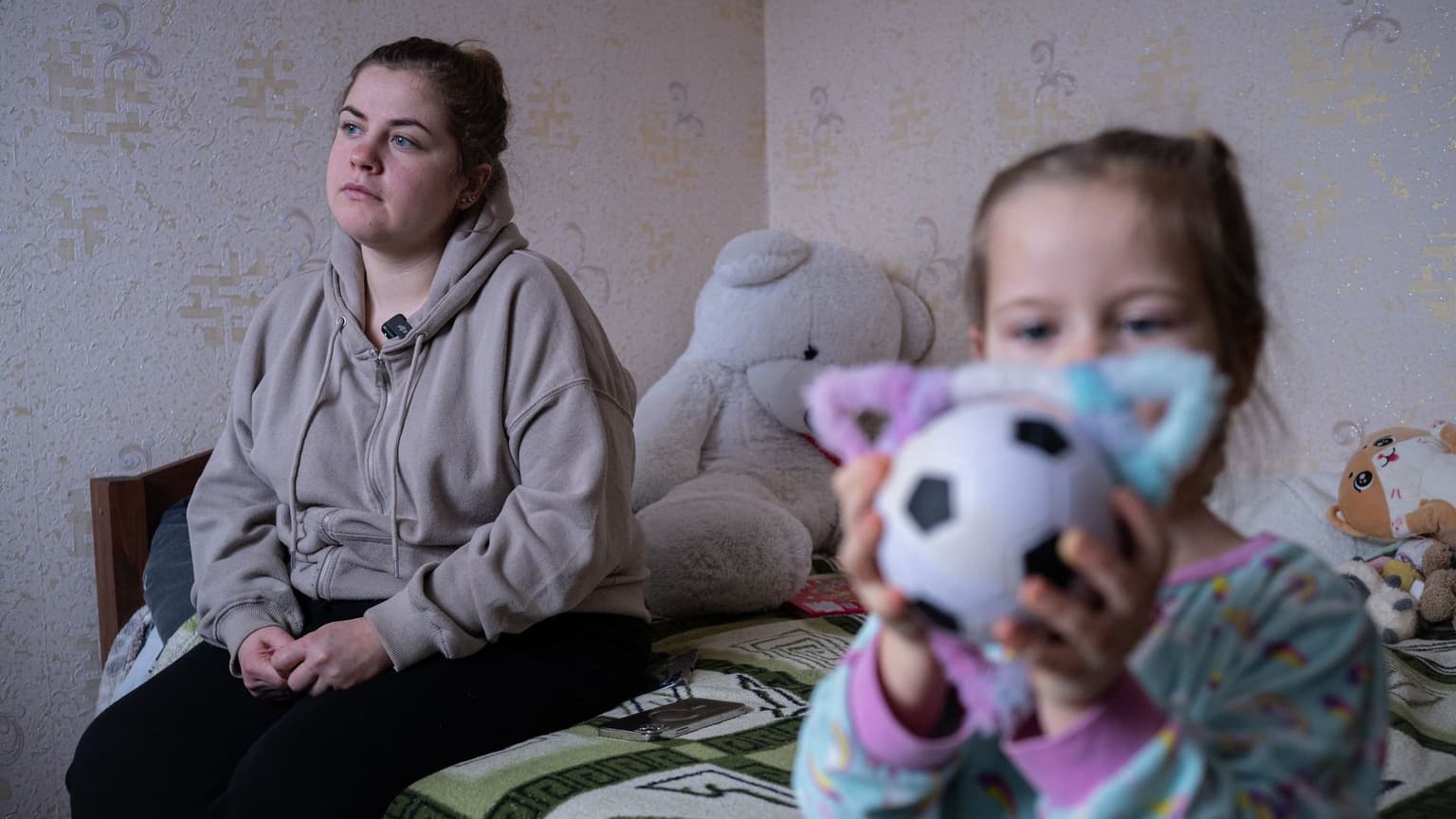
Daria and her daughter Taia in their apartment in Kyiv, Ukraine, on Jan. 27, 2026. (Danylo Antoniuk / The Kyiv Independent)
 on Google
Upon entering Daria’s apartment in a large complex in Rusanivka on Kyiv’s left bank, a faint smell of gas lingers in the cold, dim rooms. After Russia’s attacks on Ukraine’s energy infrastructure cut heat and power across parts of the city, she uses the stove daily to raise the indoor temperature by a couple of degrees, but even then it barely reaches 13 degrees Celsius (55 degrees Fahrenheit).
The warmth comes with consequences.
"We don't want to live in mold. You come in from the street and just smell dampness," says Daria, a young mother, as her toddler, Taia, plays with toys on wet towels covering the windowsill.
Beads of water drip from the ceiling and trickle down nearly every wall. Severe condensation from constant gas use has created ideal conditions for mold to grow and spread. The wallpaper has started peeling, and Daria runs her hand down the wall, and then shows her wet palm.
The conditions inside Daria’s apartment reflect the deteriorating living conditions in her building. The 17-story block, home to hundreds of families, has been without central heating for weeks and fully disconnected from the city’s power grid, relying on a generator that provides only a few hours of electricity each day.
With radiators gone cold for weeks, Ukrainians like Daria are forced to get creative to stay warm in their homes.
More than 1 million residents of Kyiv's left bank continue facing the most adverse conditions in the city, with many living without electricity or heating during the toughest weeks of the year as temperatures regularly plunge below minus 10 degrees Celsius (14 degrees Fahrenheit).


Those outages follow repeated Russian strikes on Ukraine’s energy infrastructure by carrying out mass attacks on Jan. 9, Jan. 20 and Jan. 24, sending the energy sector into a state of emergency.
While the situation is most serious on the left bank, the whole city has been affected: Ukraine's capital continues to endure an energy crisis amid a harsh, cold winter. As of Jan. 29, over 600 residential buildings, mainly on Kyiv’s left bank, remain disconnected from central heating after Russia's attacks. Conditions in thousands of apartments like Daria's have continued to deteriorate as time passes.
"I'm already leaning more towards the fact that, probably, we won't have heating until the end of winter."
"We've been waiting since the ninth (of January). We haven't had heating since then," Daria said. Despite the circumstances, she considers herself lucky compared to those whose apartments have become uninhabitable.
Severe cold is bursting radiators in homes across the city and has damaged Daria's building too. She noticed that this week some apartments above hers had their radiators completely removed.

"I'm already leaning more towards the fact that, probably, we won't have heating until the end of winter," she said with a laugh.
Still, her family has learned to adapt to their new reality. In the kitchen, Daria showed a reporter an unplugged, empty refrigerator and explained that she only prepares dinner for one sitting since there's nowhere to store leftovers.
The balcony has been converted into a makeshift cooler to store milk and fresh produce for a couple of days. Nearby, she also hung up a washing line, but added that clothing takes days to dry.
Without electricity, mundane activities like laundry, cooking, and watching television have become virtually impossible. The building's elevator has not worked for weeks, leaving Taia (the toddler) upset that her "legs hurt" after a seven-story journey up a narrow staircase.
Taia hasn't been attending kindergarten during these challenging weeks. With the generator only able to provide enough energy for light, temperatures inside the classrooms have dropped close to 10 degrees Celsius (50 degrees Fahrenheit), making it too cold for many children to tolerate.

In the upcoming days, another cold wave is expected to hit Ukraine, bringing temperatures to below minus 20 degrees Celsius (minus four degrees Fahrenheit).
Even as residents cope with the cold and outages, Kyiv remains under repeated Russian missile and drone attacks. Daria recalls when, in the autumn, she thought her apartment windows were blown out by a blast wave. After running into Taia's room, she realized it was debris from an apartment above.
Shahed drones struck this neighborhood a couple of days ago, destroying cars and damaging a school nearby. Last November, another drone struck a residential building only a five-minute walk from Daria's house.
Daria does not consider moving abroad to be an option; her entire family, work, and life are based in Kyiv. She's amazed by people's resilience, but can't shake a lingering question.
"Have you ever thought about how strange it is that we are all used to this?"