Washington will give Ukraine's next ambassador little time to learn
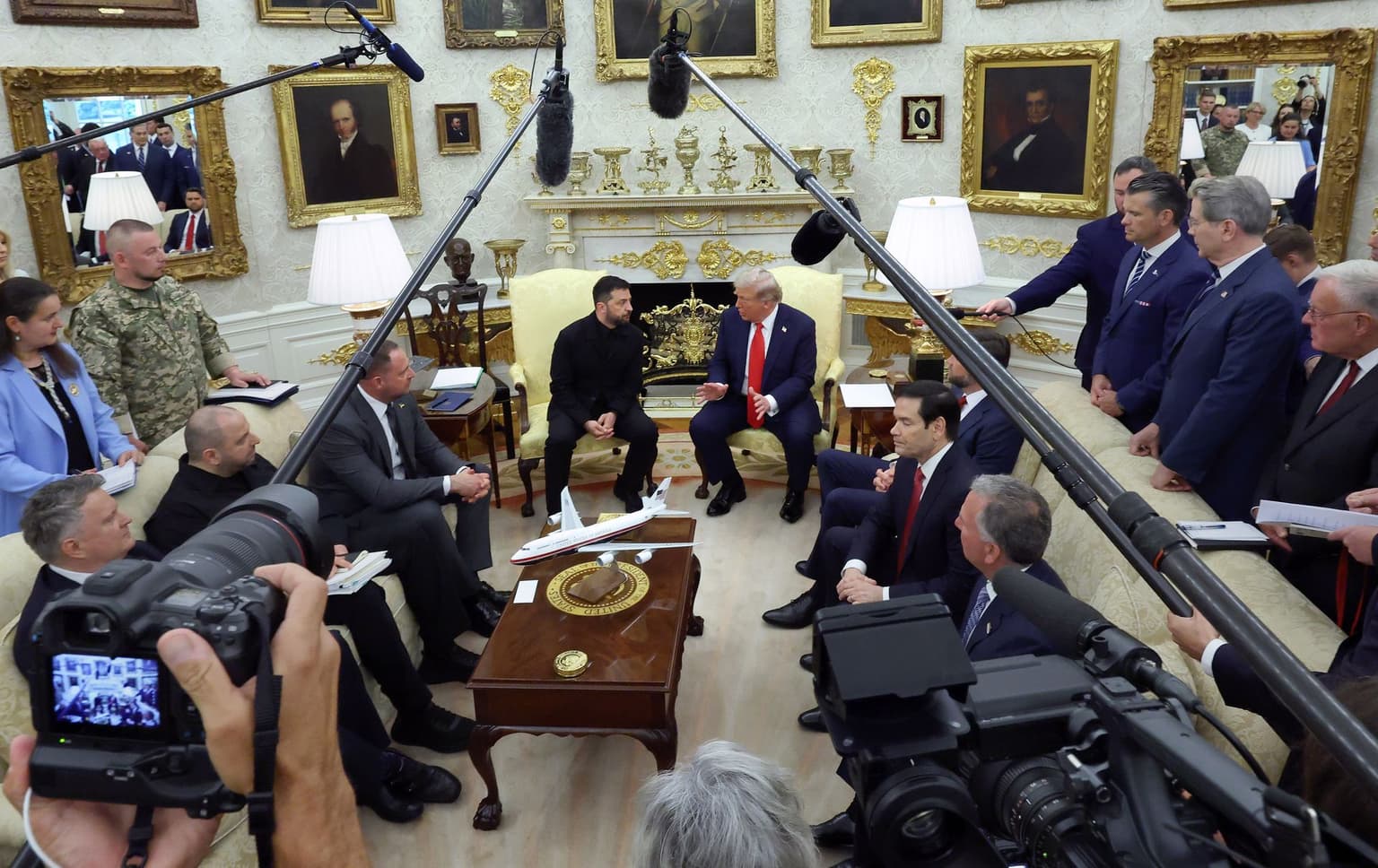
U.S. President Donald Trump (C-R) meets with President Volodymyr Zelensky (C-L) in the Oval Office at the White House in Washington, D.C., U.S. on Aug. 18, 2025. (Anna Moneymaker / Getty Images)
 on Google
Myroslava Gongadze
Foreign policy and security expert
Ukraine has just lost almost a year in Washington that it could not have afforded to lose.
Olha Stefanishyna arrived and departed as Ukraine's ambassador to the United States within that year. Her departure came amid renewed scrutiny from Ukrainian anti-corruption authorities over allegations of illicit enrichment and false asset declarations, which she denies.
Yet the reputational risk was not unforeseeable. Questions surrounding Stefanishyna and corruption investigations were already part of the public discussion before her appointment.
During critical months for Ukraine, rumors fueled an uncomfortable discussion about corruption in Kyiv and gave ammunition to those seeking to undermine U.S. support to Kyiv.
This is not an argument about Stefanishyna personally. She worked during an extraordinarily difficult period in U.S.-Ukraine relations and maintained important relationships in Washington. The larger question is what kind of ambassador Ukraine needs today, and how much credibility and trust matter in strengthening the U.S.-Ukraine relationship.
I learned the difference between title and credibility long before Ukraine was at war.

When I arrived in Washington in 2001, Leonid Kuchma was president, Kostyantyn Hryshchenko was Ukraine's ambassador, and Kyiv-Washington relations were deeply strained. Ukraine was grappling with corruption, political assassinations, democratic backsliding, attacks on press freedom, and uncertainty over its geopolitical direction.
For those of us trying to explain Ukraine to Americans, there was often an uncomfortable distinction between defending Ukraine and defending the Ukrainian government, a tension I came to understand early on.
Over the next quarter century, as a journalist and later working closer to Washington policymaking, I watched ambassadors arrive under different presidents and circumstances.
The most successful understood something fundamental: every ambassador represents a government, but the best ones manage to represent their country.
Oleh Shamshur arrived after the Orange Revolution with a rare advantage: he carried hope after the difficult Kuchma years. Americans wanted to believe that an emerging democratic, European Ukraine was ready to leave its post-Soviet political culture behind.
Got an opinion on anything you've read in the Kyiv Independent so far?
and it may appear in our Letters section.

The doors were open, but an open door is only an opportunity. Shamshur spoke truthfully to his American counterparts and acknowledged mistakes and disagreements inside Kyiv while still making a persuasive case for his government's policies and Ukraine's direction. He was heard because he was believed.
Oksana Markarova offers another lesson. When appointed in 2021, she was not a career diplomat, yet she understood that preparation for Washington begins before you arrive.
I remember meeting Markarova in Kyiv before her appointment. I did not know that her meetings were deliberate preparations for the job. Looking back, I remember someone listening, observing, and building connections. When she arrived, she was prepared and had ideas. She spoke to me about her plans for Ukraine House, a platform reaching beyond traditional diplomacy to government, business, media, culture, and civil society.
Then Russia's full-scale invasion transformed her job.
Markarova had to work across the administration, Congress, media, business, and civil society as American politics around Ukraine became increasingly polarized. Navigating that required diplomatic skill, political instinct, and credibility. Those qualities matter even more today.

Washington is a city where power rarely stays in one place for long. The congressional staffer sitting across from you today may be making policy in the White House tomorrow, a think-tank expert may become an assistant secretary of state, or a little-known member of Congress can become a powerful committee chairman. Sometimes, a first-term senator becomes president.
A smart ambassador, therefore, does not build relationships only at the top.
You talk to Republicans and Democrats, Congress and the administration, people inside government and those temporarily outside it. You talk to journalists, experts, business leaders, and civil society, and you build those relationships when you are not asking for anything. People have to know you before you need them.
Ukraine must also protect something it has spent decades building: bipartisan support.
It cannot afford to become the foreign-policy project of one American party, administration, or political camp. Its ambassador must make Ukraine's case even in rooms skeptical of further assistance.
The policy objectives are concrete: sustaining U.S. military support; expanding defense cooperation, joint production, and investment in Ukrainian defense technology; securing financial support for Ukraine's stability and reconstruction; and building bipartisan backing for stronger economic pressure on Russia and those helping Moscow sustain its war.
The ambassador must explain why these are not favors to Ukraine but investments in American and transatlantic security. That argument must be made to the White House, Congress, American business, the media, and an increasingly skeptical public.
Ukraine's next ambassador cannot spend six months learning Washington. The relationships and credibility should already exist. The person must understand American politics from experience while having enough standing in Kyiv to deliver uncomfortable messages home.
Most of Washington does not expect Ukraine to be perfect, but in this political climate, every mistake Ukraine makes is amplified.
Sometimes an ambassador who can say, "We made a mistake. Here is what happened, and here is how we are correcting it," can do more for Ukraine than someone who reflexively defends every government decision. People here know the difference between an explanation and a talking point.
Diplomatic protocol will provide the title and the meetings, but Washington decides separately whether to trust the person holding that title.
Today, Ukraine cannot afford another year of learning curves or reputational uncertainty, and the next ambassador will inherit one of the hardest diplomatic assignments Ukraine has ever had. The foundations of that work will have to be laid before the credentials are presented in Washington, as the ambassador's effectiveness will depend as much on the relationships and connections already cultivated as on the authority conferred by the post itself.
Editor's note: The opinions expressed in the op-ed section are those of the authors and do not purport to reflect the views of the Kyiv Independent.