Amid Iran war, Ukrainian drone makers fear Zelensky risks missing 'window of opportunity'
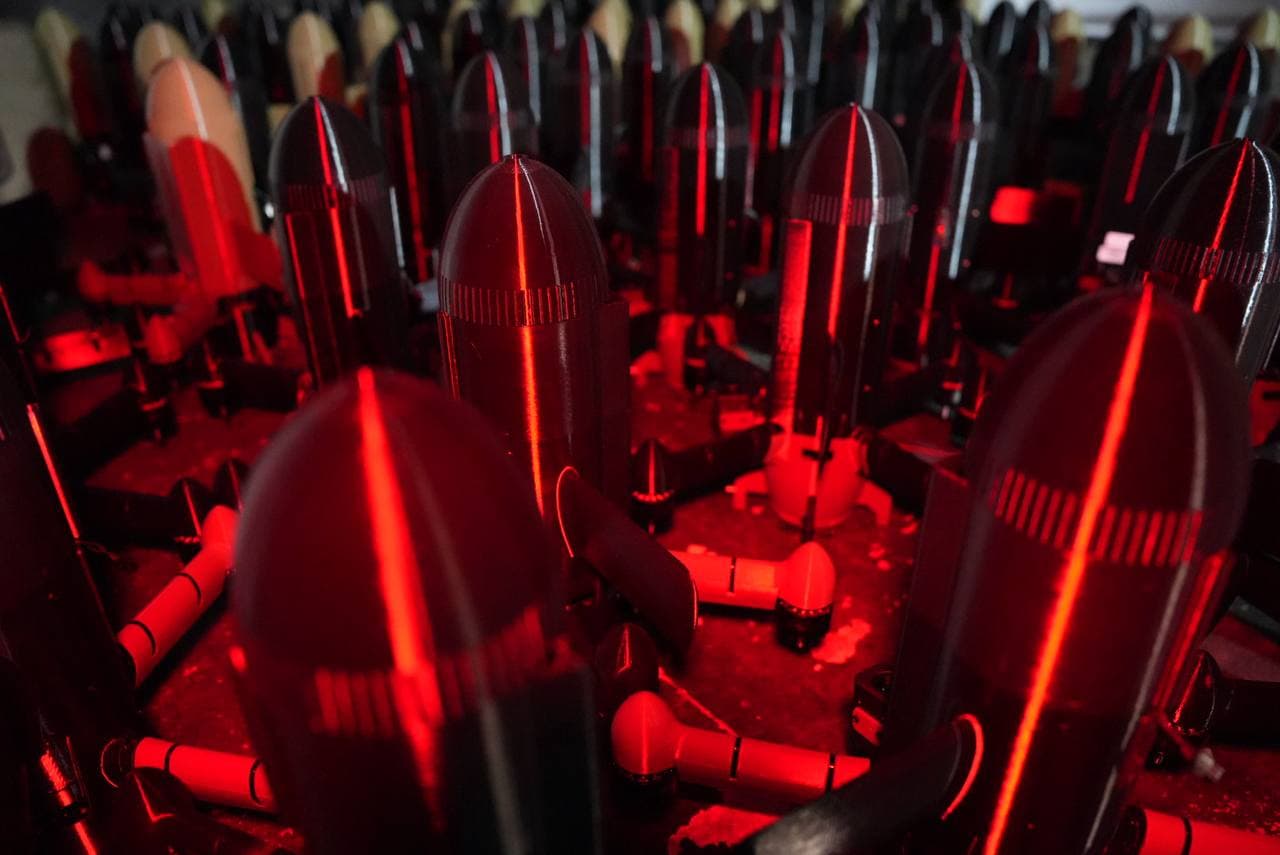
Ukrainian Sting drone interceptors in an undated photo. (Wild Hornets/Telegram)
 on Google
Ukraine’s drone industry is abuzz with anticipation of a deal that would allow them to sell interceptor drones abroad, hoping for the first big relaxation of wartime export restrictions that would finally put their technology in the hands of foreign militaries amid the U.S. war with Iran.
But President Volodymyr Zelensky is seemingly holding out for a deal over PAC-3 missiles, an anti-air munition for Patriot systems that are uniquely good at defending against Russian ballistic attacks.
The result is frustration felt across Ukraine’s defense sector which sees a window of opportunity for sales that is diminishing by the day. Foreign firms are profiting from a wartime boom while Ukrainian companies that built their expertise on the battlefield still aren’t on equal footing in those markets.
"The whole Ukrainian defense tech market, we’ve paid an enormous price — paid with lives, with territory, with five years of full-scale war, twelve overall," Marko Kushnir, director of communications for the General Cherry drone company, told the Kyiv Independent.
"We are hoping that the Ukrainian government and its representatives will be able to find a decent working option."

Drones for missiles
Amid the U.S. war with Iran and the escalating threat from Shahed attack drones, Zelensky is floating Ukrainian interceptors as a possible means of exchange with both the United States and Middle Eastern countries that hold Patriot stocks, telling the New York Times on March 9 that Ukraine was sending soldiers to protect U.S. bases in the Middle East as part of Kyiv’s case that it can offer something in return.
It’s a point U.S. President Donald Trump has been loath to concede.
Negotiations with Israeli Prime Minister Benjamin Netanyahu began on March 16, with Zelensky seemingly framing them as a possible exchange of Ukrainian interceptor drones for additional air defense missiles, potentially including Israel’s older Patriot systems. On March 17, Zelensky announced that Ukraine had already sent 201 anti-Shahed drone specialists to the Middle East.


The moment seems as close as Ukraine has come to selling a major batch of its wartime weapons tech abroad. Since the start of Russia’s full-scale invasion, the Ukrainian government has restricted the export of weaponry.
The restriction makes sense given the desire to send maximum kit to the frontline. But wartime export controls have long been a sticking point for Ukraine’s new generation of ambitious young miltech startups, which see markets booming abroad while the Ukrainian government confines them at home to the Defense Ministry's procurement system, which caps their profits and cannot always buy all they can produce.
With foreign interest in Ukrainian interceptors surging, they fear the current window may not stay open for long.
"Now we have this window of opportunity to enter the American market and work with America more fruitfully," Kushnir said.
General Cherry is one of the largest drone makers in the country. They are one of several Ukrainian drone companies competing in the U.S. Pentagon’s "Drone Dominance" program, a fast-track Pentagon program to buy a new fleet of kamikaze drones, in the hopes of earning a seat at the table of future War Department drone purchases.
"Certainly we liked this program a lot, and we're waiting on similar programs for interceptors. Seems to us that from the perspective of interceptors we can definitely showcase our quality," Kushnir continued.
As to whether that window of opportunity would close, Kushnir was confident.
"100%," Kushnir said. "’When' is a difficult question, but I think that there's not all that much time. One way or another American companies will catch up with us."
One of the most conspicuous winners from the Ukrainian market is Merops, an American interceptor project by former Google CEO Eric Schmidt that has gotten extensive testing in Ukraine. Merops interceptors are reportedly already on their way to the Middle East.

Ukrainian drone makers contacted by the Kyiv Independent remained stoic about exports remaining blocked off, but unanimous in noting a surge of interest in their interceptors. The Defense Ministry had not returned a request for comment as of press time.
"The question of exports is complicated, and pretty unsettled, but we see that the president and the Defense Ministry are trying to move in this direction," said Kushnir. "We welcome these steps and hope that we can see some results in the near future."
”For now there are no new regulations," Oleh Tsilvik, acting head of Ukraine’s State Service for Export Control of Ukraine, told the Kyiv Independent. As to export of interceptors in particular, "I have seen no such permits," Tsilvik said.
It’s a long-running standoff. But the tension is at fever pitch amid what Kushnir called a "definite boom” in interest from the Persian Gulf and other countries of the Middle East who find themselves under Shahed attacks.
That interest has resulted in new products hitting the Ukrainian market. For one example, Moto-G, a Ukrainian electric motor manufacturer, announced on March 11 that they are launching a new model specifically for interceptor drones.
Moto-G CEO Oleksiy Grebin told the Kyiv Independent that the firm is not yet producing these ultra-fast motors at scale but plans to start proper mass production in April.
Another project is Wild Hornets, which makes the "Sting," maybe the highest volume of all Ukrainian interceptor drones. Would-be buyers are currently reaching out to them "constantly," according to a representative who asked not to be named out of security concerns.

"We’re focusing on providing to the Armed Forces of Ukraine," the representative told the Kyiv Independent, saying that any negotiations are happening at the level of the federal government and that Wild Hornets currently has no plans to sell any of their wares abroad.
Oleksandr Yakovenko is the founder of TAF Industries, which makes between 60,000 and 80,000 drones per month. Their biggest seller is an FPV called the Kolibri, but they also make the TAF-I10 interceptor, and are one of multiple licensed producers of the Octopus interceptor, to which the Defense Ministry owns the rights.
These days, Yakovenko is focused on building out the company’s future business in Europe and the U.S., knowing that the mass of FPVs that the Ukrainian front demands is not a sustainable post-war business model.
"Of course that won’t survive. It’s impossible, I realize," Yakovenko told the Kyiv Independent. "Because of that we have in our plans co-engineering with an American company, that is a joint R&D center, which will produce new products.
"As in, we’ll go from being a company that mass produces to being a company that manufactures and tests unique solutions that we then make in limited series in a subscription format.
"60,000 to 80,000 drones to the front won’t be necessary. But 100,000 drones in a warehouse that you upgrade every half-year with new telemetry and software etc. — that’s a model," Yakovenko said.
A global surge in weapons purchases and defense stocks outside of Ukraine is currently passing by Ukrainian producers.
"Rheinmetall and KNDS have a ton of orders and their stock prices have grown by a factor of ten, but as soon as the active military activities in Ukraine end, those stock prices will go down," said Yakovenko.