Ukraine Business Roundup — After Russian strikes, Kyiv gets back to work
 on Google
Editor's note: The following is the May 26, 2026 edition of our Ukraine Business Roundup weekly newsletter. To get the biggest news in business and tech from Ukraine directly in your inbox, subscribe here.
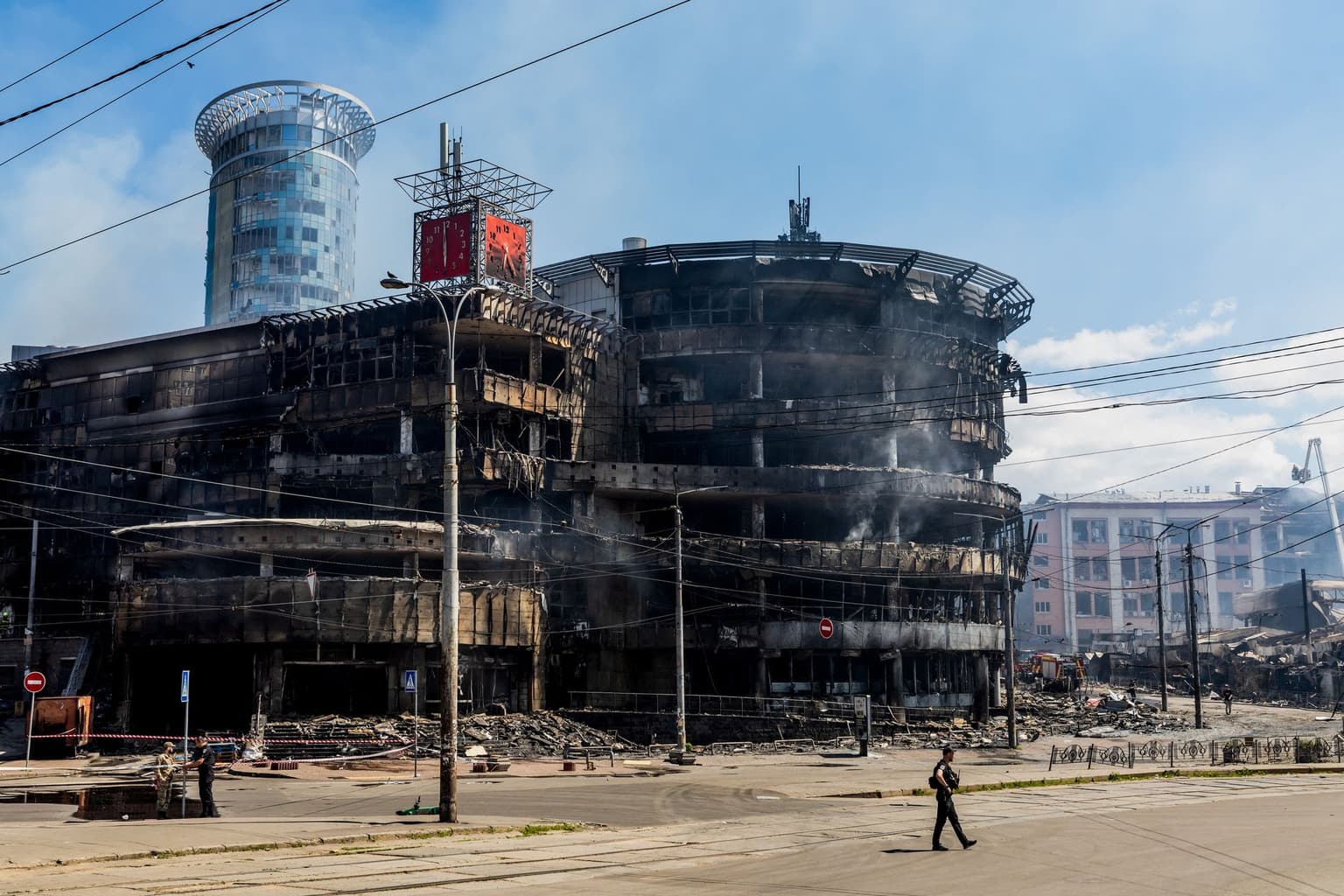
The city is still reeling from what was one of the biggest attacks — if not the biggest — against Kyiv since the start of the full-scale invasion last Saturday. Russia launched 90 missiles and 600 drones targeting mainly Kyiv and the surrounding region, causing damage to what Mayor Vitali Klitshchko said was "every district of the city."
Indeed, while all of Russia's deadly attacks cause destruction and death across the city each time, this one was remarkable for just the sheer amount of buildings, businesses, and cultural institutions — especially in the center — that were either directly hit by missiles and drones or damaged by the blast wave.
It was hard to keep up with all the reports of what had been hit. Blown-out windows and glass on sidewalks could be seen everywhere around the center for the next couple of days.
In one of the largest of the strikes that night, a missile struck and destroyed the Kvadrat shopping mall and neighboring Lukianivskyi market in the city's Lukianivka neighborhood. The area hit was also home to the first McDonald's to ever open in Ukraine. Photos of the famous golden arches melting but still hanging on circulated on social media the following day.
The Podil district suffered heavy damage. A central district with pedestrianized streets and parks, the area has hundreds of shops and restaurants popular among Kyiv residents. That night, a cruise missile hit the Chornobyl Museum — its blastwave damaging numerous buildings and businesses around it.

Cultural centers also took a heavy hit in the overnight raid. The Kyiv Opera Theater (not to be confused with the National Opera of Ukraine), also located in Podil, was forced to postpone a performance of the ballet "Thumbelina" due to damage to the building, it said on May 24.
The Lobanovskyi Football Stadium, the National Philharmonic, Ukraine House (a cultural center), and the National Art Museum of Ukraine were also damaged in the attack.
The apartment building — the infamous luxury high-rise at 9A Hrushevskoho St. — where wiretaps involving Ukrainian President Volodymyr Zelensky’s business partner Timur Mindich and other associates were recorded, and which later led to charges in the ongoing corruption case, was also hit in the attack, apparently by falling debris.
Despite the shattered windows and little sleep, some businesses refused to be deterred, opening their doors the very next morning, serving customers while they still cleaned up the debris.
Yevhen Prusak, a 35-year-old co-owner of Hogo café in Kyiv’s Podil district, told the Kyiv Independent at the scene that the café had opened just a day before the attack and was badly damaged.
"I heard a missile fly right over my head, and that woke me up instantly. Almost immediately, I got a message from my alarm system saying the windows (of the coffee shop) had been blown out," Prusak said. People lined up all day and into the next day at Hugo to buy coffee and sweets as a show of support, even as the coffee shop was full of broken glass and debris.

Zavertailo, an upmarket cafe chain in Kyiv, also suffered damage from the strike at its Podil location. The attack coincided with their preparations to open a new location in another part of the city the next day.
"All the windows are shattered, and the frames are bent beyond repair — they’ll have to be replaced," Stanislav Zavertailo, 46, co-owner of the popular Zavertailo and Honey chains, told the Kyiv Independent at the scene.
"But at least the walls held. They cracked along the seams, but they’re still standing. We’re trying to stay positive," he added.
I’ll add my own personal anecdotes to the mix. The morning after the attack, I had a hair appointment. On the way there, my cab driver told me his apartment windows had been blown out — but that he still decided to go out and work "to take the edge off."
My hairstylist’s building, in the same neighborhood, was also hit in the attack, but he brushed it off by saying it was "only the top three floors" and that his apartment hadn't been affected by the blast. When I said we could have cancelled, he waved me away and said, "Oh, no, it's totally fine."
I’m not going to launch into a long reflection on how resilient Ukrainians are in the face of such devastating and terrifying attacks. But herein lies the challenge: How to convey that life goes on, that people wake up, rebuild, and reopen businesses the next day, that there is normality despite the war, without normalizing what Russia is doing?
Ahead of the Ukraine Recovery Conference in Gdansk, where businesses will again gather to talk about investing in Ukraine after the war, I will be thinking a lot about this question.
From where I’m sitting, the war does not look like it will end any time soon — and for those who really want to do business in Ukraine, it probably means learning to live with the uncertainty and risks that Ukrainians live with and power through every day.
The roundup: What else is happening this week
1. Ukraine developing new low-cost missiles to down Russian Shahed-type drones. The country plans to increase production of the missiles "tenfold" and build up additional stockpiles for the fall and winter season, Defense Minister Mykhailo Fedorov said.
2. Fire Point developing a cheaper analogue of the Patriot air defense system, co-owner says. Denys Shtilierman said the Freya system, built with international partners, could see its first interceptions by the end of 2026.
3. Denmark denies 'put on ice' claims made by Fire Point co-owner. The construction of a Fire Point rocket fuel factory in Denmark has not been put on hold, the Danish government told the Kyiv Independent, despite claims made by the company's co-owner and chief designer.
4. Dragon Capital and Amber plan to increase Ukraine recovery funds to 1.3 billion euros. The investment firm has already raised about 600 million euros and aims to expand it by 2027, Dragon Capital CEO Tomas Fiala said.
5. Polish marketplace Allegro preparing to enter the Ukrainian market in June. "We are observing a clear trend towards the growth of cross-border e-commerce and increased interest from foreign customers, particularly from Ukraine," the company said.
6. Germany's Merz proposes radical EU membership shakeup to give hope to Ukraine, Moldova, Western Balkans. German Chancellor Friedrich Merz called on EU leaders to discuss a new status for Ukraine and other candidate countries to maintain momentum until they become full members of the bloc.
7. Kazakhstan will not enforce $1.4 billion Naftogaz arbitration award against Gazprom, Justice Ministry says. The decision follows an Astana International Financial Center ruling that upheld a Swiss ICC arbitration award in favor of Naftogaz.
8. Court of Appeal upholds $3 billion ruling against PrivatBank’s former owners Kolomoisky and Boholiubov. The court confirmed the original High Court decision finding them liable for large-scale fraud and damages owed to the bank.
9. Ukraine’s wheat exports projected to rebound sharply in the 2026–27 marketing year. SovEcon, a consultancy, expects shipments to rise to 21.2 million metric tons from 13.2 million due to high carryover stocks, warning that larger supplies could weigh on global grain prices.
10. The IMF to begin first review of new Ukraine loan program this week. The International Monetary Fund mission is expected to arrive in Kyiv on May 27, to assess the four-year $8.1 billion Extended Fund Facility, Finance Minister Serhiy Marchenko said.
Opinion

When the world watches a country enduring unprecedented historical trials, the expectation is usually that every effort will be consumed by basic survival — that the machinery of government will be running on fumes just to hold itself together.
In Ukraine, we are challenging that expectation by, in the midst of the largest armed conflict in Europe since World War II, not merely keeping our institutions afloat, but fundamentally reimagining what they are — making them more agile and more responsive to people's actual lives.
The urgency to act fast and effectively has swept away the old bureaucracy.
In its place, Ukraine has become a world-class GovTech laboratory. We are now moving beyond the traditional concept of a digital state, pioneering a new model we call the Agentic State — a proactive, AI-powered government.
This transformation rests on three foundational pillars: a revolution in public services, the active development of human capital, and adaptive regulation.
Read the full op-ed by Valeriia Koval, deputy digital transformation minister of Ukraine here.
Events
Online
Roundtable: Better legislation — less corruption? What does tax approximation to the EU give Ukraine? A Center for Economic Strategy discussion on Ukraine’s tax alignment with the EU and its impact on corruption, bureaucracy, and business regulation. Details: June 4, 2:00–5:30 p.m. Zoom. Register here.
Ukraine’s new corruption crisis: Mindichgate 2.0. A hybrid KI Insights monthly briefing examining corruption perceptions, the state of anti-corruption institutions, and ongoing reform efforts in Ukraine. Details: May 28. 6 p.m Kyiv time. Kyiv/online. Subscribers only. Register here.
Kyiv & elsewhere in Ukraine
UA Energy — International Exhibition and Conference on Ukraine’s Sustainable Energy Recovery. The event will gather policymakers, investors, financial institutions, and technology leaders with the aim of advancing a modern, independent, and more secure energy system in Ukraine. Details: May 12–14, Kyiv. Register here.
Ukraine Financing Forum. An in-person forum bringing together international financial institutions, investors, and Ukrainian corporates to discuss how capital is being deployed in Ukraine and how to scale investment for recovery and growth. Details: May 20. Kyiv. Register here.
V Foreign Investment Congress. An event bringing together global investors, businesses, and officials to support private investment in Ukraine’s recovery. Details: May 28–29, Kyiv. Register here. The Kyiv Independent will be a media partner at the event, and readers of this newsletter get a 10% discount using the promo code 2X3NP5.
Around the world
Ukraine Recovery Conference (URC 2026). A hybrid international conference focused on mobilizing support for Ukraine’s reconstruction and unlocking investment opportunities for Ukrainian businesses across key sectors. Details: June 25–26. Gdansk. More details here.
Thank you for reading! If you're enjoying this newsletter, please consider becoming a member of the Kyiv Independent for as little as $5 a month. We don't have a wealthy owner and are able to be independent because of our community of over 29,000 readers.