The Russian language is no longer neutral
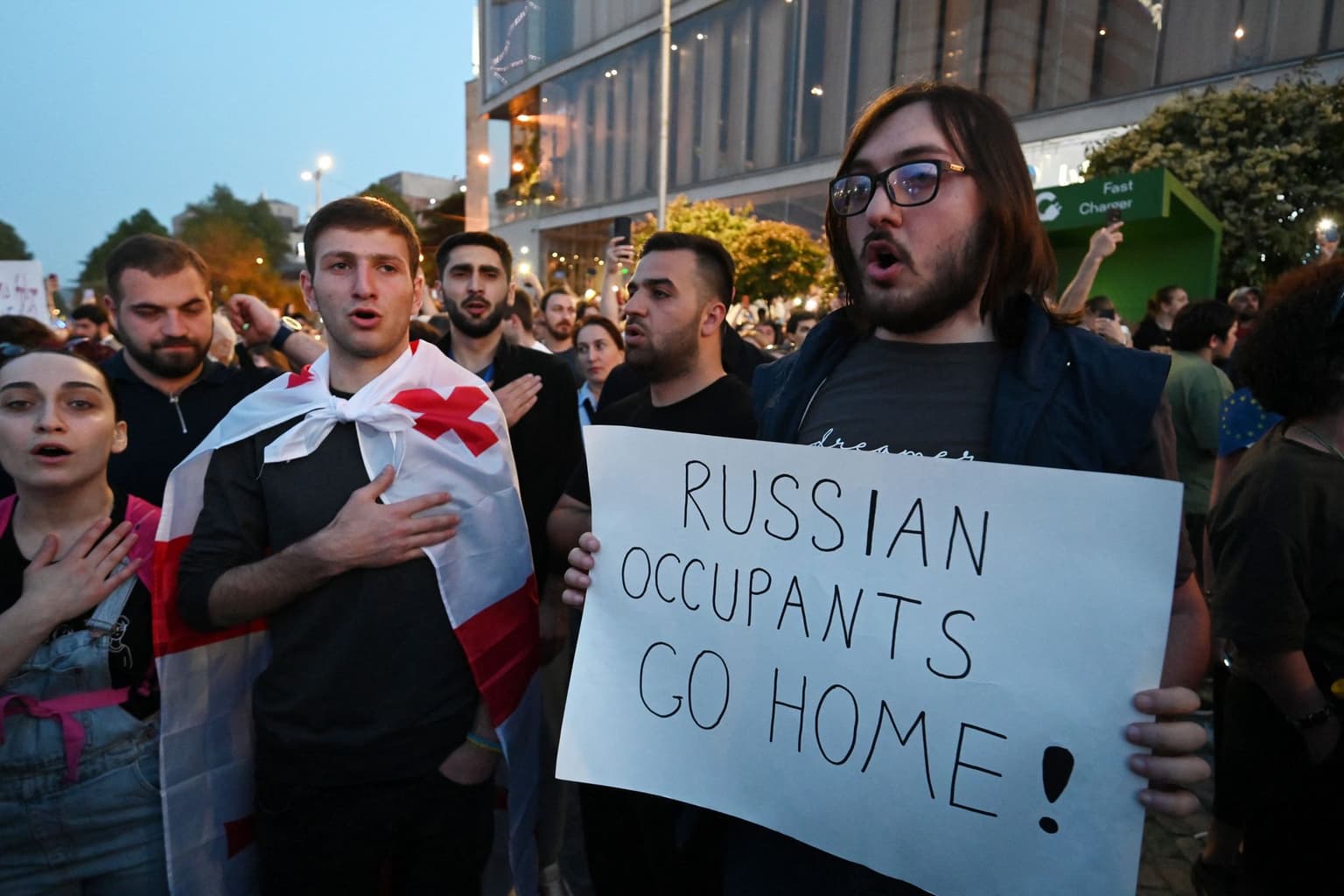
A man holds a placard during a protest against a controversial "foreign influence" bill in Tbilisi, Georgia, on April 28, 2024. (Vano Shlamov / AFP / Getty Images)
 on Google
Archil Jangirashvili
Georgian lawyer and academic
In the first year following Russia's war against Ukraine, a significant number of Russian citizens left the Russian Federation. Georgia, particularly the cities of Tbilisi and Batumi, became a key destination for many of them.
Their arrival was not marginal or gradual. Within a short period, tens of thousands of Russian citizens relocated to Georgia, while thousands registered businesses and purchased property. In 2023 alone, Russian citizens registered around 13,000 legal entities in Georgia. The speed of this process is critical to understanding its implications.
Such rapid integration into economic life would not have been possible without a certain degree of state tolerance, if not facilitation. At the same time, Georgian society raised legitimate questions: Who exactly was entering the country? Did the relevant security institutions possess sufficient information about individuals acquiring property and launching businesses on such a scale?
While Russians label this reaction as hostility, these questions are rather logical if you account for the general unease about security, transparency, and political context in Georgia.
However, rather than addressing these concerns through clear communication or institutional safeguards, the Georgian state largely avoided engaging with them at all. Instead, government representatives frequently described criticism surrounding the mass arrival of Russians as "ethnic discrimination" and accused the opposition of fueling anti-Russian sentiment.
More strikingly, the Georgian authorities pressured private banks and companies that required Russian clients to acknowledge Russia's occupation of Georgian territories or recognize the war in Ukraine as Russian aggression.
The government showed little concern for how relations between Georgian society and Russian newcomers would evolve.
Those arriving in Georgia encountered a public space already shaped by the war in Ukraine. Across Tbilisi, Ukrainian flags were prominently displayed — on restaurants, cafes, and even residential balconies, as visible expressions of solidarity with Ukraine. In the streets, slogans such as "Russian warship, go f*ck yourself" reflected a broader public sentiment that was impossible to ignore.
Beyond these political and emotional signals, many Russian arrivals faced a more practical challenge: language.
Tensions surrounding language soon appeared in everyday interactions. Local and international media documented cases in which newly arrived Russians expected Georgians to communicate with them in Russian, while many younger Georgians either could not speak the language at all or consciously chose not to use it. In some cases, these encounters became symbolic of a broader cultural and political divide between countries once extremely close to each other.


The post–Rose Revolution generation in Georgia has largely grown up without Russian as a primary language. For many younger Georgians, Russian is neither intuitive nor culturally embedded.
In contemporary Georgia — particularly in its capital — Russian no longer functions as a natural or dominant language of everyday interaction. It has, to a considerable extent, lost its place as an organic component of cultural life.
This does not mean that Russian has disappeared from public use; in some sectors, such as tourism or services, it still persists as part of economic pragmatism. But other than that, why would you learn Russian in Georgia today?
The Russian ability to compete with English has simply significantly diminished.
It would be both misleading and naive to claim that politics has played no role in the reassessment of the Russian language in Georgia. The transformation that followed the Rose Revolution in 2003 involved a broader effort to redefine the country's geopolitical orientation and overcome the legacy of Russian dominance.
This process was about breaking through a long-standing condition of isolation.
Moving away from the Soviet sphere required political and economic reforms. As Georgia moved closer to Western institutions and markets, English increasingly replaced Russian as the language associated with education, technology, business, and international opportunity.
For younger generations in particular, integration with the West was experienced not only through politics, but also through language, media, and professional aspirations. When pollsters asked Georgians which foreign language should be mandatory in schools, only 5% named Russian. For the vast majority, the answer was English.
Language, in this context, was part of the infrastructure of integration. As the Russian imperial legacy weakened, so too did the language's natural role in everyday life.
In Ukraine, however, the question of the Russian language is a crucial element of Russian coercion, where it becomes a matter of power.
Moscow has repeatedly invoked the protection of Russian speakers as a justification for political pressure and, ultimately, military intervention.
For post-Soviet countries, the central issue is not whether individuals should be free to speak Russian. Rather, it is whether sovereign societies should be allowed to determine their own linguistic and cultural trajectory without external pressure or political coercion.
This also raises a broader question for Western policymakers. If language is treated as a neutral issue while being used as a tool of coercion, responses risk misdiagnosing the nature of influence in the post-Soviet space.
If a language no longer provides access to knowledge, innovation, or global integration, but is still enforced or defended beyond its borders, its function has already changed. Russia is no great power any longer, nor an innovation engine or economic superhouse.
And Ukraine today stands as the clearest example of what happens when language is no longer allowed to evolve naturally but is instead imposed as part of a broader strategy of control.
Editor's note: The opinions expressed in the op-ed section are those of the authors and do not purport to reflect the views of the Kyiv Independent.