The drone war is becoming a race to adapt, rather than perfect
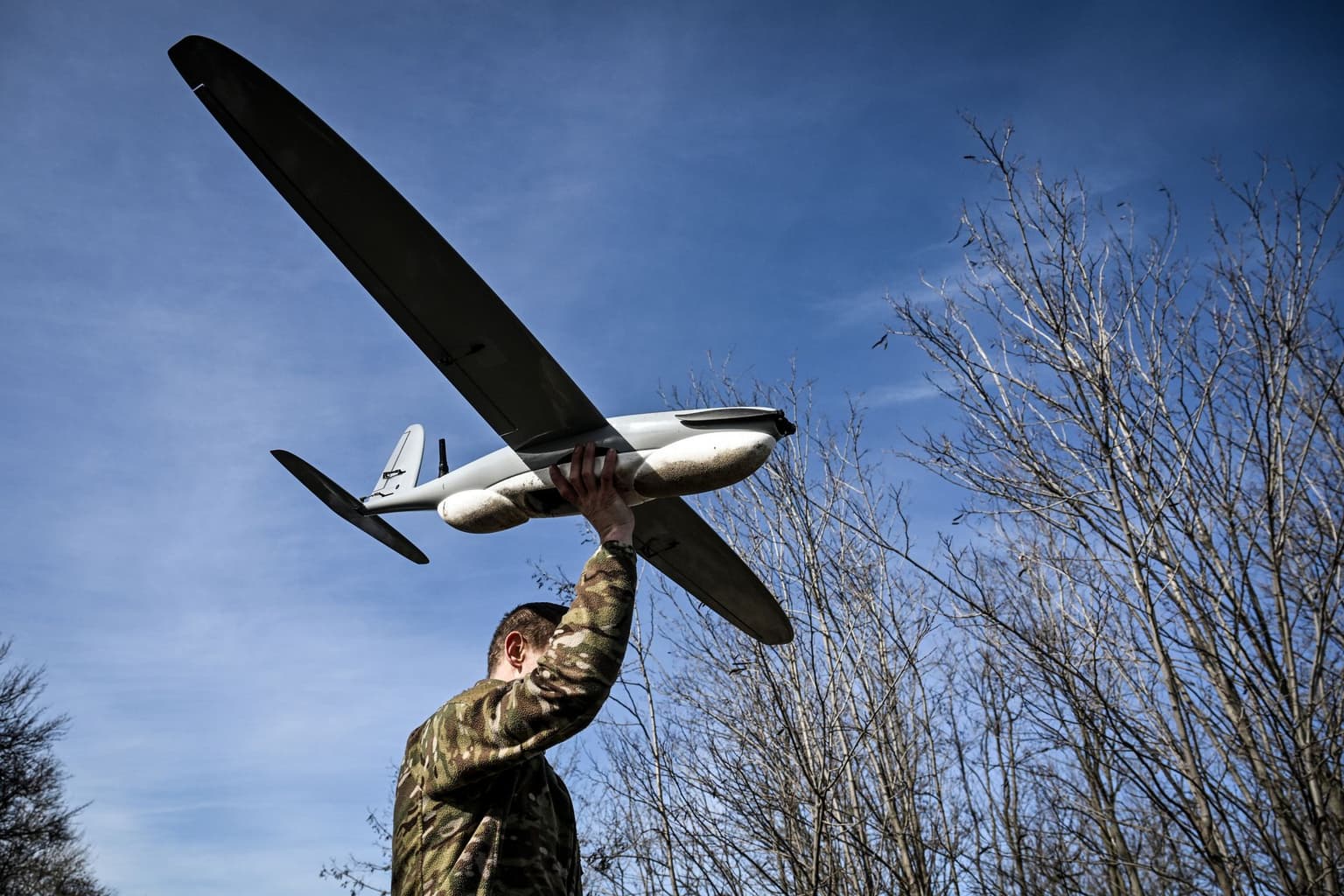
A soldier launches an RQ-35 Heidrun drone used for reconnaissance and artillery fire correction in the Zaporizhzhia direction in Ukraine, on Feb. 22, 2026. (Dmytro Smolienko / Ukrinform / NurPhoto via Getty Images)
 on Google
Robert Brull
CEO of FibreCoat
You don't need to have followed the Ukraine war closely to recognize the central role that drones have played in the conflict.
As I write, the Russian e-commerce giant Ozon is reeling following a third day of long-range drone strikes— an indication not only of the significance of drones, but also of how the drone war has evolved.
At the start of the war, such an attack was impossible; now, as of summer 2026, drones shape almost every act as part of wider systems. But readers of this publication will know that.
What relatively few onlookers outside of Ukraine recognize is the way in which every drone innovation on one side of the conflict has prompted innovation on the other. Ukrainian recon drones led Russia to pursue jamming and short-range air defense innovation; Russian improvements in electronic warfare and air cover led to the use of expendable quadcopters by Ukraine.
On and on in this vein the war has proceeded, all the way to where we are now, where drones are mass-produced, often by 3D printers for expediency, and long-range drones are routinely flying deep into enemy territory to target oil refineries, logistics hubs, and ostensibly civilian businesses seen to be supporting the Russian war effort.
Now Russia is responding with increasingly advanced air defense systems and spoofing technology. And that has brought into focus new and increasingly sophisticated forms of technology that can protect enough long-range drones (protecting all of them is next to impossible) that some are able to penetrate those Russian defenses and carry out their missions.
Chief among these, perhaps, is chaff, a relatively old technology that has recently been brought into the 21st century.
Used on military aircraft and warships since World War II, chaff is in effect a radar countermeasure typically made of tiny aluminum-coated glass fibers.
When dispensed, it forms a large, reflective cloud or fog in which each individual glass fiber reflects a radio frequency.
These resonate, confusing enemy radar, blinding ground systems, spamming false signals, and tricking radar-guided missiles into going for the wrong target. They can create massive uncertainty across even sophisticated radar systems and make decision-making difficult. They also impose a financial cost: enemies waste ammunition aiming at the wrong target.
But technology itself is not the most important thing. Innovation, at least by itself, is not the most important thing, either. The decisive factor in Ukraine, and it will be the decisive factor in all modern conflicts, is the ability to innovate at speed.
Warfare has become a competition to learn and apply what you learn fastest. Ukraine builds a new drone; Russia replies with drone countermeasures; Ukraine tweaks the drone to overcome those countermeasures; Russia tweaks its counter-countermeasures. A system that takes ten years to develop risks becoming useless before it's even out in the field.

Why does this matter? Because wider Europe is rearming. And there's an important lesson here. The present and the future of war are being decided not by the large, established contractors who produce a small number of highly expensive platforms able to last decades, but by smaller, more adaptable, fast-moving companies.
Indeed, the use of 3D printers in Ukraine points very clearly to what matters: pragmatism, flexibility, mobility, modularity, cost-efficiency, and, of course, efficacy.
In Ukraine, technology is designed, built, sent into the field, and used; and operators on the front line then feed back to the manufacturers, who redesign the technology, rebuild it, and send it into the field to be used.
It's a virtuous, if lethal, cycle of innovation, one in which iteration is continuous and "good enough for now" is the aim of the game. You could say that this is the ultimate free market of ideas, where the most useful solutions are adopted, and those that don't are not. The Ukrainians are picking and choosing the best products for their goals in a constantly evolving marketplace.
My view is that Europe has an opportunity to support its friends in Ukraine while testing out new technologies.
It could replicate the Ukrainian model of innovation, bolster Ukraine's armed forces, and use its battlefield as a live innovation engine: testing its systems, allowing them to break, then improving them at speed.
Indeed, assuming there was Ukrainian approval, Europe should consider allocating a portion of its budget towards battlefield testing.
At the very least, we should be more humble in how we think about modern warfare and seek to learn the many lessons that have been learned so painfully by Ukraine in its attempt to hold off their Russian aggressors.
First among these is that the aim of the game is to adapt, not perfect: to iterate quickly rather than build complex systems slowly. New chaff innovations may be the latest chapter in this technological contest. But it won't certainly be the last.
Editor's note: The opinions expressed in the op-ed section are those of the authors and do not purport to reflect the views of the Kyiv Independent.