Telecoms giant Kyivstar wants a seat in Ukraine's driverless car revolution
 on Google
Ukraine's most popular ride-hailing service wants to conquer the global robotaxi race.
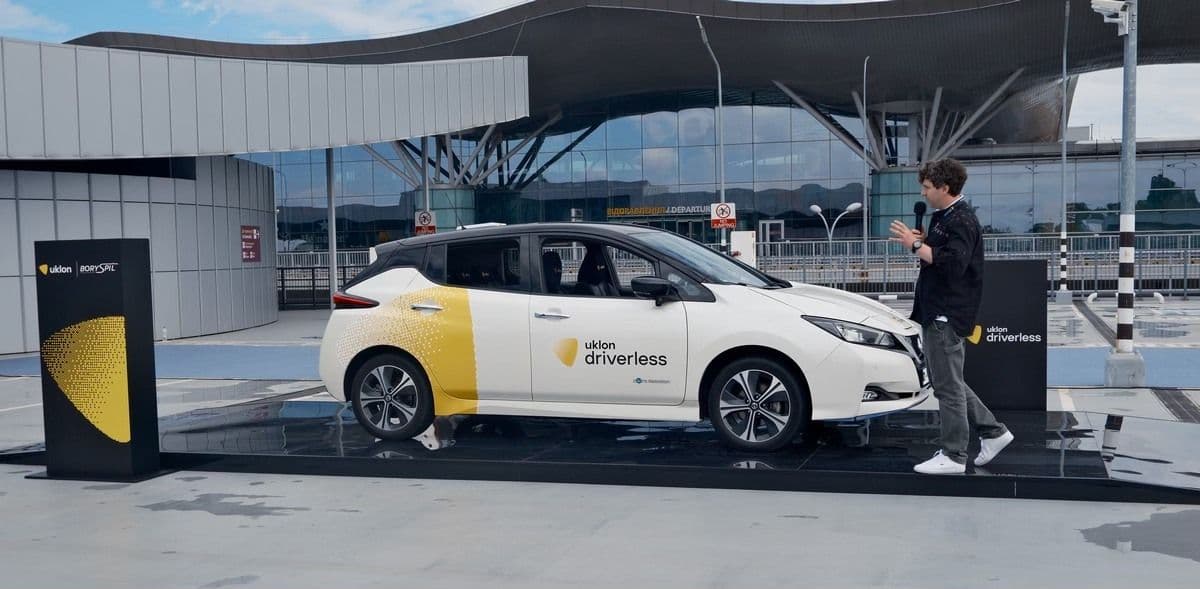
Uklon, owned by Ukraine's telecoms giant Kyivstar, gathered journalists, executives, and policymakers at Kyiv's shuttered Boryspil airport on May 27 to showcase the remote-driving technology the company is testing — and one day hopes to bring to the streets of Kyiv.
"We want Ukraine to be the best in Europe for self-driving cars," Uklon CEO, Serhiy Hryshkov, told the crowd in a sleek ceremony, during which he warned of the U.S. and Chinese headstart.
"This is what pushed us to start this technology, otherwise we’ll be catching up," he said at the pristine airport, which looks ready to begin operations, despite being closed since the start of Russia's full-scale invasion in 2022 and having no open date in sight amid ongoing threats.
Remote driving entails a human operator who pilots the vehicle from afar. It's seen as a bridge towards full autonomy at some point in the future, as the technology develops, regulation catches up, and public acceptance grows.
While a few global hotspots are leading the way in the remote driving race, there is still room to compete. Already a global leader in tech before the full-scale invasion, Ukraine will likely be able to take advantage of the AI and autonomous technology boom that is unfolding in the country, as it is forced to constantly innovate to keep Russia at bay on the battlefield.
Still in the testing phase and not yet road legal in Ukraine, Uklon is partnering with Boryspil airport to test the technology. The company held the event to get the conversation started in the country and galvanize support for legislative changes needed to make the cars a reality.
Uklon is working with parent company, the recently Nasdaq-listed Kyivstar, which operates the network used to connect the car to the driver, as well as Elmo, an Estonian remote driving company, which provides the "brain" behind the operation, according to co-founder Tuuli Tolmats-Aia.
Tolmats-Aia explained the technology to the Kyiv Independent in a bomb shelter at the airport — after a supersonic missile-capable Russian MIG jet took off, triggering a fifty-minute air raid alert.
"We add Elmo technology into the car, which includes a computer the size of a sandwich box, wiring, and cameras. The car then has a direct network link to the driving station elsewhere," she said.

Elmo uses many networks in parallel, including Starlink, 5G, 4G, 3G, and even radiolink, to ensure that the vehicle is always connected to drivers — some of whom were present at the event.
"Initially, I didn’t believe this job was possible for me. It was like something out of a sci-fi movie,” said Dmytro, a veteran who lost both his legs in the full-scale invasion.
"For me, it’s an opportunity to go back to the front line," Dmytro said, eliciting a big round of applause from the audience.
While the civilian side of the technology was in the spotlight, the use case for Ukraine's front line is obvious. Elmo is already deploying their technology in eastern Ukraine, under the military branch of the company.
When it comes to the war, another question on the mind of some spectators was the issues posed by jamming and electronic warfare — a daily nuisance for Ukrainian residents whose maps at times show them in entirely different countries or time zones.
"A stable connection is the foundation of remote driving technology, which is why we utilize multiple communication sources to guarantee uninterrupted data transmission. Electronic warfare and GPS jamming primarily affect navigation rather than vehicle control," Uklon said in a statement to the Kyiv Independent.

"Our system does not rely on GPS. Instead, it operates based on live video feeds from cameras and operator commands."
The technology is still a long way from being on the streets of Kyiv. While Elmo’s remote driving technology has been road legal in Estonia since 2022, and other European countries such as Germany are developing regulations for the sector, no regulation currently exists in Ukraine, according to Tolmats-Aia.
Representatives from the Economy Ministry, Digital Transformation Ministry, and the Kyiv City State Administration who were present at the event were upbeat, expressing enthusiasm and a sense of urgency at getting the regulation on the road.
"The development of such solutions is critically important for the country’s technological sovereignty and economic development," said Oleksandr Borniakov, acting digital transformation minister of Ukraine.
"We would be glad to cooperate with private business and welcome companies that are ready to test and scale innovative technologies together with us."