Kyiv's historic market sits nearly empty after upscale food court makeover
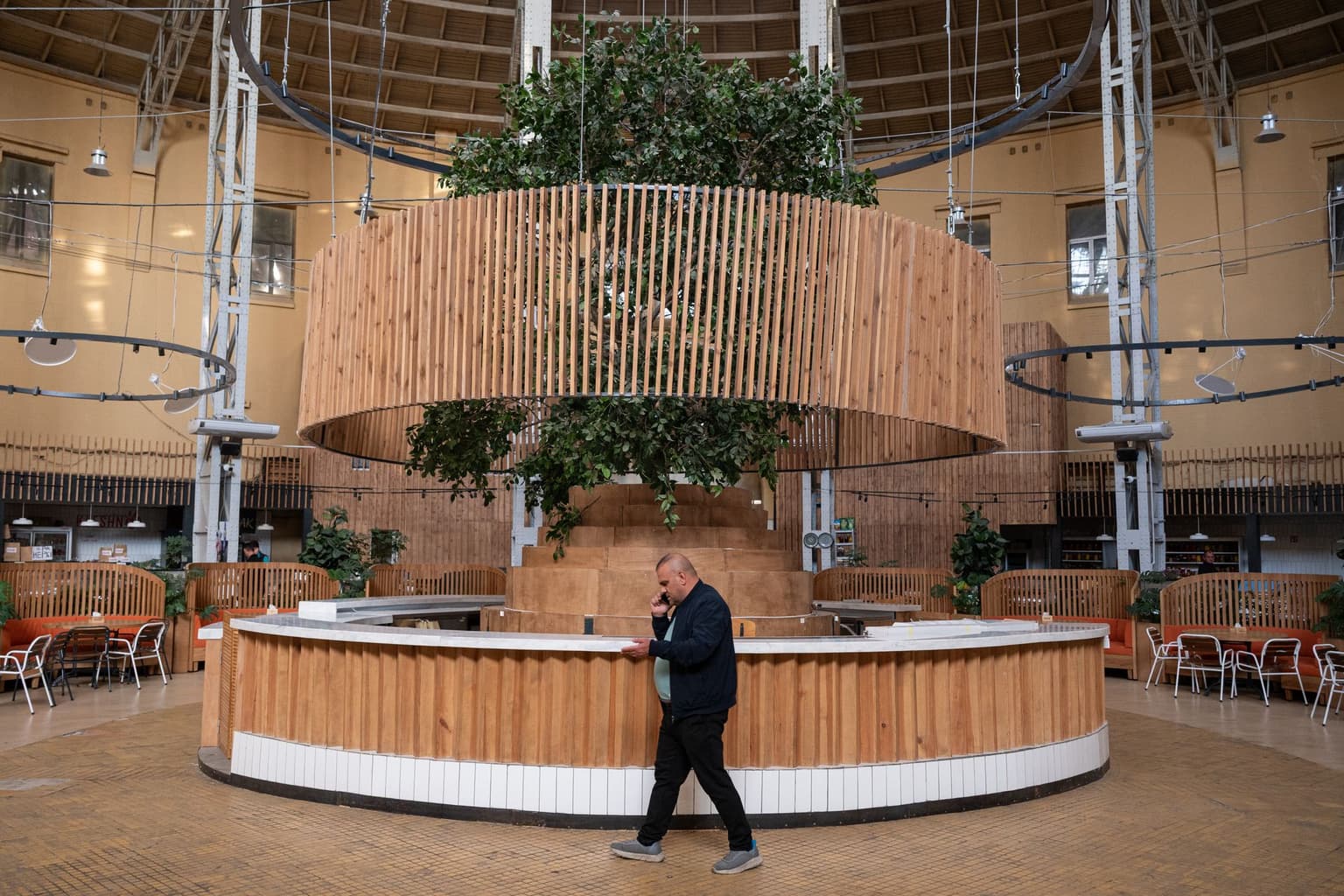
A man walks past a closed bar at the Bessarabskyi Market in Kyiv, Ukraine on Oct. 6, 2026. (Danylo Antoniuk/ The Kyiv Independent)
 on Google
Bessarabskyi Market has stood in Kyiv for 114 years. Its upscale makeover lasted less than one.
Less than a year after the late-2025 reopening, most of the restaurants are gone, and the hall is quieter than before the renovation.
Before the makeover, Bessarabskyi was a labyrinth of produce stalls, offering everything from churchkhela — a sweet from the Caucasus — and watermelons from southern Ukraine to pigs' feet and sauerkraut craft beer.
But by the end of 2025, the maze of vendors had shrunk and been partly replaced by a cocktail bar, a performance stage, and 17 new food and drink stalls ranging from a sushi bar to an Indian restaurant.
Today, Bessarabskyi has one eatery left — a fast food chain called Big Mama. The stall sits in a row of identical tiled stalls with wooden countertops, freshly built and all but one shuttered.
The project — which looked to replicate the success of the popular Kyiv Food Market — is nothing short of a failure. In early June 2026, Natalia Dzhulai left her post as manager of the $3.5 million project, and 15 of the new eateries have closed, leaving only a coffee shop and a fast food chain still standing. Natalia Dzhulai refused to provide a comment to the Kyiv Independent as she is no longer part of the project.

Bessarabskyi’s transformation is part of a wider trend. Across Europe, developers have sought to turn grocery markets into profitable food courts. But in wartime Ukraine, the reality of changing a historic market and piece of Kyiv’s heritage into a trendy food court proved more difficult than developers expected.
Why did the food court fail?
Ihor Kravets, an architectural researcher who has been vocal about Bessarabskyi’s renovation, believes that the food court may have been successful had it been launched in 2019.
"Were it not for the blackouts caused by constant attacks, the general emotional exhaustion of the public, and the growing financial constraints facing consumers — the food court could have continued operating despite the other disadvantages."
The wider economy is also strained. Mobilization and the 3 million people who have fled Ukraine have created a shortage of 2.5 million workers in Ukraine’s economy, according to the European Bank for Reconstruction and Development. In March 2026 alone, 300 Kyiv food and drink establishments closed, according to Olga Nasonova, who runs a restaurant consulting business in Ukraine.
But Bessarabskyi’s renovation faced obstacles beyond its wartime circumstances.
Before the opening, the renovation was met with heavy criticism for its lack of transparency. As a municipal enterprise, the renovation needed to be a city-led project, but the public was not shown what the food court would look like. The developers and project managers sought no input from the community, and even to this day it is still unclear who the architect behind the food court actually is.

"The criticism (of the project) started before the opening, and after it the outcry only got stronger, so the operator started from a minus," said Pavlo Peker, an architect who pioneered the project to protect Kyiv’s historic Zhytnyi Market from a similar food court renovation.
Peker attributes the failure of the food court at least in part to the lack of public involvement: "The failure…could’ve been predicted…People don’t like that…Kyivans were just not a part of the process…so the people behind the Bessarabskyi project didn’t really know what the project needed," he said.
The lack of research meant the renovation ended up replicating what already existed nearby, but at higher prices and lower quality. Kravets said. "This was particularly off-putting given the venue's environment: unbearably stuffy in the summer and plagued by icy drafts in the winter."
"Kyivans were just not a part of the process…so the people behind the Bessarabskyi project didn’t really know what the project needed."


In the winter of 2025, Kyiv endured record-breaking cold and blackouts brought on by Russian attacks so severe that Mayor Vitali Klitschko urged those who could to leave the capital.
Some of Bessarabskyi’s new tenants felt that the impossible task of heating Bessarabskyi, a vast brick building with high ceilings, multiple entrances and a heritage status that restricts structural modifications, was the reason the food court lost customers.
"The winter started and it’s impossible to warm a place like Bessarabskyi, so customers stopped coming, and gradually stalls started to close," said Ruslan Kravchenko, the owner of Big Mama. Kravchenko would likely have also had to close up shop, had Big Mama not had a branch nearby with which it could share resources.
Kravchenko’s stall is surrounded by empty seating for the few and far between customers and a new stage added during the renovation.
While Kravchenko was speaking about the lack of customers, a shirtless man holding a plastic beer bottle clambered onto the stage added during the renovation, which after the reopening hosted live music and even a Q&A with former Foreign Minister Dmytro Kuleba but has not held a performance in months. The man’s shouts echoed across the empty building as he was removed from the building by police.

Above the stall, a slideshow of photographs of old Kyiv play on a 2x2 meter screen: Khreshchatyk as a dusty road for carts and horses, Kyiv’s center made up of two-story buildings — and, of course, Bessarabskyi bustling with customers.
Bessarabskyi today couldn't be further away from the one in the photographs.
Even without competitors, Big Mama may soon have to close. "When there were other restaurants, customers would bring their friends, and that would drive business, but now it’s difficult," said Kravchenko.
What does this mean for Bessarabskyi’s produce market?
Although the eateries at Bessarabskyi have proved to be short-lived, more of the produce vendors have remained.
Natalia Vorovyoba is one of two remaining fresh fruit vendors at Bessarabskyi and, like many of the remaining produce vendors, has worked at Bessarabskyi for almost three decades. The renovation, which many hoped would drive profits, made Bessarabskyi unrecognizable, she said.
"The bar in the middle of the market…makes no sense for a grocery market,."
Vorovyoba has managed to remain at Bessarabskyi despite business declining over the years. She now fears that the renovation may have dealt the fatal blow and that she may soon have to leave.

"When I first started working at Bessarabskyi, there were so many people there was barely anywhere to stand. I could sell 60 kilograms of strawberries at once, but there are days now when I don’t get any customers," Vorovyoba explained.
While Natalia Dzhulai, the manager of the food court project, promised that 50 grocery vendors would stay at the market — 90% of the number pre-renovation — now only a handful remain.
"They didn’t tell us what it was going to look like — they said only half of it would be taken by the food market, but you can see it’s clearly more than half," Vorovyoba said.
The future of Kyiv’s grocery markets is uncertain. Some, like Peker, are optimistic that this is just another chapter in Bessarabskyi's history, while others, like Kravets, are less so.
"It’s a very worrying situation. Potential investors have been scared off. The priceless historic building has fallen into neglect, and it’s unclear who will fund its upkeep," Kravets said.

But in some ways Bessarabskyi’s produce vendors are lucky to have survived the market's development at all. Other projects to turn markets into more profitable venues threaten to change the site altogether.
Demiivskyi Market in Kyiv is set to be torn down completely and will be the site of a new 30-story building which will be built by Manhattan Invest.
Other markets in Kyiv have become the sites of Russian attacks. In Kyiv in 2026 alone, Russia destroyed both the Lukianivskyi Market and the massive book and flea market on Pochaina in two separate and direct strikes.