'It means more than any medal' — Ukraine's skeleton racer sacrifices Olympic dream to honor war victims
 on Google
Editor's note: This story has been updated to reflect details on the Court of Arbitration for Sport's ruling on Feb. 13, which upheld the disqualification.
Wearing a helmet commemorating Ukrainian athletes killed by Russia is not allowed, the International Olympic Committee (IOC) ruled on Feb. 12.
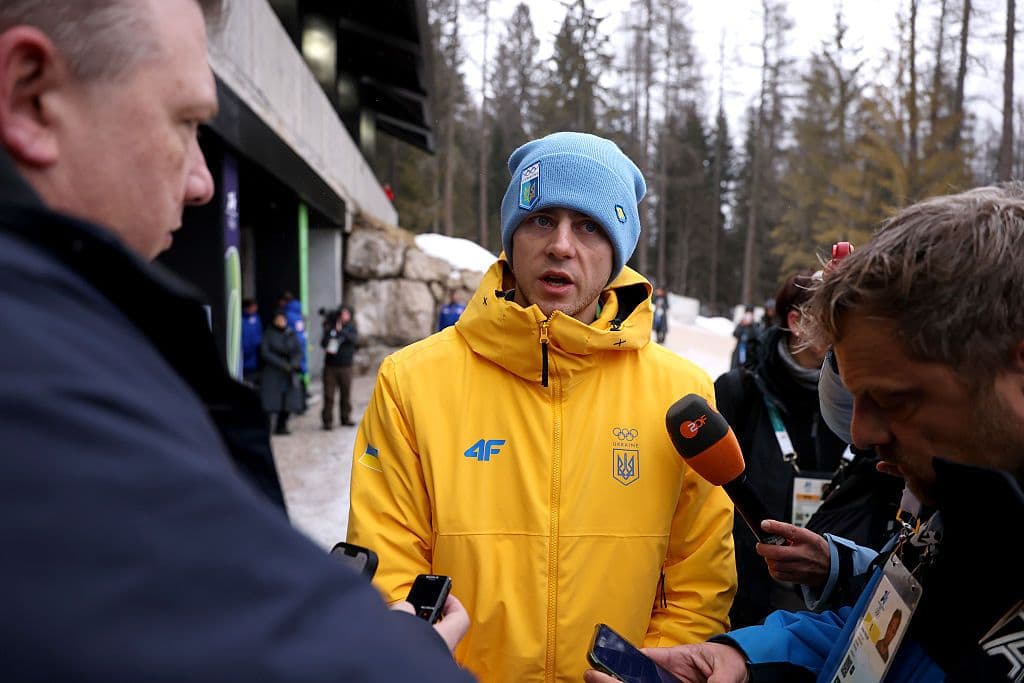
Vladyslav Heraskevych, Ukraine's skeleton racer, was scheduled to compete in his third Olympic Games on Feb. 12. He was barred from taking part in the competition after refusing to change his helmet, one depicting the faces of Ukrainian athletes killed during Russia's full-scale invasion.
The IOC and the International Bobsleigh and Skeleton Federation (IBSF) ruled that the tribute violated competition rules, bringing his Olympic stint to an abrupt end.
"This is the price of our dignity," Heraskevych, 27, wrote on Instagram after being informed — a few hours before his Olympic run — that he had been disqualified.
On the eve of the competition, Heraskevych told the Kyiv Independent that he had been approached by a third party and urged not to stage any demonstrations in support of Ukraine at the Winter Olympics in Italy — a request he believed may have come from the IOC.
It did not deter him. The helmet at the center of the controversy depicted more than 20 Ukrainian athletes killed in the war. Among them are former competitors who left their sporting careers to join the Ukrainian Armed Forces, as well as civilians killed in Russian attacks. Some were children, at the very start of their careers.
"For me, the sacrifice of the people depicted on the helmet means more than any medal — because they gave the most precious thing they had," Heraskevych said.
"Plain, simple respect for them is exactly what I wanted to give."

Heraskevych believed he had not violated Rule 50.2 of the Olympic Charter, which bans demonstrations or political, religious, or racial propaganda at Olympic venues. No slogans or chants were depicted on the equipment piece banned by the Olympic Committee.
The ban set off a ripple effect, as other Ukrainian athletes joined the line wearing gloves with the phrase "remembrance is not a violation." The spontaneous display soon grew into a flash mob, with Ukrainian soldiers and public figures adding their support for Heraskevych.
At the same time, other Ukrainian athletes have spoken out about similar restrictions imposed by the IOC.
Freestyle skier Kateryna Kotsar said she was barred from wearing a helmet that depicted the following words: "Be brave like Ukrainians." Likewise, short-track speed skater Oleh Handei said he was prohibited from wearing a helmet that read — "where there is heroism, there can be no final defeat" — a verse written by the renowned Ukrainian poet Lina Kostenko.
"(Organizers) banned it, saying it was a political slogan, about war, and it was not allowed," Handei told Ukrainian public broadcaster Suspilne.
Expressing his disagreement with the IOC's position on social media, Heraskevych pointed to several similar instances at the 2026 Olympics in which athletes honored the memory of the deceased without facing punishment.
At the opening ceremony, Israeli skeleton racer Jared Firestone honored the memory of those lost at the 1972 Munich Games by wearing a kippah inscribed with the names of the athletes and coaches who were killed.
American figure skater Maxim Naumov paid tribute to his own family after his performance. He held his childhood photo depicting him and his parents, who died in a 2025 plane crash. Canadian skier Jessica Linton also carried a personal message on her helmet, "I ski for Brayden," and displayed it to the cameras after her run, likely in memory of moguls skier Brayden Kuroda, who passed away in 2020.
Heraskevych slammed the IOC's stance as a glaring case of "double standards" and continued to wear his helmet during official training sessions. Yet, he never wore it during an official race.
In the Feb. 12 statement, the IOC cited a breach of its Athlete Expression guidelines as the reason for barring the Ukrainian athlete from competing. The committee also said Heraskevych's case was distinct, describing it as a deliberate and premeditated act, in contrast to the "spontaneous" expressions seen from other athletes at the 2026 Olympics.
"If everyone is allowed to express themselves in that way, beyond a black armband, it could turn the field of play into a field of expression," Mark Adams, IOC spokesperson, said during a press briefing on Feb. 12.
"And even if one agrees or disagrees with the sentiments, you can see how that could lead to a chaotic situation," he added.
The committee also said that it had offered Heraskevych alternatives, such as wearing a black armband and displaying his helmet before and after the race, but the athlete rejected these proposals.
"No one is disagreeing with the messaging. The messaging is a powerful message of remembrance, it is a message of memory, and no one is disagreeing with that," IOC President Kirsty Coventry told journalists on Feb. 12.

"Sadly, we have not been able to come to that solution. I really wanted to see him race today. It has been an emotional morning."
Vadym Guttsait, president of Ukraine's National Olympic Committee, told the Kyiv Independent that the entire Ukrainian team supported Heraskevych's actions and did not expect him to be suspended.
Ukraine's political leaders also expressed their support for Heraskevych in wake of the IOC's decision, with President Volodymyr Zelensky thanking Heraskevych for his "clear stance."
"His helmet, bearing the portraits of fallen Ukrainian athletes, is about honor and remembrance. It is a reminder to the whole world of what Russian aggression is and the cost of fighting for independence. And in this, no rule has been broken," Zelensky said.
Foreign Minister Andrii Sybiha echoed similar comments, calling the incident a "moment of shame."
"The IOC has banned not the Ukrainian athlete, but its own reputation," Sybiha added.
Heraskevych's team appealed the IOC's decision in an international arbitration court. The case was brought before the Court of Arbitration for Sport, which handles disputes related to the Olympic Games.
In a ruling on Feb. 13, the Court of Arbitration for Sport in Milan dismissed Heraskevych's appeal, upholding the disqualification, ruling that Heraskevych's gestures violated competition rules.
Despite siding with the IOC's decision, the unnamed arbitrator said she was "fully sympathetic to Mr. Heraskevych's commemoration and his attempt to raise awareness for the grief and devastation suffered by the Ukrainian people, and Ukrainian athletes because of the war."
Jeremy Pizzi, legal advisor at Global Rights Compliance, said that the disqualification of the Ukrainian athlete is not the only issue at play in this case.
"The real problem is the inconsistencies between the IOC permitting Russian athletes to compete when they violated neutrality rules with pro-war actions and allowing athletes to compete with a Russian flag," Pizzi told the Kyiv Independent.
"This raises the question of why one form of expression to support victims of aggression is banned, but other expressions supporting brutal crimes are not."
According to the Kyiv Independent's sources on the ground, on the day of his disqualification, Heraskevych left the Olympic Village, even though the IOC had allowed him to remain at the venues, albeit without competing.
"I did not break any rules. I defended the interests of Ukraine — not just the country, but the memory of these athletes. They deserve it," Heraskevych said before leaving the Olympic village.