Help us keep bringing the truth to light, even when Russia turns the lights out.

Shop and support
News Feed

Expert: Russia sent over 8,300 Ukrainian children to 're-education camps' in 2023

• 1 min read
Expert: Russia sent over 8,300 Ukrainian children to 're-education camps' in 2023
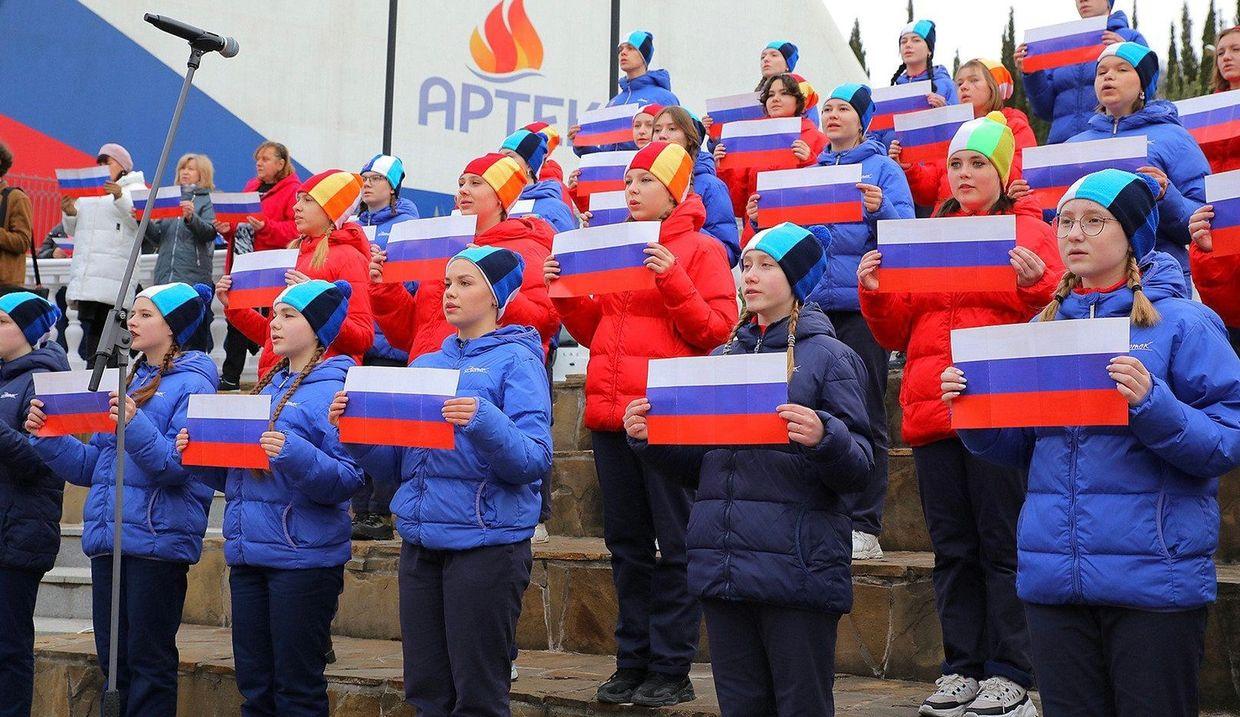
Children stand holding Russian flags in the children's center Artek, run by the Russian government in occupied Crimea, Ukraine, in February 2023. The U.S. State Department introduced sanctions against Artek and its director, Konstantin Fedorenko, for receiving Ukrainian children who are subsequently placed in extensive “patriotic” re-education programs and are prevented from returning to their families. (Artek's press center)

Russia forcibly sent at least 8,330 Ukrainian children to the so-called "re-education camps" this year for the purposes of political indoctrination and militarization, Ukrinform reported on Oct. 30, citing human rights expert Kateryna Rashevska.

These facilities, posing as "rehabilitation institutions," are part of Moscow's strategy to eradicate the Ukrainian identity and turn Ukrainian children against their own homeland, the legal expert of the NGO Regional Center for Human Rights said at a round table discussion hosted by Ukrinform.

There are at least 46 such facilities on Russian territory, seven in occupied Crimea, and eight in Belarus, Rashevska said. Some children are also placed in military camps, where they "carry weapons, learn to shoot, and salute to Russian commanders – usually Don Cossacks, who receive money for this," Rashevska said.

Join our community
Support independent journalism in Ukraine. Join us in this fight.
Support us

Another project called "Cultural Map 4+85," co-developed by the Russian Defense Ministry, the presidential office, and the Education Ministry, among others, reportedly aims to forcibly integrate Ukrainian children from occupied territories and "turn them into citizens of the Russian Federation."

Attempts at re-educating and indoctrinating Ukrainian children have a "clear genocidal character," Rashevska said, and will likely carry an impact on Ukraine in the future.

Video thumbnail

The expert emphasized that these efforts are clear violations of children's right to education and to preserve their identity. The militarization projects also have characteristics of another international crime – forced service in the armed forces of an opposing state, Rashevska noted.

At least 19,500 children have been confirmed as abducted by Russia since the start of its full-scale invasion of Ukraine, according to the Children of War database. Only 386 of them have been safely returned home.

Video thumbnail
Avatar
Martin Fornusek

Assistant Editor

Martin Fornusek is an assistant editor at the Kyiv Independent. Until recently, Martin held the role of foreign affairs reporter specializing in international and regional politics, history, and disinformation. Based in Lviv, Martin often reports on international politics, focusing on developments related to Ukraine and Russia. His career in journalism began in 2021 after graduating from Masaryk University in Brno, Czechia, earning a Master's degree in Conflict and Democracy Studies. Martin has been invited to speak on Times Radio, France 24, Czech Television, and Radio Free Europe. He speaks English, Czech, and Ukrainian.

Read more
News Feed
Video

In May 2026, Ukraine’s 3rd Army Corps launched a secret counteroffensive now known as Operation Vivaldi, aiming to strengthen Ukraine’s defensive positions in the Lyman and Sviatohirsk sectors and disrupt Russia’s plans to encircle Ukraine’s key strongholds – the cities of Sloviansk and Kramatorsk.

"Russia is building the military-industrial capacity to continue waging wars even after the war in Ukraine ends. These are not the actions of a country preparing for lasting peace," Oleksandr Danylyuk, chairman of the Center for Defense Reforms and former chief adviser to Ukraine’s defense minister, told the Kyiv Independent.

 (Updated:  )

For almost two years, student-led demonstrations in Serbia rallied against Vucic's right-wing incumbent Serbian Progressive Party. Protesting against alleged corruption in the government, the movement was triggered when a train station canopy in the city of Novi Sad collapsed in 2024, killing 16 people.

Show More