Exclusive: Board members of problematic state-owned shipping giant say they are being set up to fail
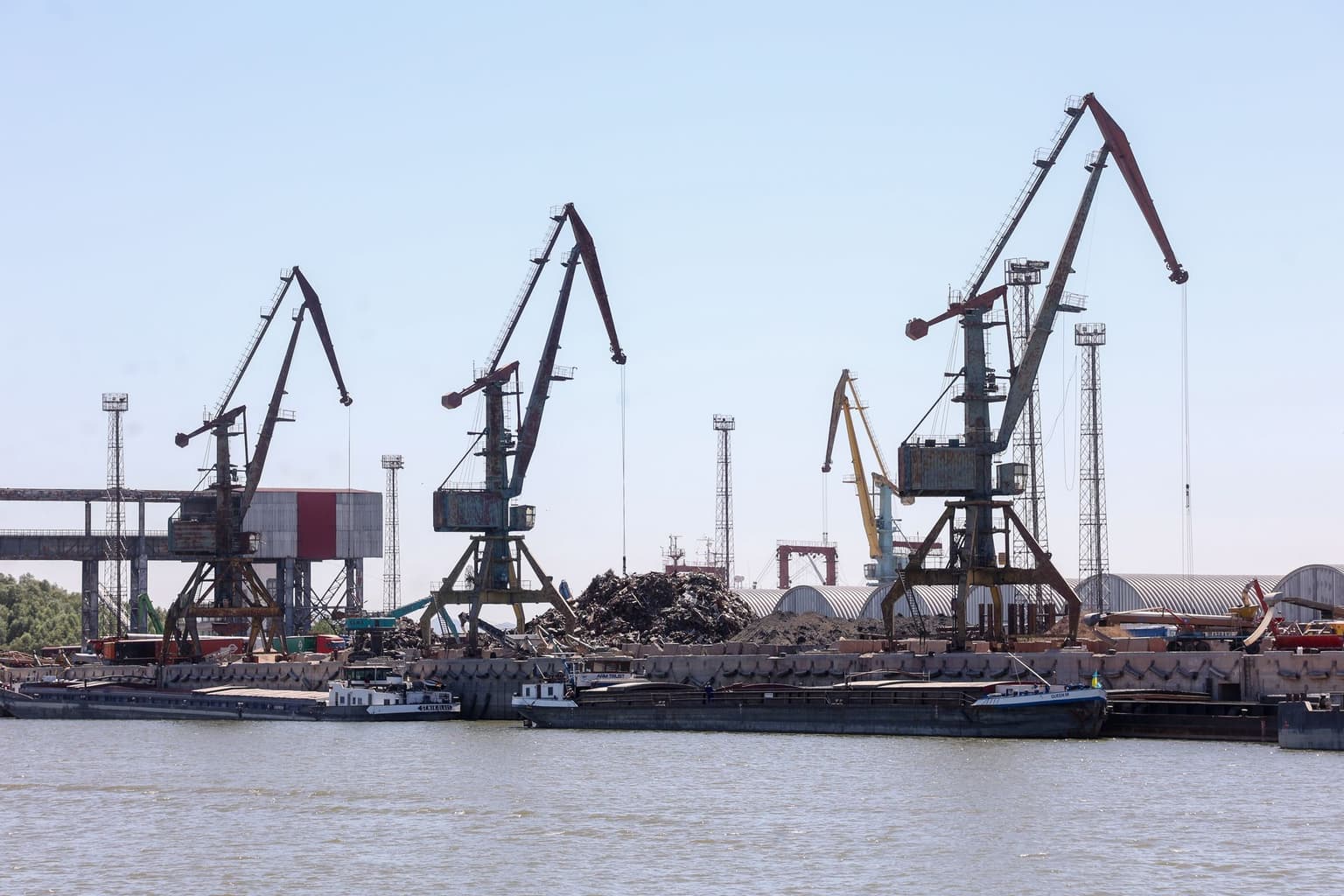
Barges are loaded with grain at the Reni river port on the Danube River in Odesa Oblast, Ukraine, on July 21, 2022. (Sergii Kharchenko / NurPhoto / Getty Images)
 on Google
Three board members of one of Ukraine's largest state-owned shipping companies say that they feel pressured to take actions that are not in the best interest of the company, neglected as they try to fix severe financial, management, and governance issues — but then accused of not having the company's best interests at heart.
The board members came forward after the Kyiv Independent revealed in July that Ukraine's parliament would look into the situation at the Ukrainian Danube Shipping Company (UDP) and hold a committee hearing on it, after the company's newly appointed supervisory board sent a letter detailing a severe decline in activity at the company due to mismanagement and chronic corruption.
UDP is one of Ukraine's more than 3,000 state-owned enterprises, a legacy of the Soviet command economy, which have frequently been the subject of governance problems and corruption.
read also
The company inhabits a strategic spot at the mouth of the Danube river, and owns valuable assets. It became a critical export corridor for Ukrainian grain and iron ore in 2022 after Russia’s months-long blockade of the Black Sea at the start of the full-scale invasion.
UDP appointed its first supervisory board in August last year, meant to act as a check on management and safeguard the company's interests. It includes three independents, appointed through a competitive and merit-based process, and two state-appointed members.
Nearly a year later, Michael Jorgensen, Dennis Olesen, and Benoit Pleska — all three independent members of the board — told the Kyiv Independent in a joint online interview that they are in an impossible bind.
"We have been completely unable to make any changes."
"As time goes on, we are becoming more and more responsible for the poor state of the company — but at the same time we have been completely unable to make any changes," Jorgensen said, who described a dire financial situation at the company.
The company is "making huge losses," some employees' salaries are over six months late, and the company owes many debts that it cannot afford to pay, according to the information available to the board, Jorgensen told the Kyiv Independent.
"We are being drip fed funds which just about keeps the company afloat, but we aren't getting enough to actually allow us to turn this company around," he said, adding that they struggle to get clear information on the financial plumbing of the company.
Pleska said that he resorted to hiring a student researcher to gather data about the company's performance from the public domain, since there was "absolutely nothing" provided to them from within the company — even simple markers of the company's performance like market share, revenue, and profit.

"This is why we asked for a parliamentary investigation. These issues have developed over many years and, in our view, require action beyond the authority of the supervisory board alone," Olesen told the Kyiv Independent.
But the board members say they've had little room to focus on the issues faced by the company due to what they see as a disinformation campaign against them, actions they felt were not adequately grounded in commercial rationale or aligned with governance standards, and poor communication with the ministry in charge.
During the company's first-ever supervisory board meeting, the board was presented with a proposal to sell vessels for scrap value with no explanation for why, nor without an independent valuation of the vessels. The board voted against it.
Additionally, just weeks after the new board got to work, the independent members say that they started to receive an abundance of letters, including from trade unions and former employees.
"We started receiving letters accusing us of poor management, and casting doubt on our intentions as supervisory members. All of these are false claims," Jorgensen told the Kyiv Independent.
Jorgensen, Olesen, and Pleska say that they believe the letters as part of a broader disinformation campaign to discredit them, and are taking legal advice regarding statements they consider false and damaging. They believe that the letters are part of a plan laying the groundwork for their dismissal, and also to distract them as they try to rectify the company.

But the three members say that this is complicated by the fact that they have no direct meetings or communication with the ministry responsible for UDP, and generally have to communicate through the two state-appointed members, Taras Boichuk and Andriy Kashuba.
Jorgensen and Olesen have long and distinguished careers in the shipping industry. Olesen is the current chief operating officer (COO) for Africa and Europe of the world's fifth largest container terminal operator, APM Terminals.
The Ministry for Recovery, Infrastructure, and Transport of Ukraine is the sole shareholder of the company. Ministries are usually expected to engage directly with supervisory boards of companies for which they are responsible.
The Ukrainian Danube Shipping Company did not respond to an email request for comment by the time of publication. The telephone numbers listed on its website are no longer in service.
Ukraine's infrastructure ministry, responsible for the company, told the Kyiv Independent that it is "monitoring the situation at UDP," and that its development is an important strategic priority — emphasizing that it is taking measures to attract international assistance from the EU and Japan's development agency, JICA.
In response to the independent members' comments regarding poor communication, the ministry also said that it engages with the company's supervisory board, including consultations regarding the expectations of the ministry as the company's owner.
The ministry also said that it has "no information regarding the letters" sent to the independent supervisory board members.