Exclusive: Ukraine shipping giant is sinking amid allegations of mismanagement and corruption risks
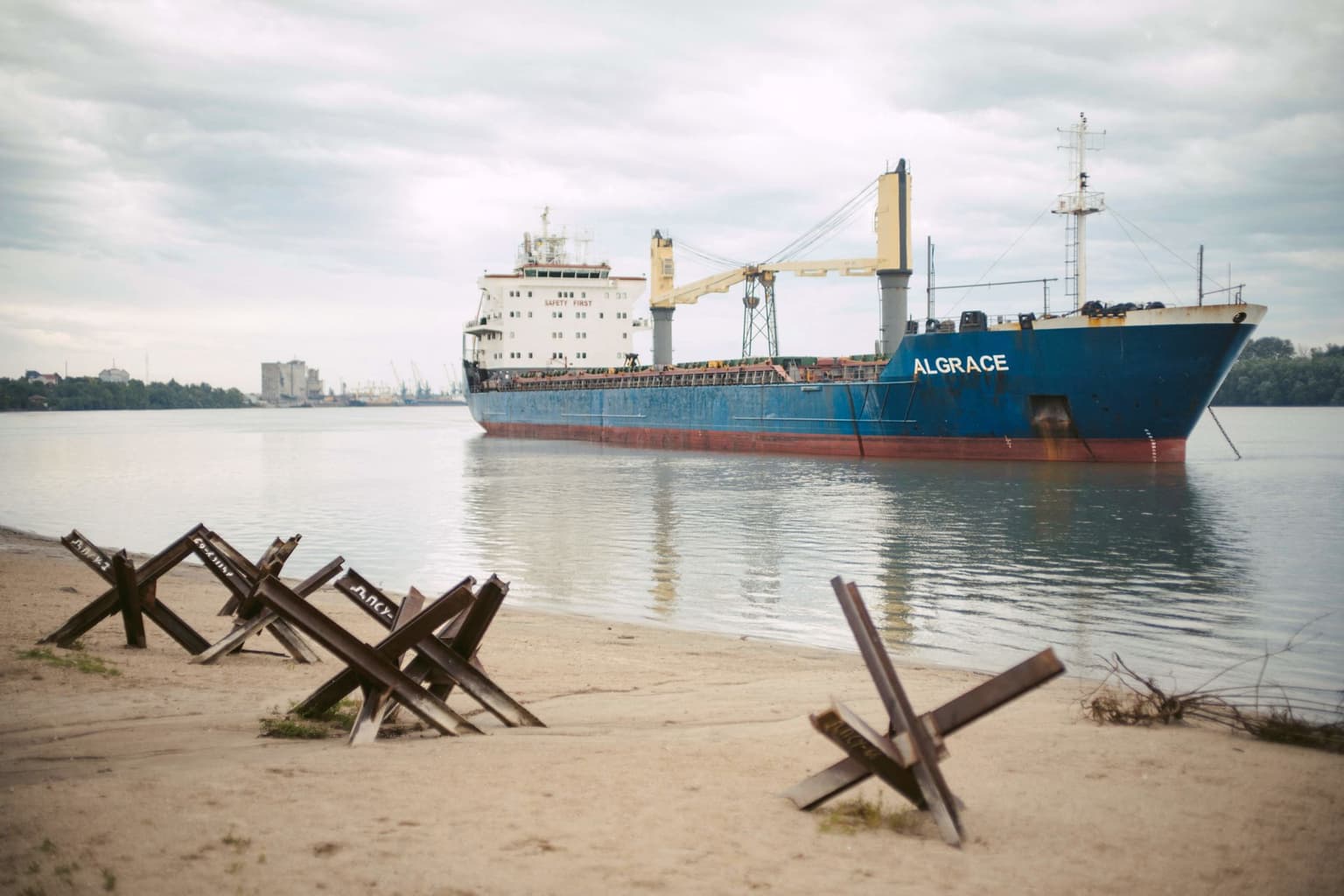
The Panamanian cargo ship Algrace anchors on the Danube River near the port of Izmail, Odesa Oblast, Ukraine, on July 27, 2023, with anti-tank defenses visible on the riverbanks. (Stringer / AFP / Getty Images)
 on Google
Leaked internal documents obtained by the Kyiv Independent suggest one of Ukraine's largest state-owned shipping companies is being run into the ground and may be under the influence of external interests — offering a rare look at the governance failures that continue to plague the country's state-owned enterprises.
In early May, the chairman of the Ukrainian Danube Shipping Company's (UDP) supervisory board sent a lengthy letter to Ukraine's parliament. In it, he sounds the alarm over a severe decline in activity at the company, attributing it to "corruption that has plagued the company's assets for decades." The chairman also says in the letter that the board's efforts to clean up the company have come up against fierce opposition.
A separate document obtained by the Kyiv Independent details an internal investigation alleging another supervisory board member had created "significant corruption risks." The investigation, however, was launched four days after the chairman’s letter was sent, despite examining events from six months earlier. The delay, along with inconclusive findings, raises questions about why the company didn't investigate the matter sooner, and its overall decision-making.
Headquartered in southwestern Ukraine at the mouth of the Danube River, UDP transports cargo and carries out shipbuilding and repair. The Danube River became a critical export corridor for Ukrainian grain and iron ore in 2022 after Russia’s months-long blockade of the Black Sea at the start of the full-scale invasion.

It is unclear from the documents who might be seeking to disrupt the company's normal operations or to what end. But UDP's declining market share despite its strategic importance underscores the long-standing governance problems at Ukraine's nearly 3,000 state-owned companies, which reformers and Kyiv's international partners have repeatedly argued should be corporatized or privatized to curb political interference and corruption.
Alongside its deteriorating financial performance, the company’s lucrative assets, including vessels and real estate abroad, have been preyed upon before, according to the letter and court cases — following a similar pattern seen at other Ukrainian state-owned enterprises.
In response to the allegations, Ukraine's parliament has said it will react. A letter dated June 4 and sent by parliament's transportation and infrastructure committee to UDP's director, Volodymyr Tostohan, that was provided to the Kyiv Independent upon request, notes the chairman's concerns. It describes the situation at the company "of significant current concern (that) undoubtedly requires a hearing and detailed review."
The letter to Ukraine’s parliament that sounded the alarm
In an explosive letter to Ukraine's parliament obtained by the Kyiv Independent, dated May 6, Benoit Pleska — chair of UDP's supervisory board — paints a damning picture of the company's decline: collapsing activity and market share since 2020, "huge resistance" against the board's cleanup efforts, chronic corruption, and the systematic destruction of company assets.
Pleska ends the letter by calling for a parliamentary investigation into illegal activity at the firm.
The board, which was appointed in August 2025, includes three independent appointees, including Pleska, and two state-appointed members. Independent members are selected through a competitive, merit-based process, often resulting in foreign professionals being chosen to sit on boards.
Citing statistics of the company's collapse at length throughout the letter, Pleska says that actions taken "(point to) structural managerial failure, governance failure, destruction of economic value, and decisions potentially contrary to the strategic interests of the state."

For example, while Ukraine's state-owned Izmail port on the Danube recorded extraordinary growth of 314% in freight volumes from 2020 to 2024, UDP’s freight volumes increased by 2.1% — resulting in their market share within a core port for the company collapsing from 18% in 2020 to almost 4% in 2024.
Pleska says the supervisory board began work in "extremely difficult financial and operational conditions."
Data from Ukrainian open-source intelligence company, YouControl, shows sharply deteriorating financial performance in 2024 and 2025. The company made losses of over $7 million dollars in 2025.
"The supervisory board is determined to eradicate the corruption that has plagued the company's assets for decades, systematically destroying the UDP fleet."
In the letter, Pleska describes the newly appointed board's attempts to turn the company around, including independent audits, a new financial plan, a full inventory of the company's assets, and the search for new management to replace the "critically low qualifications" of the current management.
But Pleska writes that these activities cause "a huge resistance from internal and external stakeholders," which included “malicious obstruction to the normal business operations of the supervisory board,” and an “informational awareness campaign” to discredit him personally.
"Such an activity aimed at distracting the supervisory board members and slowing down the corporate governance reform in UDP," Pleska writes.
"However, the supervisory board is determined to eradicate the corruption that has plagued the company's assets for decades, systematically destroying the UDP fleet," he adds.
In his letter, Pleska frames this resistance to the board's activities as his reason for calling a parliamentary investigation.

In response to an email from the Kyiv Independent, Pleska confirmed that he wrote the letter, and that its receipt was acknowledged by the "relevant authorities." It is not clear which authorities he is referring to.
"(The supervisory board) considered it our duty to inform parliament because we believed the issues we had identified could have a significant impact on the future of the company and on the implementation of corporate governance reform," Pleska told the Kyiv Independent, adding that a majority of its members supported the decision to flag the matter to the Verkhovna Rada.
"I believe that strengthening corporate governance within Ukraine's state-owned enterprises is essential for the country's future and for maintaining the confidence of its international partners," he added.
An internal fact-finding investigation within UDP
Less than a week after Pleska sent the letter to Ukraine's parliament, the company launched an internal probe. The probe, however, didn’t address the questions raised by the supervisory board chairman, instead focusing on an unrelated case from November 2025.
According to a copy of the investigation's findings obtained by the Kyiv Independent, the probe centered on Taras Boichuk, one of two state representatives on the company's supervisory board, both directly appointed by the Infrastructure Ministry, which is responsible for the company.
The "Preliminary Fact-Finding Investigation," launched May 10 and concluded just two days later on May 12, examines what it calls Boichuk's "impermissible" behavior — alleged conduct from six months prior. The timing and short timeframe of the probe suggest it was initiated in response to the letter sent to parliament rather than as part of a broader effort to address the alleged issues.
The investigation accuses Boichuk of overstepping his supervisory board role by interfering in operational matters.
According to the probe, Boichuk, at a Nov. 11 meeting, proposed hiring tax attorney Roman Popov to assist with a $17 million tax dispute. He then allegedly instructed a company employee, Hanna Vyshnevska, to provide Popov with case materials without proper authorization. Finally, along with Popov, Boichuk allegedly "recommended" cooperating with a list of law firms who could provide additional help with the case, with contracts ranging from $216,000 to $671,000.
The investigation alleges these actions violated company procedures, including rules on supervisory board members' authority, access to confidential materials, and conflict-of-interest checks. It concludes that Boichuk's conduct may indicate undisclosed private interests and recommends review by an anti-corruption officer. The findings were signed by UDP Director Tostohan and five other members of the investigative panel.
"I reject the version of events presented in the so-called Preliminary Fact-Finding Investigation."

The investigation stops short, however, of assessing the damage caused by the transfer of documents to Popov, or whether they contained trade secrets or confidential information in the first place.
The Kyiv Independent reached out to Boichuk, who denied providing any instructions or recommendations beyond the authority of a supervisory board member, nor sharing UDP documents with outside lawyers in breach of the company's procedures.
"I acted within the scope of my authority as a supervisory board member and committed no violations; on the contrary, I acted based on a risk that had been identified, which is part of my fiduciary duty," Boichuk said in an email response to the Kyiv Independent, referring to the financial deterioration of the company and the tax dispute.
The $17-million claim stated in the internal probe is larger than the company's annual turnover listed on YouControl.
"I reject the version of events presented in the so-called Preliminary Fact-Finding Investigation," he said, telling the Kyiv Independent that he had hired Popov as his personal advisor on tax matters, rather than on behalf of the company.
Boichuk also claims not to have instructed anyone to provide Popov with case materials, but rather that Popov — in his capacity as a personal advisor — advised Boichuk to review the materials himself. Neither he nor Popov recommended working with any law firms, and it was the company itself that initiated the selection process, according to Boichuk.
Echoing Pleska's claims that the supervisory board is facing resistance, Boichuk said that the claims made in the fact-finding investigation are aimed at "limiting the scope of my rights as a supervisory board member, particularly my access to information necessary to perform my duties."
Boichuk also said that the Infrastructure Ministry had initiated a review of the investigation.
"I remain confident that the facts will be clarified through the ongoing review and any subsequent lawful procedures," Boichuk stated.
The Kyiv Independent sent a request for public information to the ministry asking for confirmation that it was aware of the fact-finding mission and to provide any documents in connection with the probe. At the time of publication, the ministry was still working on the request.
Popov did not reply to a request for comment by email when reached out to by the Kyiv Independent. While Vyshnevska initially responded to a first phone call, she did not respond to a subsequent call for further comment nor a text message.
A tainted past
Pleska's letter, as well as public records, also show several apparent past attempts to prey on the Ukrainian Danube Shipping Company's assets.
In 2017, 32 of the company's vessels were allegedly lost via an embezzlement scheme, causing damages of almost $2 million. Ukraine's Specialized Anti-Corruption Prosecutor's Office is currently pursuing the case in court.

More recently, a former director of the company, Oleksiy Khomyakov, was investigated in connection with an attempt to transfer dozens of vessels belonging to UDP to a different company in Hungary.
Public records reviewed by the Kyiv Independent show that Ukraine's Security Service, the SBU, opened an investigation in 2020, before handing over the case to Ukraine's National Anti-Corruption Bureau in 2022. The bureau has since not charged Khomyakov, nor concluded whether there was any criminal intent over the transfer.
Alluding to this case in his letter, Pleska says that the ordeal risked over $50 million worth of the company's assets.
The Kyiv Independent reached out to the Ukrainian Danube Shipping Company for comment, but did not receive a reply by the time of publication.
Additional reporting by Karina El Mansoury and Alisa Yurchenko.