Europe's new gamble on Russia's exiles, explained
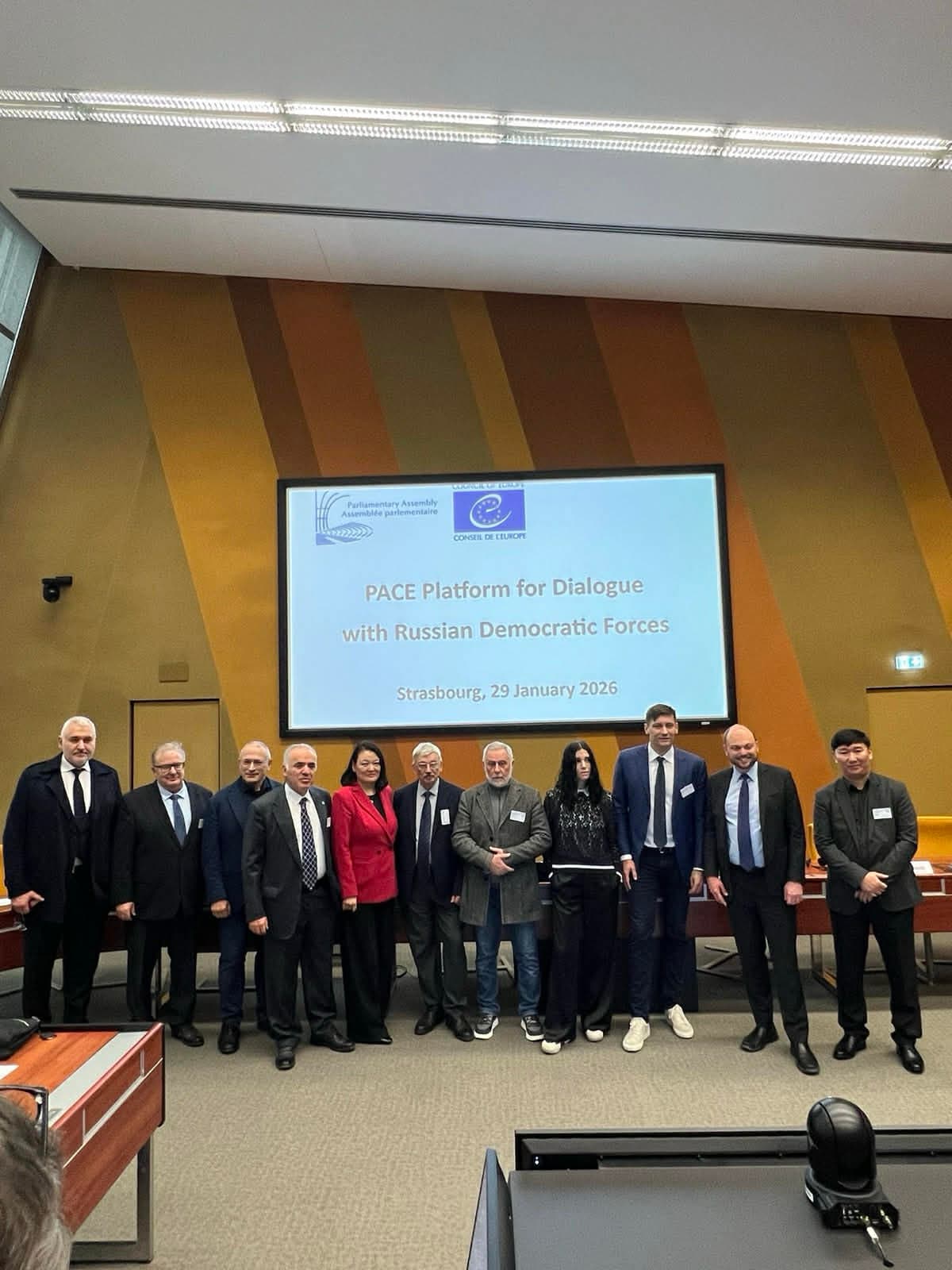
Members of the Russian PACE platform. (Photo credit: Nadya Tolokonnikova)
 on Google
Nearly four years after Russia's expulsion from the Council of Europe, the Parliamentary Assembly (PACE) has launched a new platform for dialogue with exiled Russian forces.
The move is a major shift in how Europe engages with Russian opposition figures at a time when Moscow remains isolated from the continent's main human rights body and the war in Ukraine continues with no clear end in sight.
The 15 participants of the Russian PACE platform published their first joint statement on Feb. 6, which focused primarily on the war in Ukraine.
In the statement, they place responsibility for launching the war on Russia and describe their home country as "fascist." They call for continued military support for Ukraine, accountability for aggression and other alleged crimes, and the use of frozen Russian assets to fund Ukraine's recovery.
Yet alongside declarations of solidarity and institutional backing, fundamental questions remain about how much the platform can achieve — and who, exactly, it represents.
The Kyiv Independent spoke with several participants to understand how the platform came into being and what its broader political significance might be.
What is PACE?
PACE is an advisory body of the Council of Europe, which brings together 46 countries, including EU member states as well as non-EU countries such as Turkey, Ukraine, and Georgia.
The Assembly works to promote human rights and democracy across member states.
Unlike the European Parliament, PACE does not pass laws, and its resolutions are not legally binding. Even so, the political weight it carries often shapes policy debates.
Russia joined the Council of Europe in 1996 and took an active part in PACE for more than two decades. After Moscow's illegal annexation of Ukraine's Crimea in 2014, PACE stripped Russia of its voting rights, and the Russian delegation stopped attending sessions.
In 2019, the Assembly restored Russia's powers, a decision that was controversial at the time.
For years, the Russian delegation — led by lawmaker Pyotr Tolstoy — included representatives from all of the country's parliamentary factions. None of the permitted factions were opposed to the regime.
That arrangement ended in 2022. After Russia launched its full-scale invasion of Ukraine, the Council of Europe expelled Russia, automatically terminating its participation in PACE.
The newly-created platform, however, is not a replacement for that delegation — a distinction that has already caused confusion.
A platform, not a delegation
In September 2025, PACE's Political Affairs Committee proposed establishing a platform inside the Assembly for dialogue with "Russian democratic forces in exile."
The Assembly set out strict criteria: delegates must be individuals "of the highest moral standing" who unconditionally recognize Ukraine's territorial integrity and commit to working toward "regime change" in Russia.
Delegates will serve one-year terms and may attend committee meetings and discuss "issues of common concern" with Assembly members, but they will not be able to vote on PACE resolutions or hold the formal status once granted to Russia's official delegation.
The platform includes 15 members, though PACE has not publicly detailed how it selected the candidates — a lack of transparency that has fueled debate about the body's legitimacy.

Among the selected participants are Dmitry Gudkov, a former member of the Russian parliament; Vladimir Kara-Murza, an opposition politician and vice president of the Free Russia Foundation; Garry Kasparov, former world chess champion and co-founder of the Free Russia Forum; and Nadya Tolokonnikova, co-founder of the feminist group Pussy Riot.
Five seats are reserved for representatives of Russia's indigenous and minority communities. Among them are Ruslan Kutaev, a Chechen opposition figure; Ekaterina Kuznetsova, an artist and founder of Ingria House, a project focused on Finno-Ugric cultures; and Lana Pylaeva, an indigenous rights consultant and founder of the Komi Daily media outlet.
The remaining participants also include Russian opposition politicians, independent journalists, civil society activists, and other public figures.
Unprecedented advocacy, questions of legitimacy
For representatives of Russia's indigenous peoples and minority communities, participation in the PACE platform offers a rare opportunity to circumvent the federal authorities and entrenched institutions that have long monopolized Russian political discourse.
"I believe that strategically, representatives of Russia's indigenous peoples and Ukrainians are allies," Pylaeva told the Kyiv Independent. "We face a common challenge and a common misfortune: the imperial and colonial nature of Russia."
"As a result, indigenous and regional perspectives are marginalized and effectively ignored," she said. "This platform is the result of serious international efforts and gives indigenous peoples the opportunity to speak directly."
The wide range of perspectives included among the PACE platform's participants, each reflecting different priorities, is generally seen by them as a source of strength for the work that lies ahead.
"It was very important to us that the platform is not dominated by just one or two (opposition) groups. Instead, it brings in a wider range of people and organizations, ensuring there's no monopoly," Natalia Arno, president of the Free Russia Foundation, told the Kyiv Independent.
"We oppose Putin's monopoly in Russia, and we didn't want to see anything similar in such an important international, pan-European institution like PACE."
Nevertheless, the composition of the platform raises a delicate question: by what authority do these 15 individuals claim to represent Russia's democratic opposition?
While Belarus's opposition can point to the 2020 presidential election, which demonstrated strong support for Sviatlana Tsikhanouskaya, Russian democratic opposition figures have no recent electoral mandate to establish a comparable claim to legitimacy.

The Belarusian opposition also benefits from formalized recognition. In 2022, the Council of Europe created a "Contact Group on Belarus," where representatives of Tikhanovskaya's team participated.
Russian opposition leaders, by contrast, have thus far lacked any comparable institutional platform.
However, Pylaeva explained that the PACE forum is not a national delegation, but a provisional space for dialogue otherwise unavailable within Russia.
"This is a platform for dialogue, created in a situation where Russia is waging an aggressive war," she said. "PACE is establishing a format for communication with representatives of the opposition and civil society."
She acknowledged the criticism but framed it against the stark political realities within Russia, where independent institutions are weak, dissent is suppressed, and meaningful channels for representation — especially for indigenous and regional communities — are virtually nonexistent.
"I see the first year and format of this platform as an experiment," Pylaeva said. "It is a tool, and I believe it is important to use it."
Mikhail Khodorkovsky, the exiled businessman and opposition activist who also joined the platform, described the formation process as foundational rather than final.
"It must subsequently be revised using a procedure of elections among anti-war Russians," he said. "The main thing now is to demonstrate the effectiveness of the new institution in representing the interests of this segment of Russian society."
Notable absence of Navalny's allies
Strikingly absent from the list of PACE platform participants are any allies of the late opposition leader Alexei Navalny, whose network of activists and political operatives has long challenged the Kremlin's authority and shaped Russia's opposition landscape.
Navalny's Anti-Corruption Foundation (FBK) continues to operate after his death under the leadership of his wife, Yulia Navalnaya, and his close associates.
With a robust online footprint, the organization commands YouTube channels and social media platforms that reach millions across Russia and around the world.
A senior FBK representative told the Kyiv Independent that the group received multiple invitations to join the PACE platform but decided, for now, to decline.

"We were indeed invited several times to take part in the work of the platform," the representative said. "We discussed this issue extensively within our organization and decided, at this stage, to refrain from participating."
"Our priority is working… with anti-Putin and anti-war forces within the country," the representative added.
According to FBK, PACE officials said they would monitor the platform's performance for a year before deciding whether any adjustments were needed.
"We will also be watching," the representative said, leaving open the possibility of reconsidering the organization's involvement. "I do not exclude at all that in a year, for example, we may revise our decision."
read also
Support for Ukraine
As Russia's full-scale war against Ukraine enters its fourth year, one of the questions surrounding the Russian democratic opposition is how effectively and to what extent they might use the PACE platform to call for increased military aid to Ukraine.
Tolokonnikova is among those calling for support that goes beyond mere statements of solidarity, urging concrete action to provide Ukraine with more weapons.
"I think it's very important to represent the voices of those fighting Putin not just with words but with actions, including with weapons for the Russian partisan movement inside Russia, as well as people who left to fight on Ukraine's side," Tolokonnikova told the Kyiv Independent.
"These are some of the brightest representatives of the anti-war movement, and yes, their voices are important."
Arno emphasized that Ukraine has "every right to defend itself by all available means" and said that the Free Russia Foundation provides legal support to pro-democracy Russians residing and working in Ukraine as volunteers and soldiers.
The Free Russian Foundation's Kyiv branch is also actively aiding in the search to locate Ukrainian POWs and civilians kept in Russian shadow prisons, she added.
"Unfortunately, we know Russian prisons all too well. We understand the system, and far too many of our people — including our Vice President Vladimir Kara-Murza — have experienced it firsthand," Arno said.
"We have submitted numerous reports to the ICC, the UN mechanisms, and the OSCE. We also bring delegations of Ukrainian families — both those whose loved ones are still imprisoned and those who have been released — so they can share their personal stories."
"Additionally, we document the methods used by Russian authorities, such as the widespread practice of charging Ukrainians with terrorism. Monitoring and exposing these abuses is one of our organization's top priorities."
A long-standing criticism of the Russian democratic opposition has been that some of its leaders frequently invoke the vision of a "beautiful Russia of the future," yet offer little clarity on the practical realities of a post-Putin transition.
Self-proclaimed pessimist Tolokonnikova told the Kyiv Independent that imagining the so-called beautiful Russia of the future is becoming "harder and harder each year" and that it's important for the Russian democratic opposition to convey the threat posed by Russia not only to Ukraine but to all of Europe.
"I can't guarantee to anyone that after Putin's departure, Russia will necessarily become democratic," she said.
"That's why I think it's necessary to contain Russia as a dangerous neighbor to Europe on all possible levels. What's needed is the language of strength and coercion, not the language of requests."