End of Ukraine's 'untouchables'? Zelensky faces final choice for Ukraine's anti-corruption future
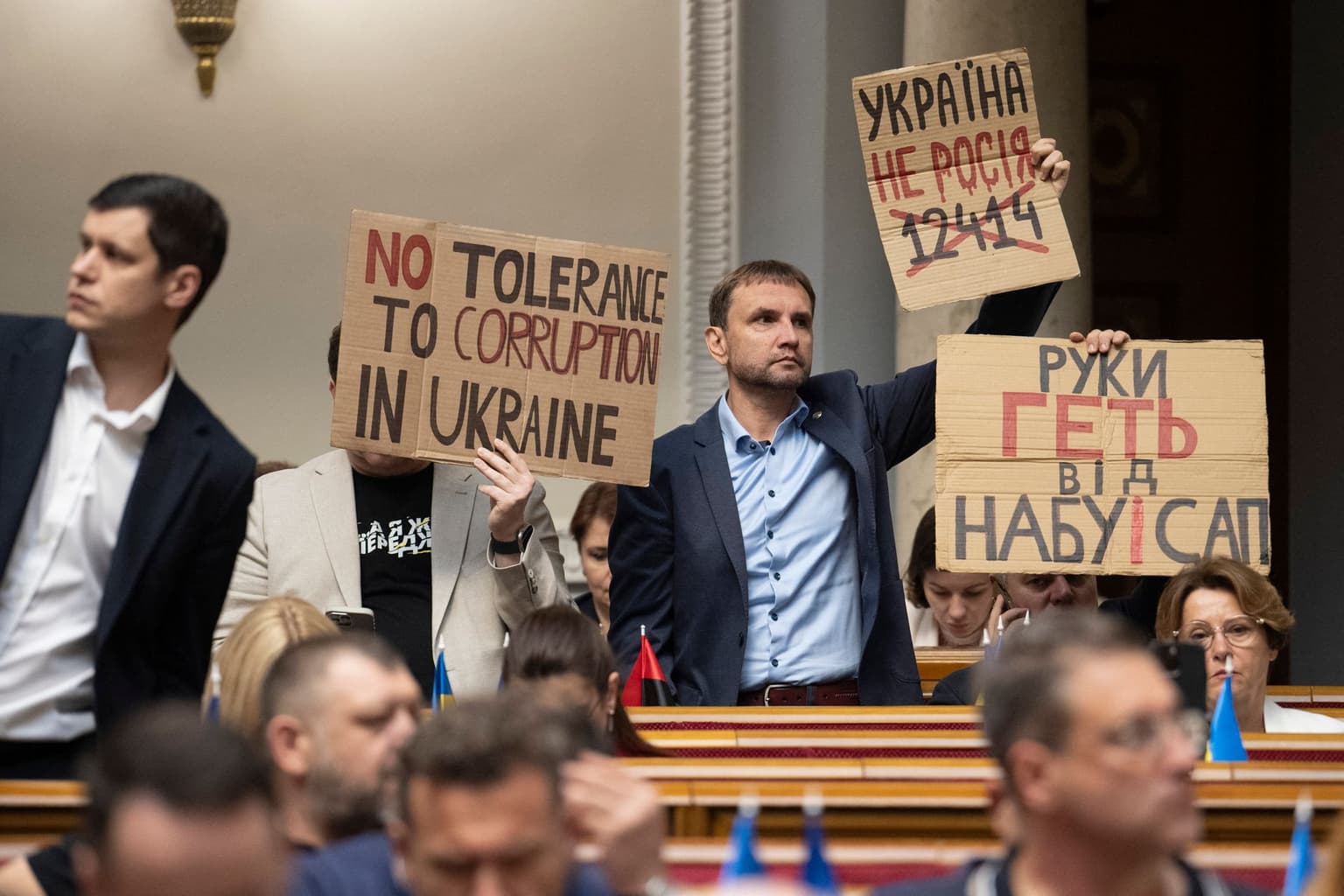
Ukrainian lawmakers protest with placards reading "No tolerance to corruption in "Ukraine is not Russia 12414 - the number of a bill to be replaced)" (C) and "Hands off NABU (the National Anti-Corruption Bureau) and SAP (the Specialized Anti-Corruption Prosecutor's Office)" (R) as they vote on a bill to replace a law that curbed the powers of anti-graft bodies on July 31, 2025, in Kyiv, Ukraine. (Andrii Nesterenko / AFP via Getty Images)
 on Google
Daria Kaleniuk
Co-founder of ICUV and AntAC
Corruption is back at the top of the news in Ukraine, and that is not necessarily a bad thing.
The latest accusations against Andriy Yermak, the former Head of the Presidential Office, do not indicate an increase in corruption, as naysayers claim. This achievement is a remarkable victory for the autonomous anti-corruption architecture that we have carefully built since the 2014 Revolution of Dignity.
Andriy Yermak was neither a normal high-ranking bureaucrat nor a regular official. He was the head of the presidential office and was generally considered the country's second-most-powerful man.
He handled domestic and foreign policy issues much as President Volodymyr Zelensky himself did. It is very remarkable that independent anti-corruption entities persisted in harboring suspicions towards such a powerful figure, despite facing tremendous pressure and multiple attempts by unreformed institutions to meddle with their operations.
With a full-scale invasion ongoing, this kind of event shall be treated as the mark of institutional maturity, showing that no one is "untouchable" in Ukraine, not even the country's second-most-powerful figure.
This development did not happen in a vacuum. Ukraine's friends, especially the EU, should be widely recognized by the international community for the framework they helped build.
A decade ago, it was sustained EU pressure through reform conditionalities attached to the visa liberalization regime and macrofinancial assistance packages that compelled Ukraine to establish independent anti-corruption bodies in the first place. National Anti-Corruption Bureau (NABU) and Specialized Anti-Corruption Prosecutor's Office (SAPO) were the price of closer integration with Europe, and that price has now proven its worth.
“The ‘carrot’ of EU integration, which includes things like visa liberalization and the prospect of full membership, has led to many complex but essential changes.
The European Union is now more than ever in a position of strength, with the arrival of 90 billion euros ($104.6 billion) in financial aid just around the corner. The NABU and the SAPO shall serve as examples for further reforms. The leadership of these institutions was chosen through an open, merit-based competition that included foreign partners, enabling them to achieve these accomplishments.
The Prosecutor's Office and the State Bureau of Investigation are critical law enforcement institutions that need to adopt this same high standard, but still remain under the shadow of control coming from the Presidential Office.
Yet if there is one lesson from recent years, it is that Brussels can set the framework, but it cannot substitute for the will of the Ukrainian people themselves.

The drive for change runs far deeper than the bureaucratic niceties of EU conditionality, because it is rooted in the lived experience of ordinary Ukrainians who have seen corruption cost them dearly, in money and in blood.
Nowhere was this more apparent than in July 2025, when mass protests broke out nationwide against Law No. 12414, which posed a significant threat to the independence of NABU and SAPO. The rallies commenced promptly following the Verkhovna Rada's vote on July 22 and the President's subsequent signature. The streets were crowded with thousands of Ukrainians, many of them young, defending their institutions.
This grassroots mobilization had a significant impact. The Verkhovna Rada passed a new law on July 31, 2025, restoring the full independence of NABU and SAPO in response to overwhelming public clamor.
Additionally, according to a study conducted by the Rating Group and the EU Advisory Mission in summer 2025, 74% of Ukrainians consider the Ukrainian authorities' efforts to implement reforms insufficient. The lowest ratings are in the fight against corruption (86% dissatisfied) and in the reform of the judicial system and the prosecutor's office (71% dissatisfied).
But this discontent is coupled with a tireless desire to join the European Union; as of February 2026, 83% of Ukrainians were in favor of joining the EU, the highest since 2021.
The general population has recognized corruption for what it is: a threat to the nation's safety. Every dollar wasted in war is a soldier on the front line going without food, water, and shelter.
As for President Zelensky, he now has a once-in-a-generation opportunity to "reboot" his power thanks to the unfolding of Yermak's case. This opportunity enables him to finally leave behind the "manual management" of the past and distance himself from his old "friends."
Despite reports of legislative deadlock, the political will is there to move forward, and the Rada will support these amendments if asked by the leadership.
The EU should not be swayed by assertions that the Parliament is "exhausted," that further reform is unattainable, or that the requisite votes are absent. When faced with an obvious need and the political will to take the lead, the Ukrainian Parliament has proven time and again that it is capable and willing to vote for any legislation required.
The way forward is clear: Ukraine must continue its internal cleansing, regardless of the war.
Whether Zelensky will use this opportunity to institutionalize transparency or revert to his old ways of consolidating power through crooked connections remains to be seen. That decision will determine Ukraine's hopes for Europe and the country's security.
Editor's note: The opinions expressed in the op-ed section are those of the authors and do not purport to reflect the views of the Kyiv Independent.