From Tehran to Kyiv: Ukraine’s Iranian diaspora live through war while watching another
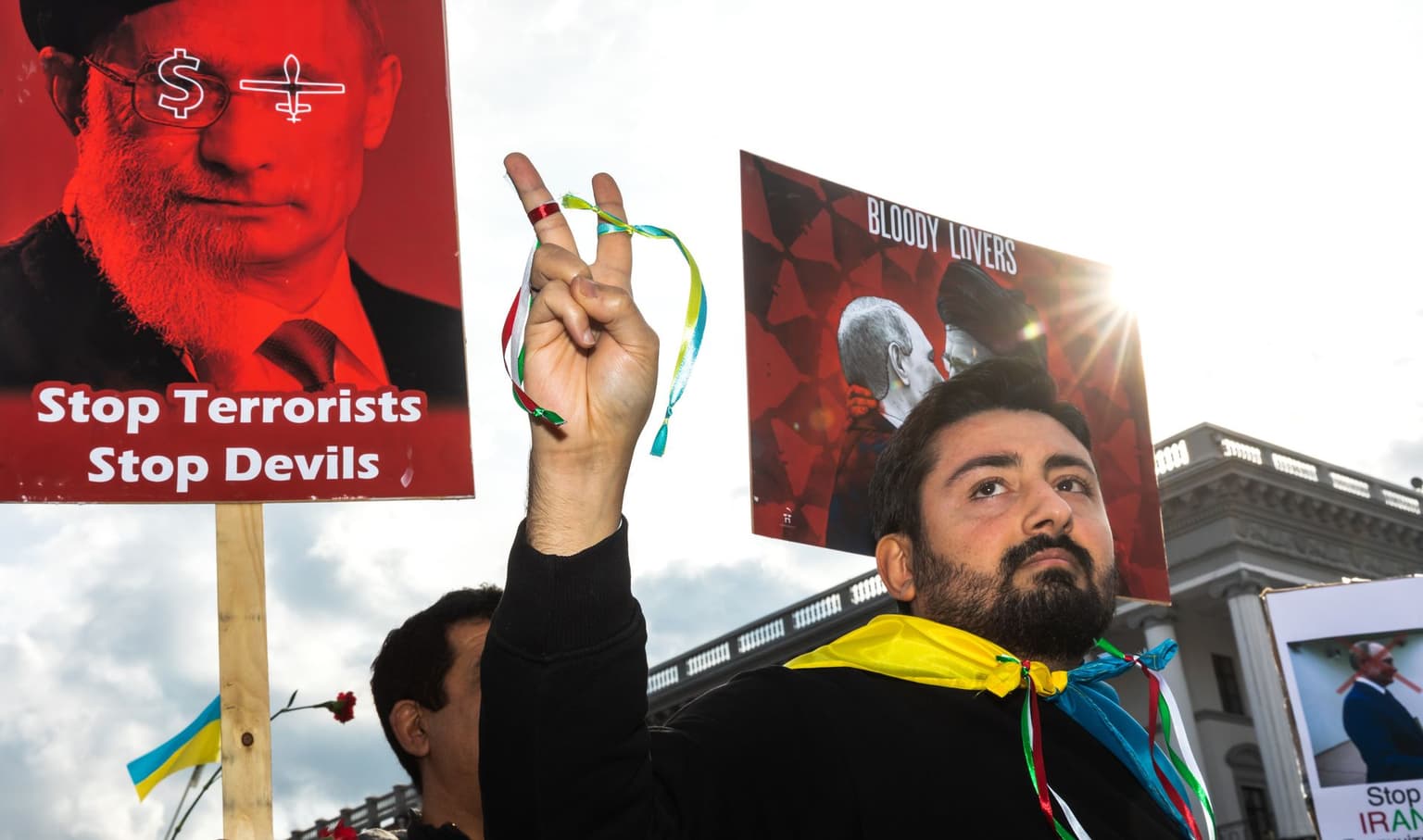
A person shows a victory sign with ribbons in the colors of the Ukrainian and Iranian flags during a protest against Iran’s support for Russia’s aggression in Kyiv, Ukraine, on Oct. 28, 2022. (Mykhaylo Palinchak / SOPA Images / LightRocket / Getty Images)
 on Google
With air raid sirens and missile strikes part of daily life in Kyiv, many Iranians living in Ukraine found themselves watching another crisis unfold in their homeland — one that feels both distant and painfully familiar.
Following the U.S. and Israeli war on Iran and the assassination of Supreme Leader Ali Khamenei, along with several senior figures of the regime, members of the small Iranian community in Kyiv say they are following events closely, balancing hope for political change with fear for friends and relatives caught in the escalating conflict.
Khamenei was succeeded by his son, Mojtaba Khamenei, in a rapid transition that has deepened uncertainty over Iran's political future, after the Assembly of Experts selected him as supreme leader on March 3.
For many Iranians in the diaspora, the moment feels surreal. Watching the war unfold in Iran, while already living through Russia's full-scale invasion of Ukraine.
"I've lived through the wars twice now," said Ramin Ghaderian, an Iranian musician and filmmaker who has lived in Kyiv for more than two decades.
"First, as a child during the Iran–Iraq war, and now here in Ukraine."
Iranians in Kyiv
Before Russia's full-scale invasion in 2022, a few thousand Iranians lived in Kyiv, many of whom attended Ukrainian universities. Since the war began, many of them have left.
Today, community members estimate that only around 100 to 200 Iranians remain across Ukraine.
Maziyar Mian, an architect who moved to Ukraine in 2006 to study in Kharkiv and later settled in Kyiv, said the remaining community stays connected largely through activism.
Iranians in Kyiv have organized rallies outside the Iranian embassy and gatherings on Kyiv's Maidan Square, condemning Tehran's military support for Russia and expressing solidarity with protest movements inside Iran.


Iran has supplied Russia with Shahed-type attack drones used in repeated strikes on Ukrainian cities and energy infrastructure. Iran has also shared the technology behind them, enabling Russia to produce its own versions, known as Geran drones.
"The Iranians who stayed in Ukraine support Ukraine," he said. "Despite the war, they chose to remain here."
Watching the war from afar
News of the initial U.S. and Israeli strikes spread quickly through the diaspora community. As attacks continue across Iran, many Iranians abroad remain glued to their screens, closely following the updates across news outlets and social media.
For some Iranians in Kyiv, the escalation was not entirely unexpected.
"We knew something was coming," Mian said, pointing to years of protests and mounting tensions inside Iran.

Ghaderian agrees that many Iranians had long anticipated a major confrontation.
"We've been waiting for this for almost 20 years," he said, referring to repeated waves of protests against the Iranian regime that were often violently suppressed.
Yet the unfolding events have also brought anxiety. Many members of the community have struggled to contact family members as authorities in Iran have again restricted internet access.
"Sometimes you just lose contact completely," Ghaderian said. "You don't know if it's the internet, or something worse."
Despite fears about the growing conflict, several interviewees said many Iranians hope the current escalation could weaken the Islamic Republic enough to allow a new wave of protests to succeed.
"People want to decide their own future in a free country," Mian said.
While some in the diaspora see the strikes as a potential turning point, experts warn that Iran's security apparatus remains intact and could consolidate power rather than collapse. The system is sustained by powerful military, clerical, and bureaucratic elites who have everything to lose if it falls.
Some supporters of the opposition believe Reza Pahlavi – the son of Iran's last monarch – could play a role in a political transition, though opinions among Iranians remain divided.
At the same time, many worry about the human cost of a wider war.

"War is what worries me most," Ghaderian said. "We know what that means for ordinary people."
For many Iranians in Ukraine, years of war here have reshaped how they see the crisis now unfolding in their own country.
Alireza, an Iranian who studied in Ukraine from 2013 and now moves between Ukraine and abroad after a Russian missile strike near his home in Kyiv's Obolonskyi district, said he sees striking similarities between the two societies.
"They kill us, and we keep coming back," he said of repeated protest movements in Iran.
For him, that persistence echoes what he witnessed during Ukraine's mass protests and wartime mobilization.
"I see a resemblance between Ukrainians and Iranians," he said. "People stand in the streets until they get what they want."
He added that demonstrations abroad frequently feature both Ukrainian and Iranian flags, which he described as a symbol of solidarity between the two nations despite tensions between their governments.
For many Iranians living in Ukraine, the hope is that the current turmoil could eventually lead to a democratic transition in Iran.
If that happens, Mian said, relations between the two countries could look very different.
"A free Iran would be a friend of Ukraine," he said, "not the enemy represented by the current regime."
For now, members of Kyiv's Iranian community say they are following events from afar – caught between two wars, one they live through in Ukraine and one reshaping their homeland.