'But what did we do?' — How Ukraine's strikes on Wildberries brought Russia's war home
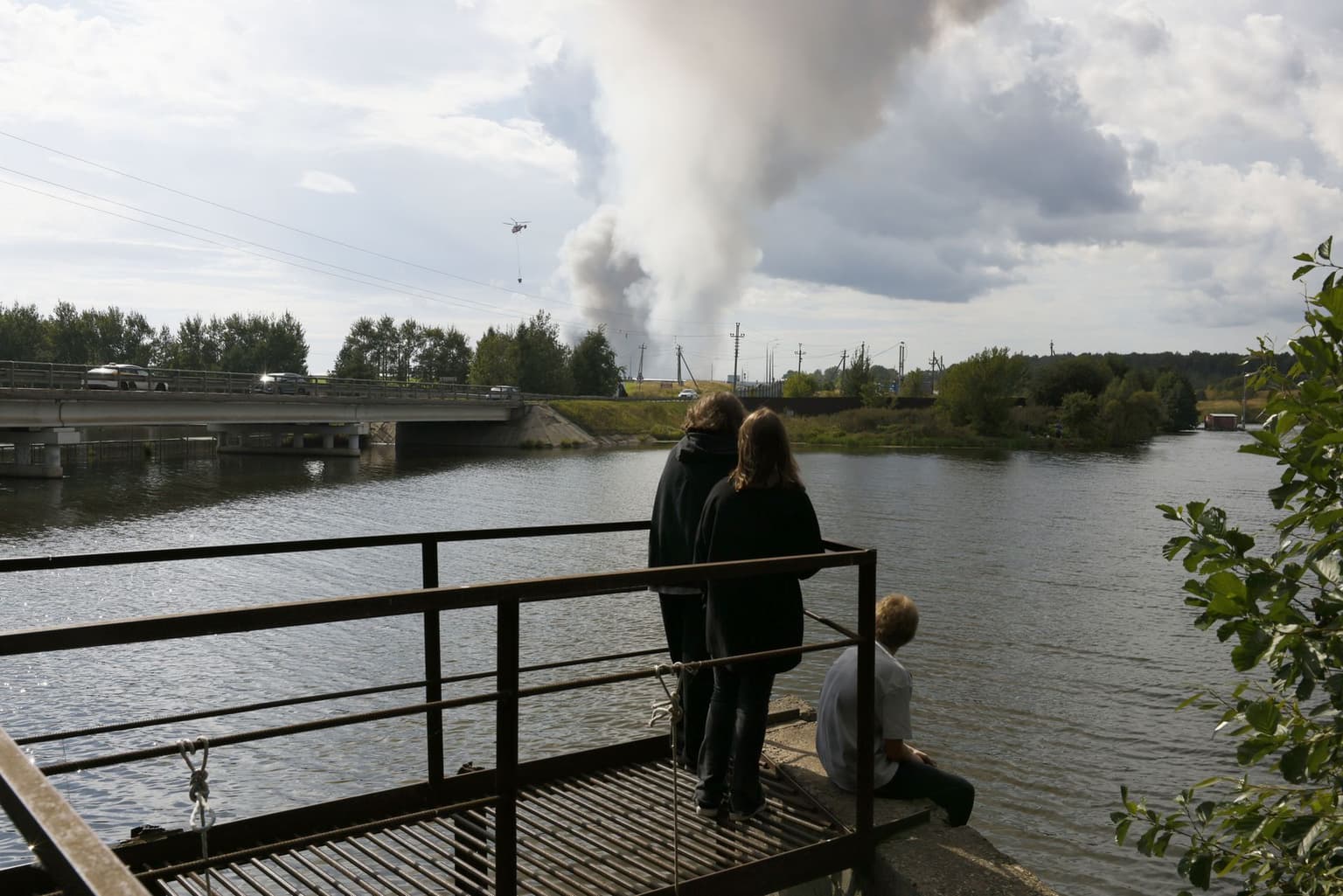
Black smoke rises from a distribution warehouse following a Ukrainian drone attack near Moscow, Russia, on August 16, 2026. (Stringer/Anadolu via Getty Images)
 on Google
Liubov Tsybulska
Director of Join Ukraine
When we started this series in the spring, the idea was simple: every month, to take apart the five most notable Ukrainian strikes deep into Russia and see how Russians themselves are living through them.
This is the third installment — and the format had to change substantially.
In July, the five "most significant" strikes had already been racked up by around the middle of the month, and the list of noteworthy ones kept growing. So this time there is no strict ranking: first, briefly, about the strikes on oil infrastructure, which have already become routine for Russians, and then about the main story of the month, one that was entirely absent from our previous pieces.
Let's start with oil because you can see how quickly the bar is shifting here.
On July 4, drones hit the St. Petersburg oil terminal and the port of Vysotsk on the Baltic. On July 6, for the first time in the war, drones reached the Omsk oil refinery — Russia’s largest plant and the last of the 11 biggest gasoline producers that had not been hit until then; that is 2,500 kilometers (about 1553 miles) from the Ukrainian border.
On the night of July 8, the Saratov oil refinery shut down. On July 11–12, Ukrainian drones set the Syzran oil refinery ablaze — according to satellite imagery, the fire engulfed the AVT-5 unit, while a second primary refining unit, AVT-6, sustained significant damage; refining at the plant was halted completely.

On July 13–14, the target was "Gazprom Neftekhim Salavat" in Bashkortostan — almost 1,500 kilometers (932 miles) from Ukraine.
Separately, in the middle of the month, a Ukrainian naval drone destroyed the Federal Security Service patrol ship "Izumrud" near Novorossiysk — the very ship that in November 2018 took part in the seizure of Ukrainian boats in the Kerch Strait.
The hunt for the "shadow fleet" continued as well: the Unmanned Systems Forces struck nearly two hundred vessels of the "shadow" fleet in the Black and Azov Seas. Although the extent of damage to each vessel cannot always be assessed independently, every strike was filmed.
What a year ago would have been the top news of the week is now a line in a daily summary. And that is visible even in the Russian regional communities we track.
Our monitoring covers around 1,000 regional Telegram and VKontakte groups, from Pskov to Khabarovsk, where Russians usually discuss housing and communal services, prices at the local store, and petty officials — and far less often such "trifles" as geopolitics or the war.
The main story of July, of course, is the Wildberries warehouses, Russia's largest marketplace.
The tone around Wildberries is noticeably different from the tone around "ordinary" strikes. We aggregated 223,793 reactions under Telegram posts about the warehouses and 1,174,336 under all other posts about strikes over the same period.
Among the other strikes, the prayer/hands-together reaction accounted for 17.6%; under the Wildberries posts, only 4.4%.
The share of the clown-face reaction, often used for mockery, meanwhile reached 15.3% against 9.6%.
That points to a markedly more sarcastic response to the attacks on the marketplace, although the emoji itself does not make it possible to establish exactly whom the user was mocking — Ukraine, Wildberries, or the Russian authorities.
The comments show that the anger is aimed not only at Ukraine. There is no shortage of anti-Ukrainian outbursts — they appear in roughly 7–8% of comments.
But alongside them come steady grievances against the authorities, ruling party United Russia, and the air defenses: together about 5% of comments on Telegram and 9% on VKontakte.
On the latter platform, complaints about their own side even slightly outnumber attacks on Ukraine.
"I wonder, will Wildberries employees and sellers go and vote for United Russia after this?" — the most upvoted comment under a Krasnodar post, 339 likes. "Why pay taxes at all if your state cannot protect you?" — 199 likes from occupied Crimea.
"They'd have done better to give us a bonus" — 160 likes under a post about awards handed out to warehouse workers.
Someone quotes Orwell on a war that "must go on forever without victory, in order to preserve the established order." And someone in Tambov spells out the essence of dual use in plain words: "The owner of Wildberries knew that sanctioned components for unmanned aerial vehicles were going through her company — that's why she wrote in that force majeure clause."
Speaking of force majeure: on July 7, eleven days before the first strike, an updated Wildberries offer agreement took effect, which excluded compensation for goods destroyed as a result of "the fall of an unmanned aerial vehicle."
The marketplace did later start paying compensation, but the amounts are often disproportionate to what was lost.
Over more than 25 years of Putin in power, Russian society has largely lost its civic self-awareness and its traditions of political participation.
In the reactions we are seeing, the Russian citizen — in this particular case, the entrepreneur — often behaves as though they were not a party to the conflict but a third party: just living their life, selling socks or stylish tactical smartwatches.
The war is somewhere out there, on television. And when their business is destroyed, they meet it with an almost childlike incomprehension: "But what did we do?"
On Threads or X, you can also come across posts by "ordinary Russians" — not propagandists or activists, but ordinary people for whom, until recently, the war was a purely on-screen event.
They describe their suffering and their economic losses, and Ukrainians who care comment on these posts actively: ironically, sarcastically, aggressively.
In response, these Russians write: "I'm not interested in politics," "I was just doing my job," "I never did anything bad to you," "Why are you being so aggressive toward us?" They speak as if they were outside this war: the Russian state is one thing, and they are quite another.
The likely reason for this is the bargain the Russian authorities held with their society for many years.

It was simplicity itself: you don't meddle in politics, you keep your head down, you remain a "little person" — and you are left alone, and in return you get a certain standard of living and security.
For a quarter of a century, for a large part of society, this genuinely worked. And now the little Russian person, who did everything "by the rules," sincerely does not understand why it was their turn to be hit: they are convinced they held up their end of the bargain.
Where this sense of injustice will spill out is, honestly, unknown.
One can imagine ruined entrepreneurs marching on the Kremlin one day, the way Prigozhin once did, but that has more than a whiff of fantasy about it. One can imagine the opposite: that the grievance will be channeled against Ukraine and will feed public mobilization — but that is also unlikely, because it, too, requires self-organization. And we did not see it at earlier stages of the war either, with the possible exception of the Kursk operation, and even then only partly.
The most mundane scenario is that nothing dramatic happens at all, and the irritation simply settles as one more layer on a long-standing erosion: the Russian version of the social contract is cracking, but not where the authorities expected and not as loudly as we would like.
Editor's note: The opinions expressed in the op-ed section are those of the authors and do not purport to reflect the views of the Kyiv Independent.