As Russia attacks Ukraine’s grid, solar offers a path to resilience
With help from government incentives, Ukrainian businesses and households are increasingly investing in solar.
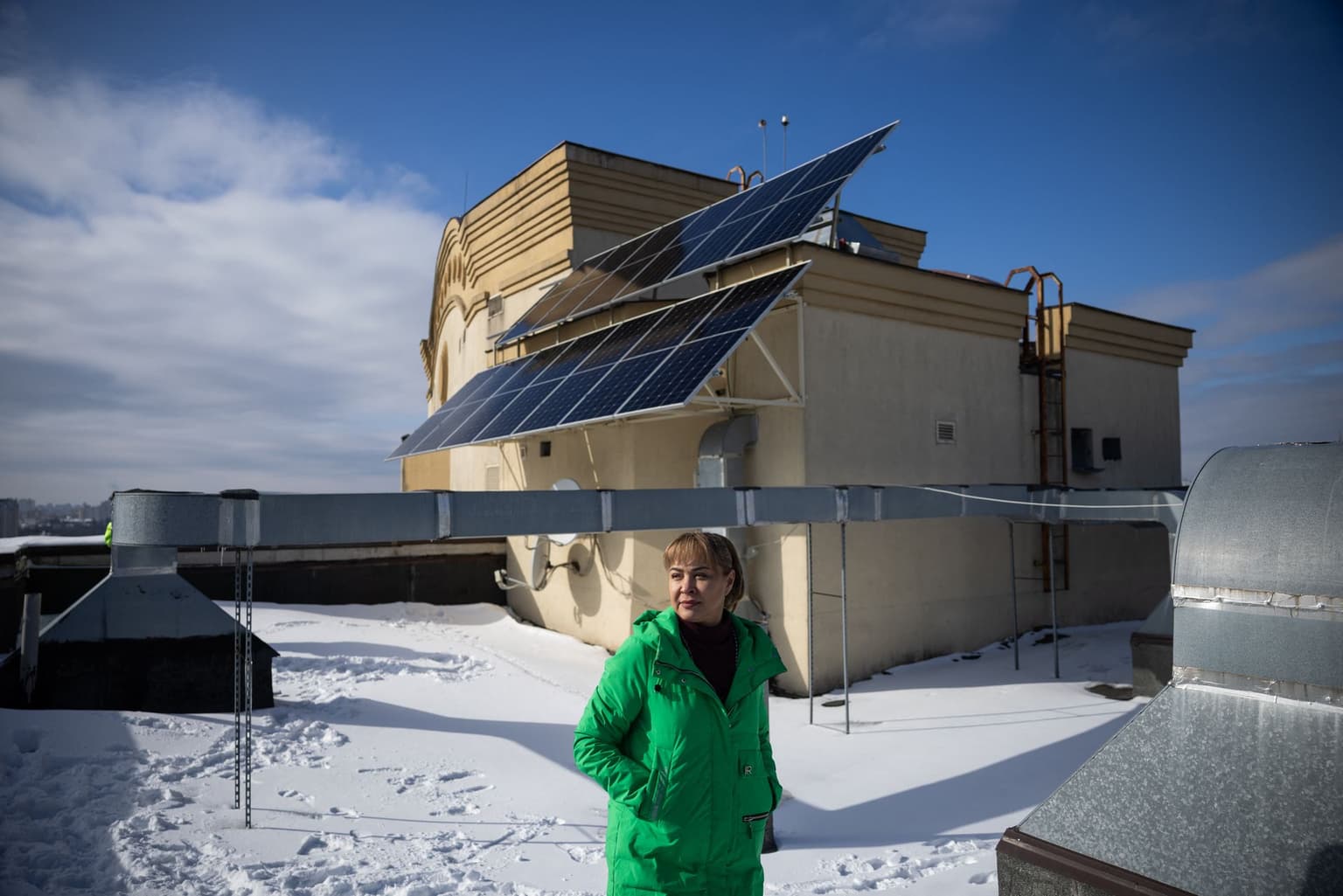
Local resident Tetiana Chernyshenko, 55, stands next to solar panels installed on the rooftop of her residential building to mitigate the effects of power outages, in Kyiv, Ukraine, on Feb. 19, 2026. (Henry Nicholls / AFP via Getty Images)
 on Google
This story was produced by Grist and co-published with the Kyiv Independent.
On a spring day earlier this year, 10 men stood on the rooftop of a door manufacturing facility in the central Ukrainian town of Bila Tserkva, surveying the rows of solar panels that surrounded them. Since Russia invaded in 2022, the town has endured repeated attacks, triggering mass power outages. For the factory, which supplies doors to homes and businesses, keeping production going had become extremely challenging.
The outages were particularly brutal in the winter, when limited power supplies led to rolling blackouts across the country.
Some days, the employees burned discarded wood in a fireplace to keep the warehouse warm. The facility has backup generators, but they were expensive to run. Tired of relying on a grid that was being routinely bombarded by Russian missiles, Yaroslav, the facility’s owner, decided to switch to solar earlier this year. Yaroslav requested that the Kyiv Independent use only his first name and withhold details about the facility for fear of Russian retaliation.
Switching to solar energy will "further expand our capacity and be a bit more independent from the general grid," he said. "It will be cheaper, more economical, and more ecological."
In the spring, he contacted Yasno, a Ukrainian electricity and gas supplier owned by Ukraine's largest private energy company DTEK, to install solar panels on his rooftop. Yasno’s clients pay for the panels to be installed, often with the help of a government program that covers some of the installation expenses.
Ukraine created incentives to encourage businesses to switch to renewable energy, like the "Affordable Loans for 5-7-9%" program, which offers loans to purchase solar panels and other equipment. The preferential loans have interest rates of 5, 7, or 9 percent, depending on the type of business, and can cover up to 80 percent of the installation costs.
Yasno will ultimately decide where to station hundreds of solar panels on the warehouse rooftop and install them. The project is one of dozens that the company has undertaken across the country. In the past two years, it has installed solar panels at 117 sites with a combined capacity of 23 megawatts. The company paused its work for the first two years of the war, but resumed operations in the summer of 2024.
Volodymyr Hershtun, a service maintenance manager with Yasno who led the project in Bila Tserkva, said that Ukraine is rapidly developing its renewable energy portfolio in part because the country needs to be resilient as it continues to face a barrage of Russian attacks.
"The enemy is trying to destroy energy infrastructure, and we are building what is very easy to restore," he said. "And those same systems can store electric energy."

Before Russia’s invasion, Ukraine relied on a highly centralized electricity system dominated by nuclear power. More than half of the country’s electricity came from four nuclear power plants, while natural gas and coal generated roughly a quarter of the energy mix.
Renewables made up a small share of the energy portfolio, though the country had been rapidly expanding its solar generation in the years leading up to the war. The surge was driven by the country’s "green tariff" program, which encouraged households and businesses to produce solar and wind power through guaranteed above-market payments for electricity.
Ukrainian law guarantees the tariff until 2030, and lawmakers have described the program as a step toward integrating the country into the European Union’s energy market.
read also
Those government incentives led Ukrainian businesses to install about 8 gigawatts of solar by 2022. But Russian attacks on Ukraine’s energy infrastructure over the past few years have upended that model. Since the invasion, missiles and drones have repeatedly struck power plants, substations, and transmission lines, leaving millions without electricity during the coldest months.
Roughly 30 percent of the installed solar capacity and most of the country’s 36 wind farms in the south were either destroyed, fell under Russian occupation, or are unaccounted for. The Zaporizhzhia nuclear power plant in southeastern Ukraine has also been shut down and under Russian control since the invasion began. Given the legacy of Chornobyl, many Ukrainians live with the fear of another nuclear disaster.
The repeated attacks on the grid have caused prolonged power outages. Parts of Kyiv continue to ration electricity with scheduled power outages that can last for hours. Ukraine’s National Bank has said that Russia’s energy infrastructure attacks this year have worsened the electricity deficit assumptions, raising them from 3 percent to 6 percent.

With the vulnerabilities of relying on large, centralized power stations exposed, Ukraine has begun accelerating its shift toward smaller, distributed sources of electricity that are harder to knock offline.
In 2025, the Solar Energy Association of Ukraine estimated that 1.5 GW of new solar capacity was built — almost double the prior year's total — and expects 2026 installations to at least match that pace.
"Renewables have become the very obvious choice for Ukraine when the full-scale invasion started and when Russia started deliberately and heavily attacking the energy infrastructure, especially centralized generation facilities," said Anastasia Vereshchynska, the director of the European-Ukrainian Energy Agency, a non-profit that works with energy efficiency and renewable resources in Ukraine.
The investments are likely to help Ukrainians weather brutal winters. Last year, as temperatures dropped to -1 degree Fahrenheit (-17 degrees Celcius), Russia’s bombardments caused widespread electricity and heating outages. Kyiv, Ukraine’s capital, had just half the electricity supply it needed to weather the winter, and President Volodymyr Zelenskyy declared a state of emergency.
In Ukraine, solar panels are a "basic human right."
Volodymyr, a taxi driver in Kyiv who asked that his last name be withheld for safety reasons, told Grist in May that during last winter’s attacks, his apartment building lost power, leaving him and his family without heating and hot water. Fortunately, he said, his apartment faced south and received sunlight most of the day, keeping it relatively warm.
In an attempt to minimize the effects of outages, the building’s management company has since decided to install solar panels on the roof to help keep the boiler turned on and operate the elevators. The installation is part of the 5-7-9% program.
"It’s a cool thing that the government covers at least part of the cost," said Volodymyr. "In emergency cases, during power outages, you could turn to the solar panels. There is no harm to the planet. It’s a good thing."
The need for renewable energy is especially critical in communities closest to the war’s front lines. As Russian forces advance, towns and villages are increasingly cut off from the energy grid as attacks destroy power lines, and the threat to maintenance workers makes repairs difficult or impossible. Some villages, in particular, have become so dangerous that repairs cannot be conducted, leaving residents without electricity and access to the outside world.

In those communities, volunteers and non-governmental organizations have stepped in to install solar panels and battery systems that can power homes and businesses.
Denny Ugorchuk, the founder of Kosmo Tabir, a non-governmental organization that works to help villages access solar energy, said that much of the funding for large projects comes from the help of international partners in the West, while local donations from Ukrainians help fund smaller projects. In one village, solar panels installed at a private residence gave a 50-year-old woman access to online university classes.
In Ukraine, solar panels are a "basic human right," said Ugorchuk. "People should have access to communicate with one another — you can call a doctor, the police, and it helps you feel safe."