'A shirt that lasts a lifetime' — Kyiv Independent staff members on their first vyshyvanka
 on Google
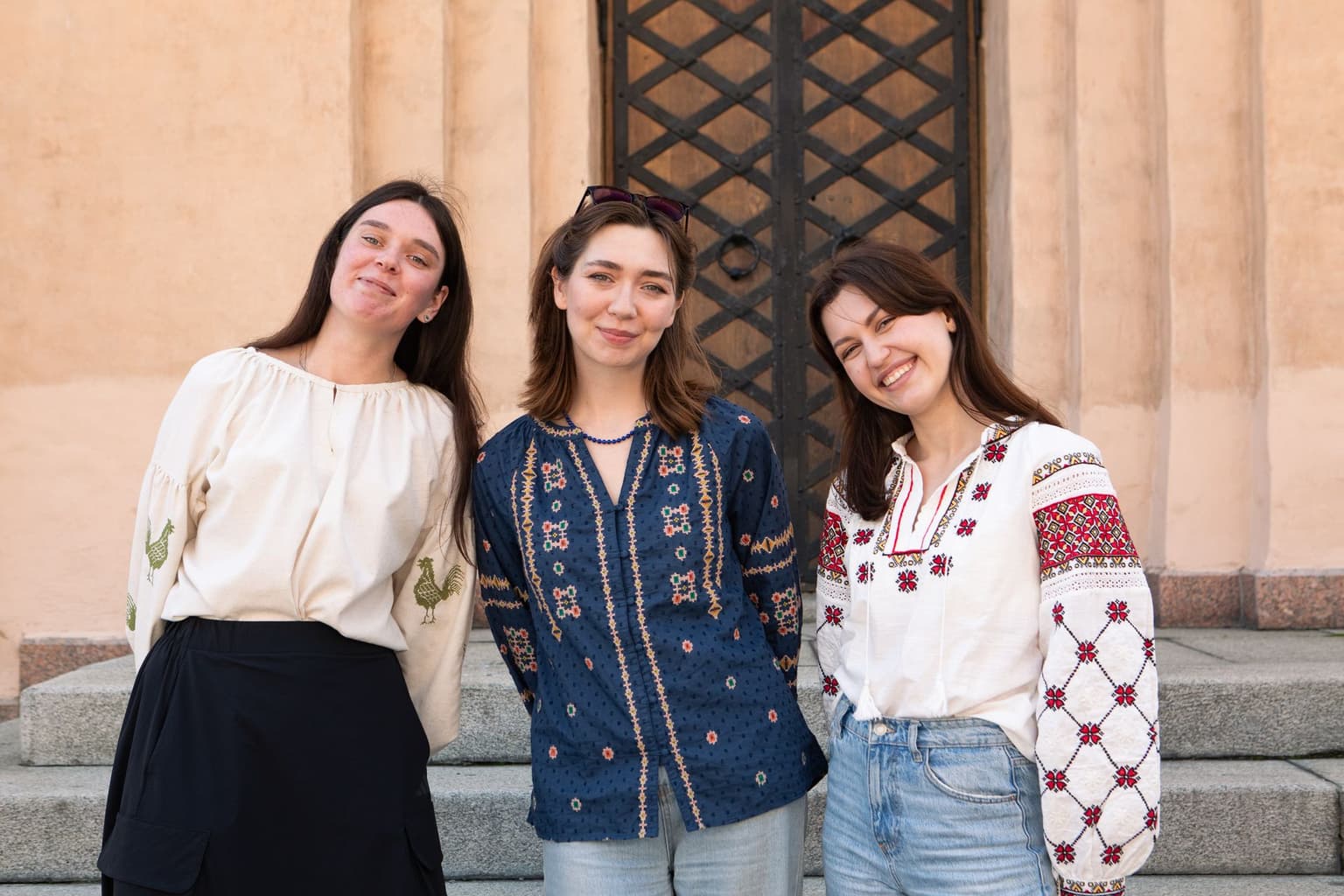
Editor's note: This article has been adapted from stories we shared on social media and via email for the launch of the Kyiv Independent's first vyshyvanka, one of the items featured in the Old Patterns, New Stories: Embroidered Collection. You can see the collection here, and sign up to get updates on new collections and special discounts from our store here.
Ukrainians have worn vyshyvankas — traditional embroidered shirts or dresses — throughout history, particularly for special occasions like weddings and holidays.
The 2014 EuroMaidan Revolution, the following Russian annexation of Crimea, and the invasion of Ukraine were catalysts for many Ukrainians to look into their traditions and history. This led to a renewed popularity of the vyshyvanka, which is now widely seen throughout Ukraine as part of everyday outfits.
Here, our staff members reflect on what it meant to them to get their first vyshyvanka — from connecting with their roots to no longer having to share one with their older brother.
"The embroidery just happened to be from the region I'm from — it was a lucky coincidence"
Olga Rudenko, editor-in-chief
I bought my first vyshyvanka in the summer of 2014, to wear on Ukraine's Independence Day.
It was the first Independence Day after the EuroMaidan Revolution. I never owned a vyshyvanka before that. I think I was 25, and, at that time, right after the revolution and the start of Russia’s invasion, there was this revival of Ukrainian national identity. So, I thought it was a must to finally get a vyshyvanka. I bought it specifically to wear on Ukraine's Independence Day, which is Aug. 24.
The vyshyvanka I bought was very traditional — it was white with a round neckline and just very traditional red-and-black embroidery. I looked it up after I bought it to see which region of Ukraine the embroidery comes from, and it just happened to be from the same region I'm from, Dnipro – at least that’s what I found online at the time. It was a lucky coincidence. I actually wore that vyshyvanka every Independence Day for a long time.

It was the only one I owned until 2022, when I started buying them up. Now I have maybe eight vyshyvankas. I often wear them for public speaking events, special occasions, or conferences. It's actually very convenient because traveling outside Ukraine is pretty difficult now, and you can throw your vyshyvanka in a suitcase and wear it at a conference or a speaking event. It always looks great, and it's something that connects you to Ukraine.
It is so easy for somebody watching Ukraine from the outside to view Ukraine as just the war, and nothing beyond that. But Ukraine has such a robust culture that is thriving even now, and its traditions and fashion are part of that.
"I have a small dream: to one day find an authentic vyshyvanka from my home region"
Tata Omelchuk, project manager at the Kyiv Independent Store
I was born in Luhansk Oblast, in the city of Siverskodonetsk, and lived there until 2016. Growing up, almost everyone around me spoke Russian. We lived close to the border with Russia, and Ukrainian cultural identity often felt distant, blurred, or heavily filtered through a Soviet or Russian narrative.
As a child, I attended Ukrainian folk dance classes. At the time, I thought the costumes we wore were traditional Ukrainian clothing. But looking back now, I realize they were actually a stylized version of "Ukrainian culture" shaped through a Russian Imperial lens. Satin ribbons, theatrical costumes, bright polyester embroidery — more like a performance of Ukrainian identity than the real thing. Nevertheless, they shaped my understanding of what a vyshyvanka was for many years.
No one in my family owned a vyshyvanka. I didn't know that different Ukrainian regions had their own embroidery traditions, colors, and symbols. I had no idea that the Luhansk Oblast had its own embroidery heritage, too.


My hometown was occupied twice — first in 2014, after which it was quickly liberated, and again in 2022. It remains occupied to this day.
After the full-scale invasion, my family scattered across different places and countries. I spent the first months of the war in Italy before returning to Ukraine. My mother moved to Khmelnytskyi Oblast — the region my grandfather was from.
In the summer of 2022, after I came back to Ukraine, I visited her there. One day, while walking around Khmelnytskyi together, she bought me my very first real vyshyvanka. A handmade one.
Since we started working on the Kyiv Independent embroidered piece, I have a small dream: to one day find an authentic vyshyvanka from Luhansk Oblast. Maybe even a vintage one originally made there. They are incredibly rare. I have been searching for months now and still haven't managed to find one.
"I like the designs so much — we don't have anything like this in the UK"
Dominic Culverwell, business reporter
When I moved to Kyiv from the UK in 2023, I had already long admired Ukrainian embroidery; a friend of my mother is a Lviv-born dressmaker who makes beautifully embroidered clothes. When I decided Kyiv would be my new home, I celebrated by going to one of Kyiv's best-known vyshyvanka stores to get one of my own.
With the help of a sartorially savvy friend, I found the right one, with folk motifs worked into a contemporary cut that I could wear casually, even back in England. The price gave me pause for thought, but my friend talked me round. She reminded me that it's a shirt that lasts a lifetime. I hope she's right!
A week later, I wore it to my interview at the Kyiv Independent. It must have been a good luck charm, as I was offered the job.


I wear it for every celebration now — Christmas, Easter, New Year's. I love showing it off when I'm home in the UK. When people ask where it's from, I proudly tell them it's a Ukrainian vyshyvanka. And then they want to know where they can get one, too.
I now have three. I just like the designs so much. Ukrainian men get to wear embroidery with these incredible patterns — we don't have anything like this in the UK.
"The rooster from Kherson represents life, protection, and light"
Daria Kolos, digital marketing manager
I grew up in Kherson in southern Ukraine. I got my first vyshyvanka when I was 13. It wasn't a traditional vyshyvanka; my mom made it for me. She just bought some embroidery strips and sewed them onto a shirt. We used to wear vyshyvankas at school for some celebrations. In Kherson, people didn't wear vyshyvankas every day, but you could see people in the city wearing them at the holidays.
I bought my first proper vyshyvanka last year for Independence Day. I like to dress up for national holidays, my husband had just bought one for himself, and I wanted us both to wear vyshyvankas for celebrations. We both wore our vyshyvankas for our wedding anniversary.
A while ago, I saw someone on Instagram posting a vyshyvanka handmade by a girl in Kherson, featuring a traditional Kherson pattern, which is quite unique. I followed her, and a year later, I ordered a vyshyvanka from her. The pattern has green roosters — they were common in historical vyshyvankas from Kherson Oblast because we are on the steppe, so animal patterns were our thing. The rooster is supposed to represent life, protection, and light.


The designer comes to Kyiv from time to time to sell her work at small markets, and one day I decided to visit. We didn't know each other before, but when we met, we felt an immediate connection. We had no need to talk because we shared the same pain. We had a lot more in common than I thought.
People quite often ask me where I got my vyshyvanka and want to know more about it. It's a cool opportunity to tell people about my home and remind them that Russia is still occupying the region.
"It's a subtle way to represent Ukraine when I travel abroad — I love that about it"
Zakhar Protsiuk, chief operating officer
I grew up in Ivano-Frankivsk, in western Ukraine — a region where Ukrainian traditions were less oppressed by Russian influence than in the east. My brother and I shared a single vyshyvanka — handed down from our grandmother, one between two boys. At our school, the uniform was non-negotiable — a suit and tie, with no exceptions. Well, almost no exceptions. If you wore a vyshyvanka, the tie could stay home.
My brother had clocked this immediately. And so, with the quiet ruthlessness only an older sibling can muster, the vyshyvanka was almost always on his back by the time I went looking for it.
In 2009, our mum, a professor of literature, took on an extra job on the side. The moment her paycheck came in, one thing was at the top of her agenda: buying me my own vyshyvanka. Finally, I didn't have to wear a tie to school every day.
A few years later, when I was around 13 or 14, I joined my dad — a novelist — on a trip to a book fair. Among the stalls, I came across something I'd never seen before: a modern vyshyvanka, still embroidered, but in a contemporary style, nothing like the traditional vyshyvanka I'd grown up fighting over. I was completely sold. My dad had no choice but to buy it for me.

What I notice, looking back, is how consistent my family was. My grandmother, my mum, and my dad all made sure I had a vyshyvanka. It was just something worth having.
These days, I (mostly) buy my own vyshyvankas (the one in the photo above was given to me by my mum). I particularly like to wear them when I'm traveling abroad as a way to represent Ukraine. It's a subtle thing, but I love that about it.
from the Kyiv Independent