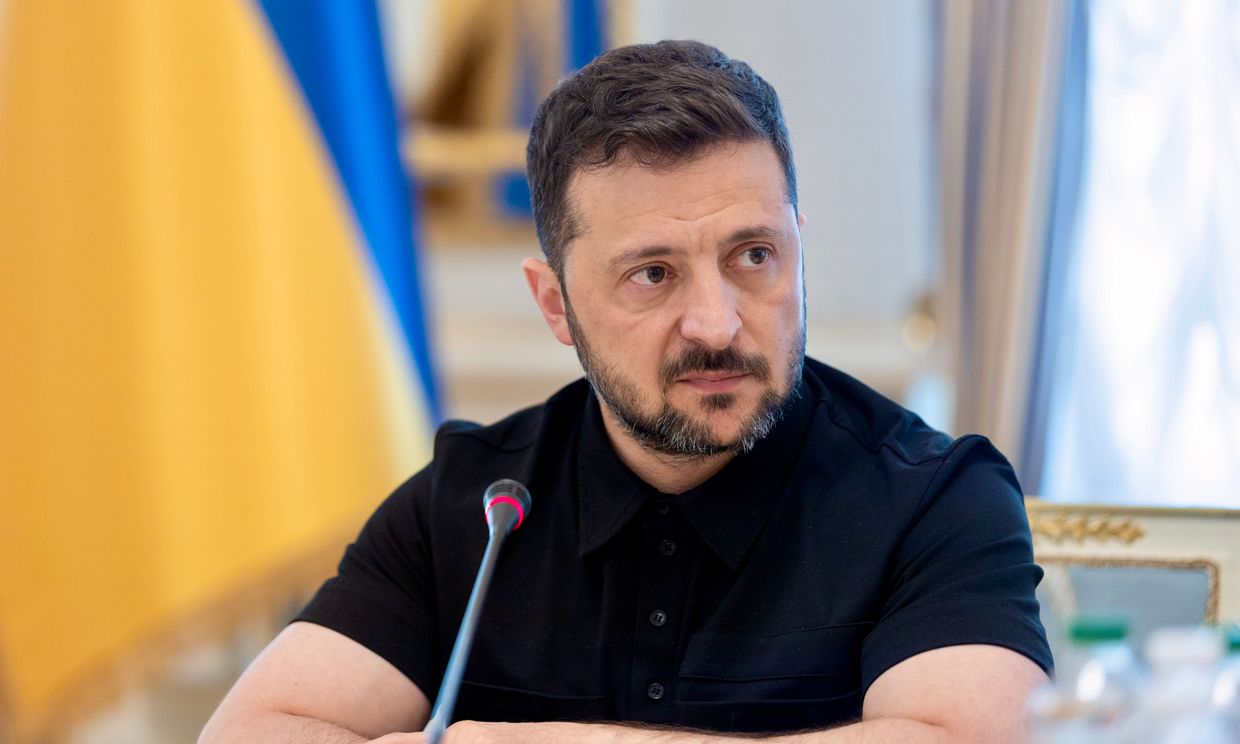
President Volodymyr Zelensky signed a decree on Dec. 2 to approve a proposal by the National Security and Defense Council to ban Russian-affiliated religious groups and impose sanctions on a number of pro-Moscow bishops.
The primary target of these measures is the Ukrainian Orthodox Church of the Moscow Patriarchate, an affiliate of the Russian Orthodox Church.
The National Security and Defense Council instructed the Cabinet on Dec. 1 to draft a bill on such a ban. The bill is expected to be considered by the Verkhovna Rada, Ukraine's parliament.
Zelensky also sanctioned Vadym Novynsky, an ex-lawmaker from the pro-Russian Opposition Bloc and sponsor of the Moscow-backed church; Pavlo Lebid, head of the Russian-affiliated church's Kyiv Pechersk Lavra and an ex-lawmaker from the pro-Russian Party of Regions, and Rotyslav Shvets, a bishop who "annexed" his Crimean diocese of the Russian-backed Ukrainian Orthodox Church to the Russian Orthodox Church in June.
Sanctions were also imposed on several other Moscow Patriarchate bishops in Ukraine's Crimea and a bishop who annexed his diocese in Russian-occupied parts of Luhansk Oblast to the Russian Orthodox Church in October.
The SBU reported on Dec. 2 that it was conducting searches at Moscow Patriarchate churches and monasteries in Zhytomyr, Rivne, and Zakarpattia oblasts.
The security measures aim to counter the subversive activities of Russian special services in Ukraine and protect the population from provocations and terrorist attacks, according to the SBU.
During previous raids, the SBU found Russian propaganda and xenophobic literature, Russian passports belonging to senior clergy, and documents with pro-Russian ideological messages at the premises of the Russian-backed church.
In May, the Moscow-affiliated Ukrainian church said it would have “full independence” from the Russian Orthodox Church, reacting to criticism of Russian-backed church leaders amid the full-scale invasion of Ukraine.
The Ukrainian branch also said that it “condemns the war” and “disagrees with the position of Patriarch Kirill of Moscow on the war in Ukraine.”
However, skeptics said it was just a ploy to appease critics since the Ukrainian branch effectively remained part of the Russian church and did not declare “autocephaly” – the Orthodox term for genuine independence. Under Orthodox rules, only one independent - or "autocephalous" - church can exist in a specific country.
The Russian-backed church's full independence under Orthodox rules would imply its merger with the independent Orthodox Church of Ukraine but the Moscow-affiliated church has opposed such a unification.
Edit post
Zelensky approves proposal to ban Moscow-backed church, sanctions bishops.
December 3, 2022 1:07 AM
2 min read
This audio is created with AI assistance
 (Updated: )
Editors' Picks
With no new US aid packages on the horizon, can Ukraine continue to fight Russia?
From buffer zone to new front: Russia pushes deeper into Sumy Oblast
As Russia inches closer to Dnipropetrovsk Oblast, new Ukrainian region might soon be at war