When righteous calls to end the war become warmongering
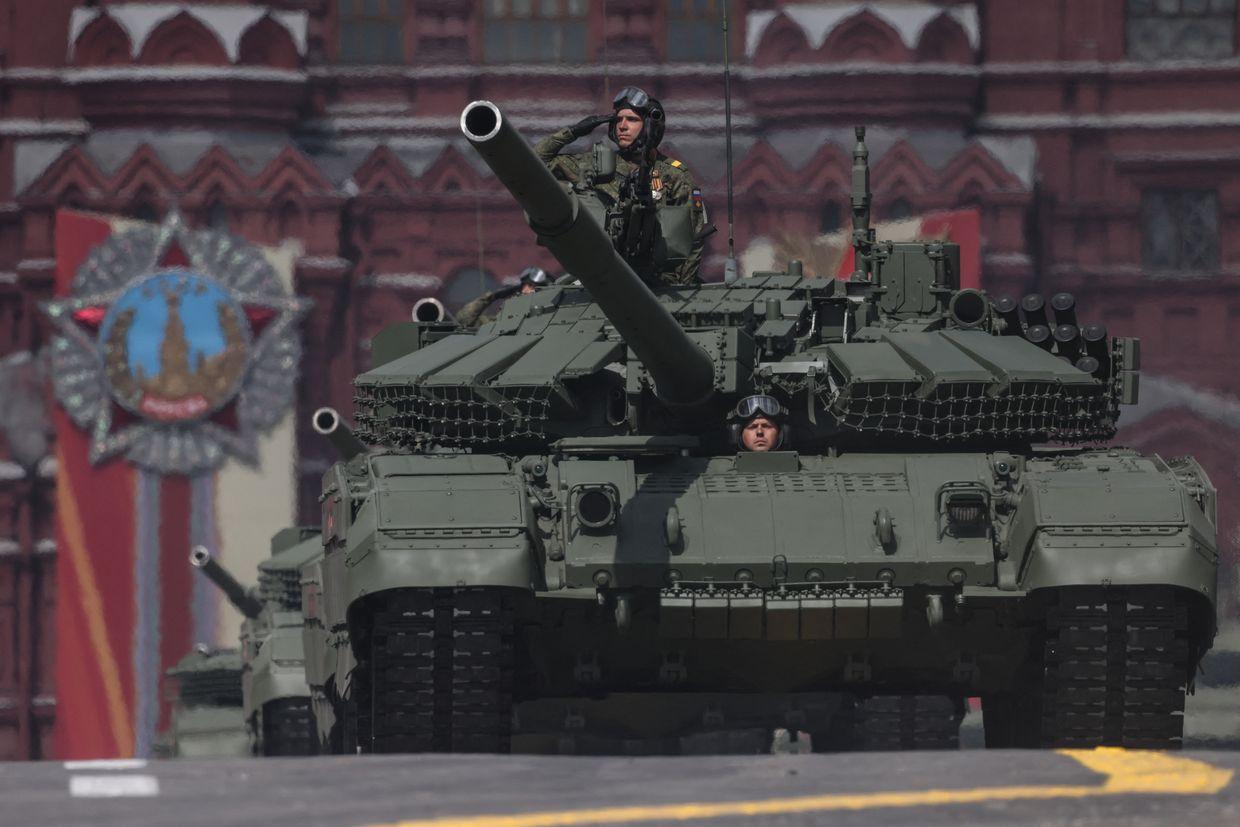
Russian tanks roll across Red Square during the Victory Day military parade in Moscow, Russia, on May 9, 2025. (Stringer / AFP)
 on Google
Andrew Chakhoyan
Academic director at the University of Amsterdam
Russia's war on Ukraine has yet to end because Russia keeps waging it.
It is shocking, though regrettably unsurprising, that in the fifth summer since the 2022 escalation by the aggressor, and 12 years since Russia first invaded Ukraine, pundits, scholars, and unscrupulous politicians still offer "solutions" to resolve a "conflict," pointing up and calling it down while ignoring basic facts and laundering the Kremlin's lies in plain sight.
To offer blood, sweat, and tears would be decidedly out of fashion and no way to make friends these days, so why not call for "diplomacy," always a safe choice? Is not talking better than killing?
This rhetorical misdirection invites agreement with a claim no one disputes while quietly smuggling in insidious manipulations.
Moscow plants false premises in seemingly innocuous language, and these enter public debate through either careless repetition or deliberate amplification. Russia's invasion becomes a "war in Ukraine." Moscow's neo-imperial bid for a sphere of influence, where neighbors are to be murdered until they give up sovereignty, becomes "security interests." Ukraine's refusal to be massacred morphs into an obstacle to peace. A few carefully chosen narrative threads can make Russian occupation, torture chambers, and mass graves sound humane, and self-defense appear reckless.
Two recent examples stand out.
A Russian oligarch, Andrey Melnichenko, whose ammonia plants feed the aggressor's military-industrial complex – a supply chain culminating with Russian missiles hitting Ukrainian homes – is presented to us by The Economist as an "industrialist." A calculated choice for everyone knows that an oligarch in today's Russia is a billionaire who is allowed to keep his fortune at Vladimir Putin's pleasure.
Melnichenko's guest essay is full of "fresh" ideas; The Economist bills it as an act of courage to speak up. But engage with the four scenarios he lays out: humiliation, Chinese vassalage, fragmentation, and permanent siege, and you will have tacitly legitimized the premise-setting fraud. To contest Melnichenko's asinine take on sovereignty comes at the cost of giving credence to the big lies on which the whole argument rests.'
Moscow's war of choice, an attempt to recolonize Ukraine, is surreptitiously repainted as a struggle between "the West" and Russia. Neither Ukraine's suffering, as the only country spilling blood in defense of freedom, nor the agency of the Ukrainians, embodied in the valor of the bravest nation on Earth, resisting its destruction, gets a mention. In fact, both are dismissed in absentia.

The proxy-war sleight of hand is nearly invisible, yet it undergirds the Melnichenko "info op," with The Economist cast as a patsy.
The tired fabrication "Russia under siege" is deployed to justify the unjustifiable. In 1942, Joseph Goebbels addressed a crowd in Berlin beneath a giant banner that read, "Never forget that England forced the war on us." In an eerie echo of that logic, Putin, and now Melnichenko, blame Russia's war of choice on NATO.
Negotiations are among the instruments through which Moscow delays accountability, disguises aggression, and seeks to legitimize gains achieved through violence.
The second example comes from the pages of the FT, where Samuel Charap, an American scholar who studies Russia but appears to understand nothing about it, pleaded for diplomacy “to bring this bloody, destructive war to an end.”
Could anyone possibly object to such a noble pursuit? Except that this righteous call for "action" (read: inaction) recursively attributes the war to itself. The horrors must end! Such comfort-giving language sounds so much more agreeable than saying that the aggressor must be confronted and punished if Moscow's appetite for warmaking is ever to be curbed.
Charap appears blind to the Kremlin's use of diplomacy as an instrument of war, not too different from the weaponization of energy through Gazprom, information through Russia Today, lawfare, and dark money, as documented by Catherine Belton in Putin's People. Valerii Zaluzhnyi, who has firsthand experience with Russia's war, explained that negotiations are among the instruments through which Moscow delays accountability, disguises aggression, and seeks to legitimize gains achieved through violence.
Charap's own examples give away the weakness of his case. He points to Korea and Colombia as success stories in diplomacy. South Korea has no peace treaty with its belligerent and now nuclear-armed neighbor, only an armistice. Colombia's settlement has left a country where former FARC territory is now contested by many armed groups, and cocaine production has climbed to record levels. If these are the models Charap reaches for, he has made the case against himself.
The more pertinent examples, Germany and Japan in 1945, are nowhere to be found. In both cases, the aggressor's capacity to wage war was destroyed first. Reparations, war-crimes tribunals, atonement, and diplomacy followed.
"You were given the choice between war and dishonor. You chose dishonor, and you will have war," said Churchill, addressing Neville Chamberlain, who believed he had secured peace in Munich in 1938 by striking a deal with Hitler.

Russia's revanchism has already reached Western Europe: the radioactive poisoning of Alexander Litvinenko in London, the Novichok attack in Salisbury that ultimately killed British citizen Dawn Sturgess, Russian drones entering Polish and Romanian airspace, and information warfare poisoning political discourse and weaponizing Western institutions against its citizens.
Calling it a hybrid war works like magic – Europe feels safe and secure, while talking heads on Russian state TV threaten to incinerate London, Berlin, and Paris.
"Без надії сподіваюсь" ("Without expectations, I still hope") are the immortal words of Ukrainian poet Lesya Ukrainka. She meant hope as an act of defiance, sustained by will when circumstances offered no comfort. What we see in parts of the old continent is its inversion: hope emptied of will and detached from action.
Opinion leaders and people in positions of authority entertain the baseless expectation that peace awaits only a breakthrough summit, a more skilled mediator, or a negotiated pause that will automatically lead to something better.
As Chatham House reminded in a recent study, ceasefires with Moscow, in Moldova, in Georgia, and twice at Minsk were a cynical farce on the side of Russia and an exercise in obfuscation, or self-betrayal to be more precise, on the part of Europe. Instead of abandoning its predatory ambitions, Moscow doubled down on malice and violence. Each attempt to skip past peace-through-strength has left Europe worse off than before.
"Ending the war" sounds morally unimpeachable. In practice, it manifests as warmongering when such calls leave the aggressor rewarded, armed, and undeterred from striking again. Ukrainians know the difference. The guns never truly fall silent unless aggression fails.
Editor's note: The opinions expressed in the op-ed section are those of the authors and do not purport to reflect the views of the Kyiv Independent.