US Congress has the power to help Ukraine. It’s time to use it
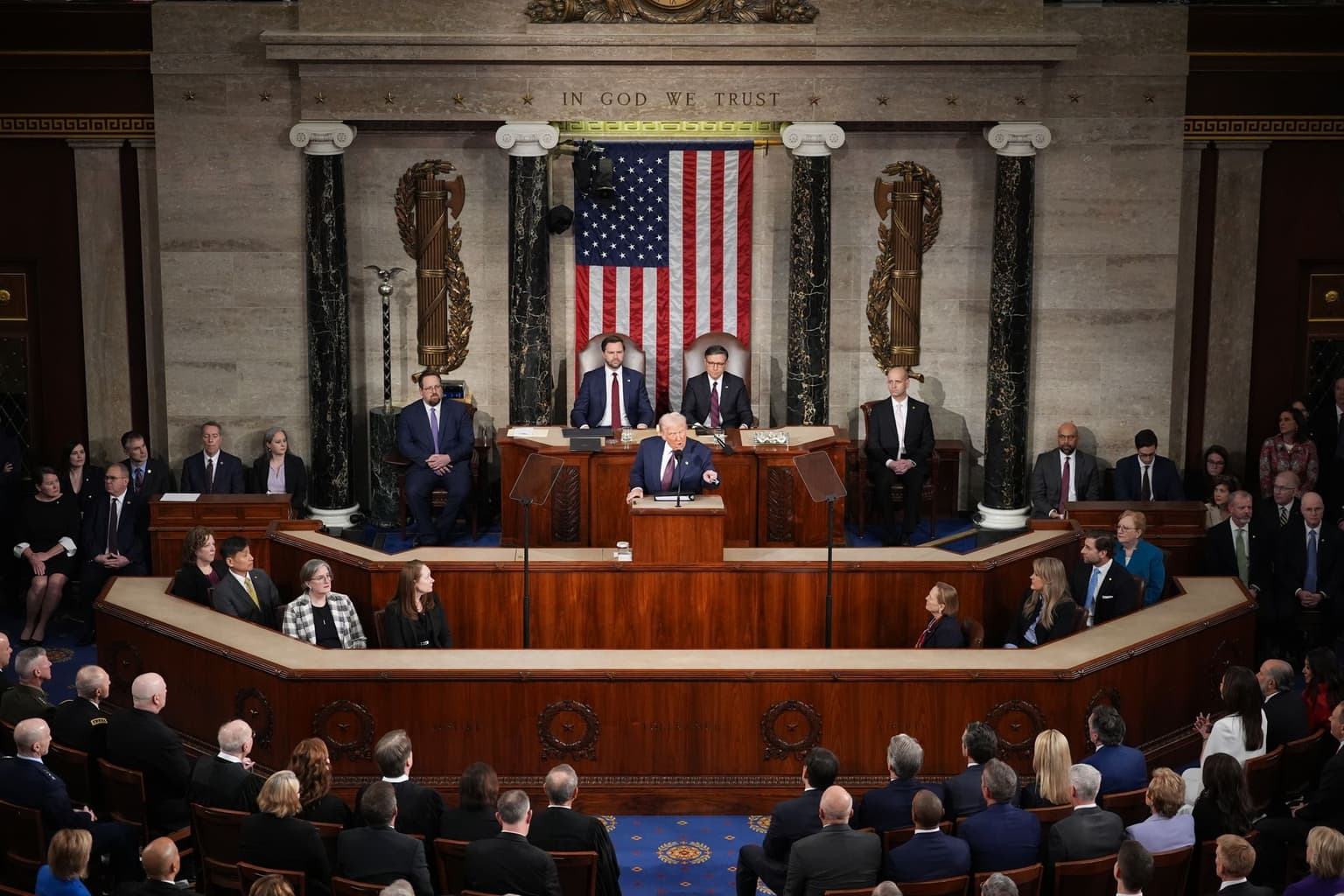
U.S. President Donald Trump addresses a joint session of Congress at the U.S. Capitol in Washington, D.C., U.S., on March 4, 2025. (Andrew Harnik / Getty Images)
 on Google
Gregory P. Wilson
Consultant and author
About the author: Gregory P. Wilson is a consultant, author, and former Deputy Assistant Secretary of the U.S. Department of the Treasury.
Oct. 24 is not a memorable date, but it was an important moment for Ukraine in the United States.
As the latest round of so-called “peace” negotiations flounders due to Russia’s intransigence, Kyiv is facing a significant financing gap to bolster its economy and defend its land from Russian President Vladimir Putin’s illegal aggression and nightly terror campaign.
That date is the eighteen-month anniversary of the bipartisan law that authorizes the President of the United States to “seize, confiscate, transfer or vest” immobilized (frozen) Russian sovereign assets in the U.S. financial system to help Ukraine.
More importantly, it’s also the reporting date when, by law, the Trump administration was required to submit three separate, regular reports to Congress on both the total amount of frozen Russian assets here and the status of international discussions with our allies regarding the use of these funds to assist Ukraine’s recovery and reconstruction.
To date, no such reports have been transmitted to Congress.
Last year, based on the information it collected, the Treasury Department issued its first Congressional report as required, but it failed to publicly disclose the entire amount for unstated reasons.
The Treasury reported there is $5 billion sitting idle at the Federal Reserve Bank of New York, but then, curiously, classified the remaining balance of funds without explaining why. Treasury has missed this year’s reporting deadline.
There are likely far more publicly undisclosed funds sitting in American banks, funds that could otherwise be used to help meet Ukraine’s urgent military and economic needs.
One respected expert estimates that there is as much as $50 billion in U.S. correspondent banks that otherwise could be used to help Ukraine plug its immediate $65 billion financing gap.
If, in turn, these funds could be combined with the European Union’s promised reparations loan of an estimated $140 billion, then Ukraine would be on a much firmer financial foundation.
On Dec. 2, the European Commission unveiled a major plan proposing both EU borrowing and a new Reparations Loan sourced from immobilised Russian central bank assets to cover Ukraine's budgetary and defense needs for 2026–27 — an important signal of Europe’s readiness to provide financial support.
Add in the other immobilized Russian sovereign assets in Europe, G7 nations, and other countries like Australia, and Ukraine would be the beneficiary of at least an initial down payment on Russian reparations due under international law for the damages Putin’s armed forces have inflicted since his initial invasion in 2014.
Tragically, as Russia continues to escalate the war with no peace in sight, U.S. President Donald Trump remains silent on seizing Russian assets.
Worse yet, his recent Russian-U.S. 28-point plan even went so far as to plan for the United States to actually profit from the return of those Russian funds through some vague investment vehicle, a point that is as unconscionable as it would be unlawful under current U.S. law.
If Trump fails to act – a continuing sign of weakness, not strength – then Congress must reassert its authority and force him to act.
The REPO for Ukrainians Act specifically limits how Ukraine, not the United States, is to benefit ultimately from the eventual transfer of Russian assets. The United States has no legal claim to those immobilized funds under U.S. or international law.
Regardless, the President could issue a legal executive order tomorrow to authorize the transfer of all Russian funds to Ukraine, but to date, he has not. His failure to do so after being humiliated by Putin at the useless Alaska summit he hosted demands a public accounting and, better still, urgent action to help Ukraine.

If Trump fails to act – a continuing sign of weakness, not strength – then Congress must reassert its authority and force him to act. Strong, bipartisan, veto-proof majorities exist in Congress to support Ukraine with more military assistance, tougher Russian sanctions, and an expedited asset seizure and transfer procedure.
In July, the House Financial Services Committee overwhelmingly advanced the PEACE Act by a bipartisan vote of 53–1 under the leadership of Chairman French Hill. The bill is now on the House calendar, awaiting a floor vote. It could also be folded into a discharge-petition effort led by Congressman Brian Fitzpatrick aimed at fast-tracking consideration of his Sanctioning Russia Act.
The PEACE Act expedites the asset seizure process by requiring the Treasury Secretary to seize the funds and place them in the Ukraine Support Fund (ESF) for Ukraine’s eventual benefit.
It also augments current law by allowing Russian assets to be used for defensive military purposes, including buying American-made weapons to defend Ukraine’s skies and shorten the war, as President Trump has proposed.
On Oct. 22, the Senate approved the REPO for Ukrainians Implementation Act (“REPO Act 2.0”) by a voice vote during the markup in the Senate Foreign Relations Committee.
The act prompts the President to seize these idle Russian assets in an accelerated manner. It also requires new and helpful public reporting, including efforts to obtain a more accurate global public accounting of the estimated $300 billion that should rightfully be used for Ukraine’s financial benefit, military defense, and claims for compensation from Russian war damage.


President Trump could still decide to build on the foundational economic alliance embedded in his groundbreaking and strategic U.S.-Ukraine Reconstruction Investment Fund negotiated by Treasury Secretary Scott Bessent this April.
The President should sign an executive order to fully and publicly disclose all Russian sovereign assets to help Ukraine and then ensure their rapid onward transfer to Ukraine.
However, if the President won’t act, as now appears likely, Congress must immediately pass the pending legislation and force him to act to help Ukraine.
Any final version must expedite the transfer of frozen Russian funds to Ukraine and allow their use for military purposes, among other strategic needs. Once this new legislation is enacted into law, Ukraine can then turn around and use those funds to buy American-made weapons to close its skies and protect its citizens.
Ukraine can’t buy American or other weapons unless it has the money to do so.
Using Russian funds for Ukraine to purchase urgently needed American war materiel is a just and legal solution. Europe must proceed swiftly with its reparations loan to invest in its own security as well.
It is the right thing to do to help a vital European friend and ally, and the only fiscally responsible choice.
So President Trump, members of Congress, and European leaders: what exactly are you waiting for as Putin continues his reign of terror in Europe?
The failure to act only puts the international rules-based order at greater risk. The longer nations delay, the greater the cost of ending Russia’s imperialistic ambitions.
Editor’s note: The opinions expressed in the op-ed section are those of the authors and do not purport to reflect the views of the Kyiv Independent.