What Ukraine's ballooning debt means for its economy, and future
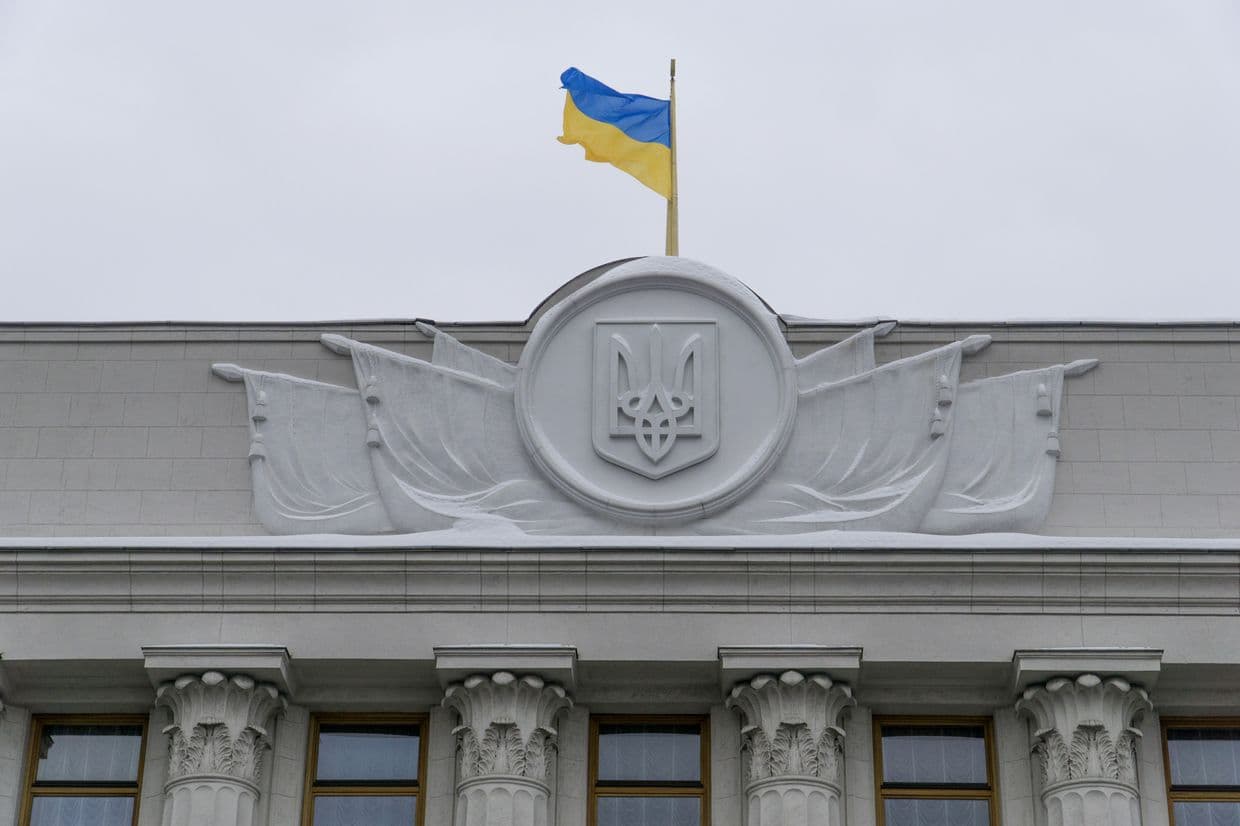
A Ukrainian flag flies above the headquarters of the Ukrainian Finance Ministry in Kyiv, Ukraine, on Feb. 8, 2017. (Vincent Mundy/Bloomberg via Getty Images)
 on Google
Ukraine's debt is ballooning. By the end of last year, the country owed over $213 billion to creditors — a hair's breadth away from the size of the country's entire economy.
That doesn't include a new 90-billion-euro loan to Kyiv agreed by European leaders at a summit on Dec. 19, of which a sizable chunk will add to Ukraine's debt pile.
As Russia's full-scale invasion approaches its fifth year and progress towards a peace deal remains uncertain, the anticipated postwar reconstruction boom is on hold. Instead, the status quo persists — Ukraine continues to rely on foreign cash, taking on more debt to keep fighting for its independence.
"It is impossible to navigate elevated budget needs and deficits — driven by higher defense and security spending — without public debt increasing," Yuriy Butsa, Ukraine's government debt commissioner, told the Kyiv Independent.
"However, we are doing everything in our power to keep debt manageable, sustainable, and not undermine Ukraine’s future recovery and reconstruction," he said.
But as outlined in a recent paper from the Peterson Institute for International Economics, "(Ukraine's) postwar public debt burden could pose a threat to economic progress."
Investors may be wary of entering Ukraine in the future if they fear that the government will raise taxes to repay the debt.
Lurking beneath the numbers, however, is a more complicated story.
Why is Ukraine's debt growing?
When Russia invaded Ukraine in February 2022, Kyiv's fiscal equation changed instantly.
Forced to massively raise defense spending, the country now spends all its own revenues on defense, and relies on continuous injections of foreign cash to supplement its military and keep the state afloat — such as salaries for some state employees, pensions, hospitals, and schools.
While some of that cash comes in grants, which Ukraine doesn't have to pay back, most has come in the form of loans.

Loans from foreign official creditors, like the EU, are by far the most significant contributor to Ukraine's debt pile — growing from $30 billion in 2021 to just under $140 billion by the end of 2025.
American budgetary support — significant under former U.S. President Joe Biden — has ceased under President Donald Trump.


The financing lines packing the biggest punch include the EU's Ukraine Facility, a Group of Seven (G7) initiative known as the ERA loans, and, most recently, the so-called Ukraine Support Loan, of which 30 billion euros is earmarked for budgetary assistance.
How bad is it for Ukraine?
For investors, the 100% debt-to-GDP ratio is a key psychological threshold, which, when crossed, rings alarm bells. Combining the latest debt data with the central bank's estimate for GDP in 2025, Ukraine's debt currently stands at 99.9%.
"The number looks terrible on paper, but the impact in real life is much smaller," Benjamin Hilgenstock, senior economist at the Kyiv School of Economics, told the Kyiv Independent.
"It's important to distinguish between the headline number and the actual burden of that debt."
A large share of Ukraine's stock of debt is contingent, long-term, with zero or close to zero interest, or doesn't require significant payments in the coming years.
The ERA loans will be repaid by the interest generated on Russian assets — not by Ukraine. Kyiv won't have to pay back the Ukraine Support Loan unless Russia pays reparations — a highly unlikely scenario. And the Ukraine Facility is offered on highly concessional terms, meaning it is "as close to a grant as possible," according to Butsa.
"For foreign investors, the level of debt is a first indicator. When it's high, it's more difficult for a country to raise market financing," Olena Bilan, head of research at Dragon Capital, tells the Kyiv Independent.
"But given the conditions on the debt, the high number generates an unnecessary negative spin."

What are the other key parts of Ukraine's debt?
A much smaller but nonetheless important component of Ukraine's debt stock is that owed to private creditors. As of December 2025, it stands at roughly $25 billion.
Ukraine has been borrowing on the market for decades. When Kyiv’s calculus shifted in 2022, Ukraine secured the agreement of key creditors for a two-year freeze on interest payments.
Communication and negotiation have been a key part of Ukraine’s strategy vis-à-vis private creditors ever since. Butsa frequently travels all over the world to meet face to face with investors and has pulled off two debt restructurings in 2024 and 2025.
With these successes in the bag, Butsa told the Kyiv Independent that, subject to favorable conditions, Ukraine envisions a return to the commercial market in 2029.
"When the war is over, and Ukraine goes back to the market and issues new Eurobonds, I think that people will be very happy to buy them," according to Hilgenstock.
"Foreigners will also invest into Ukrainian domestic debt due to attractive yields and a credible central bank, like they did in 2019," he adds.

Bond traders follow events in Ukraine closely — with privately traded debt reacting strongly to prospects of peace.
"Ukraine might be joining the EU, growing fast, and look like another Poland after 2004," Bilan says, highlighting the appeal that would have for private investors.
But Butsa's "favorable conditions" caveat is key.
"The most important condition is that investors are confident that an eventual settlement is sustainable, that it's clear that Russia will not invade Ukraine again," Bilan says.
What does the future hold?
Ukraine's future fiscal equation is a function of the war and, as such, is subject to vast uncertainty.
Without peace, the status quo will continue. Ukraine's budget deficit will remain around 20% of GDP per year, and assuming continued European cash injections, debt will continue to rise, although likely in the highly concessional form it appears today.
With peace, the need for foreign cash will fall, but not disappear. Most in Ukraine see a well-equipped army of at least 800,000 as the only real security that they can count on — a size three or four times higher than before the war, and more than Ukraine can independently afford.
The International Monetary Fund assumes that Ukraine's annual deficit will fall to single digits in the absence of the war — despite military and social spending remaining high for a long time.
"Nobody has a clue when and how this war ends, what the security situation will be or whether there is a peace dividend," says Nicolas Veron, senior fellow at Bruegel and the Peterson Institute for International Economics.
"Talking about the postwar fiscal situation at this point is so uncertainty-ridden that it's not even clear it's a relevant question to ask."