Ukraine, Russia hold US-mediated Geneva talks focused on 'practical issues,' negotiations to resume Feb. 18
 on Google
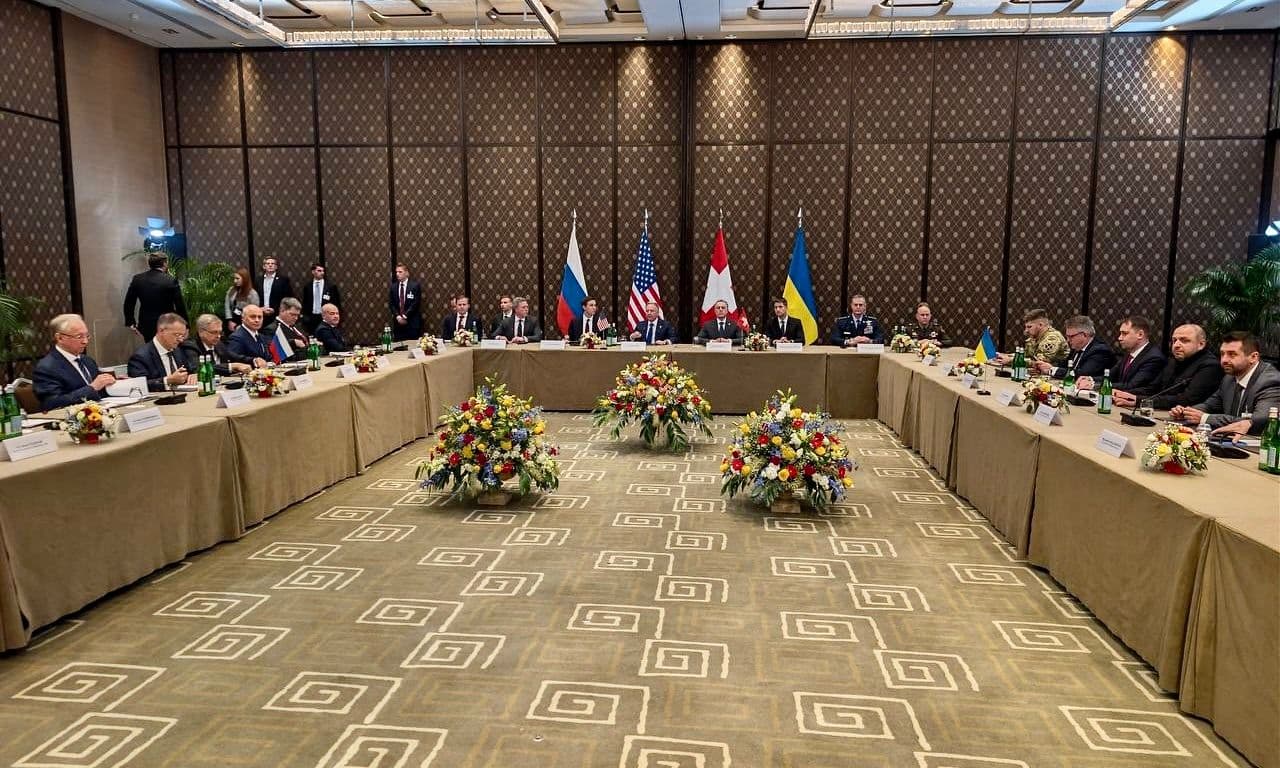
- The first day of the trilateral talks lasted over five hours.
- European officials from Germany, the U.K., and France were also in Geneva to meet with Ukrainian and U.S. delegations.
- Rustem Umerov, Secretary of Ukraine's National Security and Defense Council, said the discussions focused on "practical issues."
Ukraine, Russia, and the U.S. held a new round of trilateral peace talks in Geneva on Feb. 17, as Washington presses for progress toward a deal before summer.
A follow-up session is scheduled for Feb. 18. This marks the third round of negotiations since January, after earlier meetings ended without a breakthrough.
"Discussions focused on practical issues and the mechanics of possible solutions," Ukraine's National Security and Defense Council Secretary Rustem Umerov said. "We would like to thank our American partners for constructive cooperation."
Umerov, who heads Ukraine's delegation, added that the results of the first day will be reported to President Volodymyr Zelensky today.
U.S. Special Envoy Steve Witkoff said there was "meaningful progress" after the first day of talks in Geneva.
"Both parties agreed to update their respective leaders and continue working towards a deal," he wrote on X.
Ahead of the Geneva talks, Zelensky indicated that the most sensitive issues, including territories and control over the Zaporizhzhia Nuclear Power Plant, remain unresolved after the previous round of negotiations in Abu Dhabi.
Kremlin spokesperson Dmitry Peskov said on Feb. 16 that this round would cover a broader range of issues than the limited set discussed in the UAE.
"This time, we intend to discuss a wider range of issues, including, in fact, the main issues that concern both the territories and everything else related to our demands," he said.
The trilateral negotiations were formally opened by Swiss Federal Councillor Ignazio Cassis, who welcomed the delegations. The country is hosting the meeting in its traditional role as a neutral facilitator.
"Switzerland is not a party to the negotiations, but actively supports this trilateral approach aimed at promoting de-escalation and the search for lasting peace," a government spokesperson told the Kyiv Independent.
Just hours before the talks began — despite Kyiv having already agreed to participate — U.S. President Donald Trump publicly urged Ukraine to "come to the table."
"We have big talks. Ukraine better come to the table fast," he told reporters. "That's all I'm telling you. We are in a position where we want them to come."
Peskov told reporters that he did not expect any major developments on the first day, noting that the negotiations were scheduled to continue tomorrow.
The talks come after a week of pointed criticism from Russian officials, who have suggested that only Ukraine's capitulation would satisfy Moscow's objectives.
Who's at the table
In the days before the negotiations, Russia reshuffled its delegation. President Vladimir Putin appointed his aide Vladimir Medinsky to lead the Russian team.
Medinsky previously headed Russia's delegation during direct negotiations in 2025 and during the March–April 2022 talks in Istanbul. Ukrainian officials at the time described him as a "pseudo-historian" and accused him of advancing uncompromising positions.
During the 2025 talks, he reportedly warned that Russia was prepared to fight indefinitely and threatened additional territorial advances if Kyiv rejected Moscow's demands.
Zelensky acknowledged the change on Feb. 14 with visible skepticism.
"It was a surprise that Russia changed the head of the delegation," he said. "In my opinion, they want to postpone the decision (to make a peace deal). Maybe I'm a bit pessimistic."
The Ukrainian president's concerns appeared to be borne out shortly afterward.
The political track of the first round of negotiations stalled after Medinsky presented Moscow's positions, Axios reporter Barak Ravid wrote in a post on X, citing two sources familiar with the talks.

Medinsky is joined by Admiral Igor Kostyukov, chief of military intelligence, and Deputy Foreign Minister Mikhail Galuzin, among others.
Russian envoy Kirill Dmitriev is also present but is working on a parallel economic track. He may be involved in discussions tied to the so-called "Dmitriev package," a sweeping U.S.-Russia economic proposal that Moscow confirmed last week.
Ukraine's delegation is participating at a high level.
The team is led by Umerov and includes Kyrylo Budanov, Zelensky's chief of staff and former military intelligence chief, along with other senior officials.
The U.S. delegation includes Witkoff and Jared Kushner, Trump's son-in-law. Army Secretary Dan Driscoll and Gen. Alexus G. Grynkewich, commander of U.S. European Command, are also present.
A German government official told the Kyiv Independent that German Chancellor Friedrich Merz's foreign and security policy adviser is also in Geneva.
Officials from the U.K. and France are present as well and are expected to meet with Ukrainian officials — and possibly U.S. representatives — after the trilateral talks conclude, a source familiar with the matter said.
Umerov later reported that the Ukrainian team held a separate meeting with U.S. officials and representatives from the U.K., France, Germany, Italy, and Switzerland to discuss the results of the first day and "synchronize approaches to further steps."
"It's important to maintain a common vision and coordination of actions between Ukraine, the U.S.A., and Europe," he said. "There's an understanding of shared responsibility for the outcome."
The Kyiv Independent has learned that these European officials are not expected to participate in direct negotiations with the Russian delegation.
Territory, nuclear plant, energy
Both Kyiv and Moscow have signaled that the territorial issue will dominate the talks.
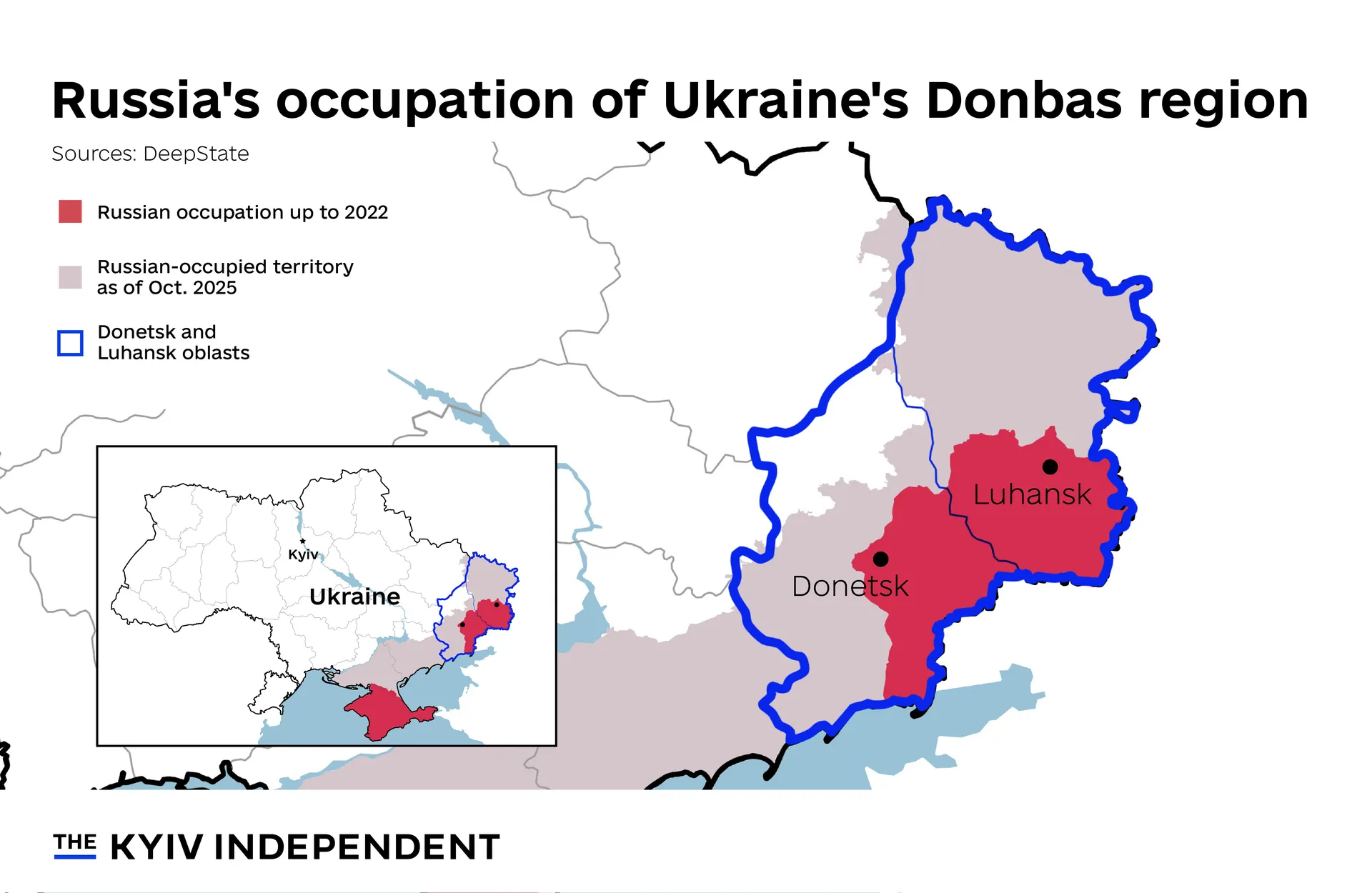
Ukraine maintains that freezing current positions offers the most realistic foundation for a ceasefire at this stage. Russia continues to demand that Ukrainian forces withdraw from Donbas as a precondition for any agreement — a non-starter for Kyiv.
The U.S. has floated the idea of establishing a free economic zone in the war-torn region. Zelensky previously said that neither Ukraine nor Russia had shown much enthusiasm for that proposal.
Another unresolved flashpoint is the Zaporizhzhia Nuclear Power Plant. Before Russia's full-scale invasion, the plant generated roughly 20% of Ukraine's electricity and remains the largest nuclear power facility in Europe.
Under a U.S.-backed framework, the plant would be jointly operated by Ukraine, the United States, and Russia, with economic benefits shared. Kyiv fears that such an arrangement would effectively legitimize Russia's occupation of the facility.
Energy security more broadly is also expected to surface in Geneva. Russia continues to target Ukraine's energy infrastructure with relentless strikes, and a potential energy ceasefire remains under discussion.
During the Feb. 4–5 talks in Abu Dhabi, the U.S. delegation proposed that both sides once again support Trump's energy de-escalation initiative.
Ukraine signaled support for the initiative, but Russia did not agree.
Moscow's dismissive stance
The Geneva talks unfold amid public skepticism from Moscow about the broader peace process — a stance that borders on outright rejection.
While trilateral meetings took place in January and February, senior Russian officials openly questioned key elements of the proposed framework.
Russian Foreign Minister Sergey Lavrov on Feb. 11 effectively dismissed a U.S.-Ukraine 20-point plan that had been expected to form the basis for negotiations.
Lavrov said that ahead of the August summit in Alaska, Witkoff handed Moscow a document outlining key issues "in line with realities on the ground."
He claimed that the sides had identified "approaches based on the U.S. initiative" that "opened a path to peace" and could have formed the basis for a final deal.
"All subsequent versions are the result of an attempt by Zelensky and (Europe) to override the American initiative," Lavrov said. "Now they are waving around some kind of document with 20 points, which no one has given us either officially or unofficially."
Bloomberg earlier reported that the plan was delivered to Putin in early January, with Witkoff and Kushner later visiting Moscow to discuss it directly with Putin.
Lavrov also warned against what he described as an "enthusiastic perception" of the negotiations on Feb. 10, stressing that "there is still a long way to go."
His remarks reinforce a broader pattern: while Russia continues to participate in talks, it publicly signals that its baseline demands — including territorial concessions and broader political conditions — remain unchanged.
The Geneva meeting is expected to test whether the sides can bridge their competing versions of the plan, with territorial issues to top the agenda.