Thanks to Ukraine's new strategy, Russia's grip on Crimea is crumbling
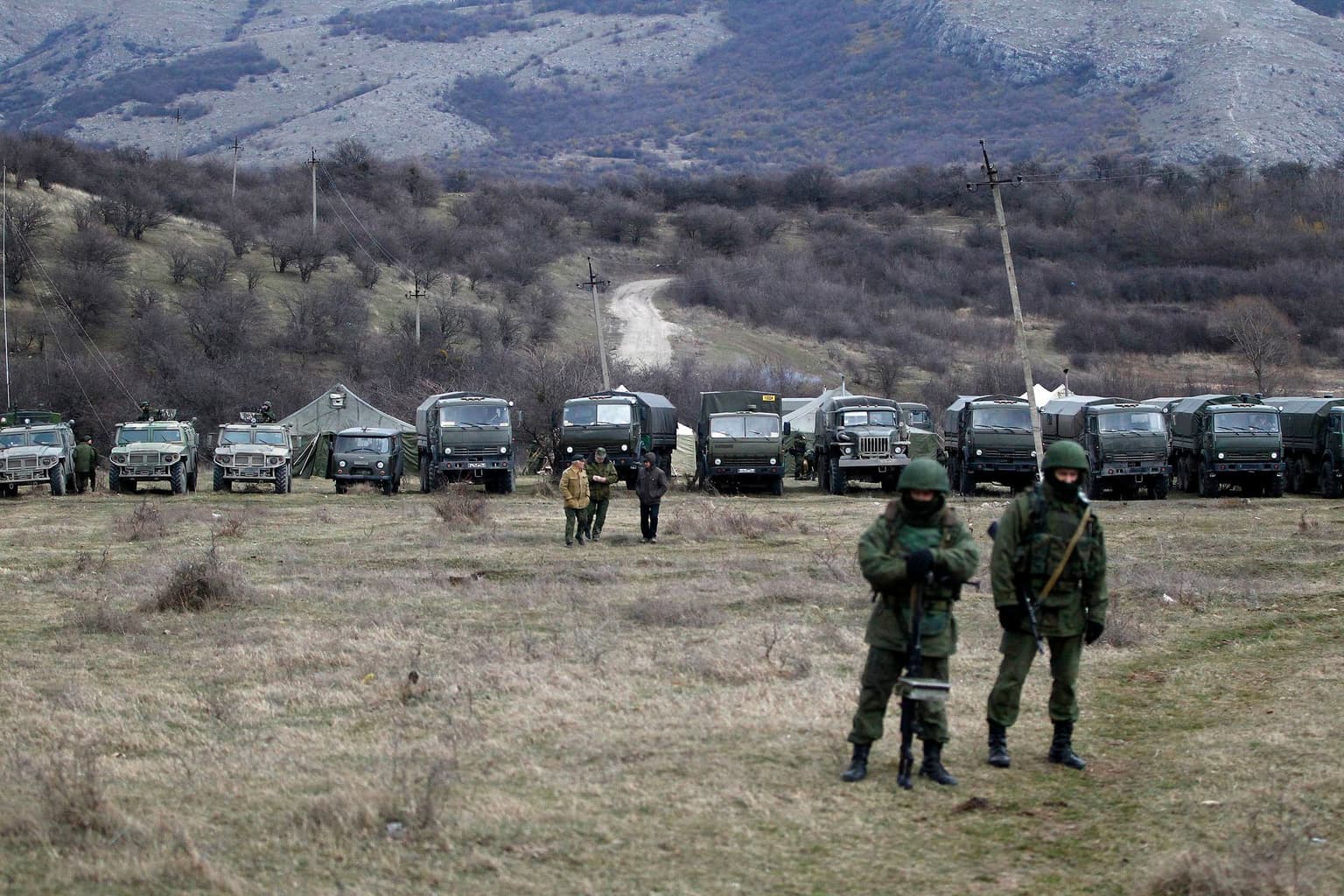
Members of the Russian armed forces stand around a Ukrainian military base in Perevalne, Crimea, Ukraine on March 2, 2014. (Bulent Doruk / Anadolu Agency / Getty Images)
 on Google
Casey Michel
Director of the Combating Kleptocracy Program
The past month has seen an entire string of successes in Ukraine's war against Russia, with both long-range attacks and swarms of drone strikes slowly turning the tide in Kyiv's favor. Few things, though, have been as successful as Ukraine's efforts to isolate the occupied region of Crimea, forcing Russian authorities to declare a state of emergency as Kyiv continues to bombard the peninsula.
The successes, however, haven't been only military.
In its months-long campaign to strangle Russia’s hold on Crimea, starving the peninsula of fuel and forcing Russians to flee en masse, Ukraine has finally, successfully killed off the idea that Crimea is some kind of "special" or "holy" place for Russians.
Instead of a place that Russians will sacrifice everything to defend, Ukraine's ongoing attacks have confirmed that Crimea is just another part of Ukraine occupied by Russian forces — and that, with the right mix of targeted strikes and economic suffocation, Ukraine can uproot Moscow's forces in Crimea once and for all.
For those familiar with Crimea's history, this is hardly a surprise.
After all, the peninsula was never the bastion of Russian identity or Russian obsession that figures like Vladimir Putin made it out to be – or that gullible Westerners later believed.
While Russia first seized the peninsula in 1783, Crimea was hardly some central node for the Russian nation, and wasn't even majority Russian until the Second World War. In 1991, Crimeans even voted, alongside every other region of Ukraine, for independence from Moscow.
In the years following, the peninsula only grew more and more diverse, so much so that by 2013, a majority of Crimeans identified themselves as something other than Russian.
Even in 2014, the supposed swell of support for Russian annexation in Crimea was largely hollow; not only did Russian militias have to force Crimean deputies to vote for annexation, but notorious Russian war criminal Igor Girkin, one of the key figures in Russia's 2014 invasion, recalled that he and other pro-Russian militia figures "didn't see any support (for annexation) from any organ of government power" in Crimea.
Few Westerners, however, knew these basic facts about the peninsula. Instead, they swallowed Russian nationalists' lines that Crimea was rightfully Russian — and that Moscow, especially under Putin, would do anything to reclaim this wayward province.
This line of thinking was popular among Western policymakers for years, with those like U.S. President Barack Obama telling Ukrainian forces to stand down as Russian troops first barreled across the peninsula in 2014.
In the years since, as Russia's grip on Crimea strengthened — and while activists, especially among the Crimean Tatar community, continued disappearing — this belief ossified.
Many voices in the U.S., even those traditionally pro-Ukraine, blanched at the thought of Ukraine using force to assault or retake Crimea. They remained convinced that Putin would do anything, even resort to nuclear warfare, to retain the peninsula.
Moreover, they were convinced that the Russian populace would, by and large, back Putin and would be willing to pay any price to retain Crimea.

What those Western policymakers missed, however, is that the strong majority of Russians backed Putin's moves into Crimea precisely because Russia paid no price for that initial invasion.
Russians in 2014 watched the West effectively roll over in the face of Moscow's expansionism, falling for Putin's bluffs. In the process, hundreds of thousands of Russian settler-colonizers flooded into Crimea, eager to enjoy their new sub-tropical environs – and assuming they'd never have to pay any cost for their occupation.
That all changed in 2022. Not during the initial days of the expanded invasion, per se – but that September, when Putin announced the further annexation of other regions of Ukraine, none of which were fully occupied by Russian troops.
Suddenly, rather than a supposedly completely unique outpost of Russian civilization, Crimea was simply part of a broader suite of Ukrainian lands claimed by Moscow. Russians — and even those Western policymakers ignorant of Crimea's history — may not have realized it, but that was the moment that Putin set himself up for ultimate failure in Crimea, which is now beginning to bear fruit.
Just look at what's been happening in Crimea over the past few weeks.
Ukraine has effectively cut off supply efforts to Crimea, leaving a trail of destroyed trucks and convoys attempting to bring everything from fuel to food to the region.
The efforts had an almost immediate effect, leaving Crimea largely without basic supplies like gasoline. In June, the situation became so dire that Russian occupation authorities declared a formal state of emergency on the peninsula. As the Wall Street Journal reported then, "panic" is now "beginning to spread on the ground in Crimea."

Instead of enlisting to defend Crimea, the Russian response has been a combination of apathy, hand-wringing, and denial. Rather than Russians surging to sacrifice for Crimea, Russia continues to struggle to replace troops lost, with those on the peninsula preferring to either flee or post social media videos whining about Ukraine's ongoing blockade.
And in the Kremlin, rather than bolster support for the war, the Crimean attacks have accelerated Russian officials' waffling, deepening their realization that the war is effectively a lost cause.
Ukraine is still far from reclaiming Crimea itself. But the past few weeks have illustrated how the idea that Russians writ large would race to the aid of the peninsula was always false. Rather than sprint to defend Crimea, rather than rallying Russians to Putin's side, Russians have largely thrown their hands up at the recent attacks.
All of which means one thing, which has always been true: the war in Ukraine will not end until Ukraine reclaims every inch of sovereign territory – including Crimea. This was true in 2014. This was true in 2022. And this is true now – and growing easier and easier to envision by the day.
Now, thanks to Ukraine's successful push to isolate Crimea, more and more Westerners are finally realizing that Russia's claims to Crimea were always a propaganda ploy, and little more.
Editor's note: The opinions expressed in the op-ed section are those of the authors and do not purport to reflect the views of the Kyiv Independent.