Why a Ukraine peace deal can't include amnesty for Russia's war crimes
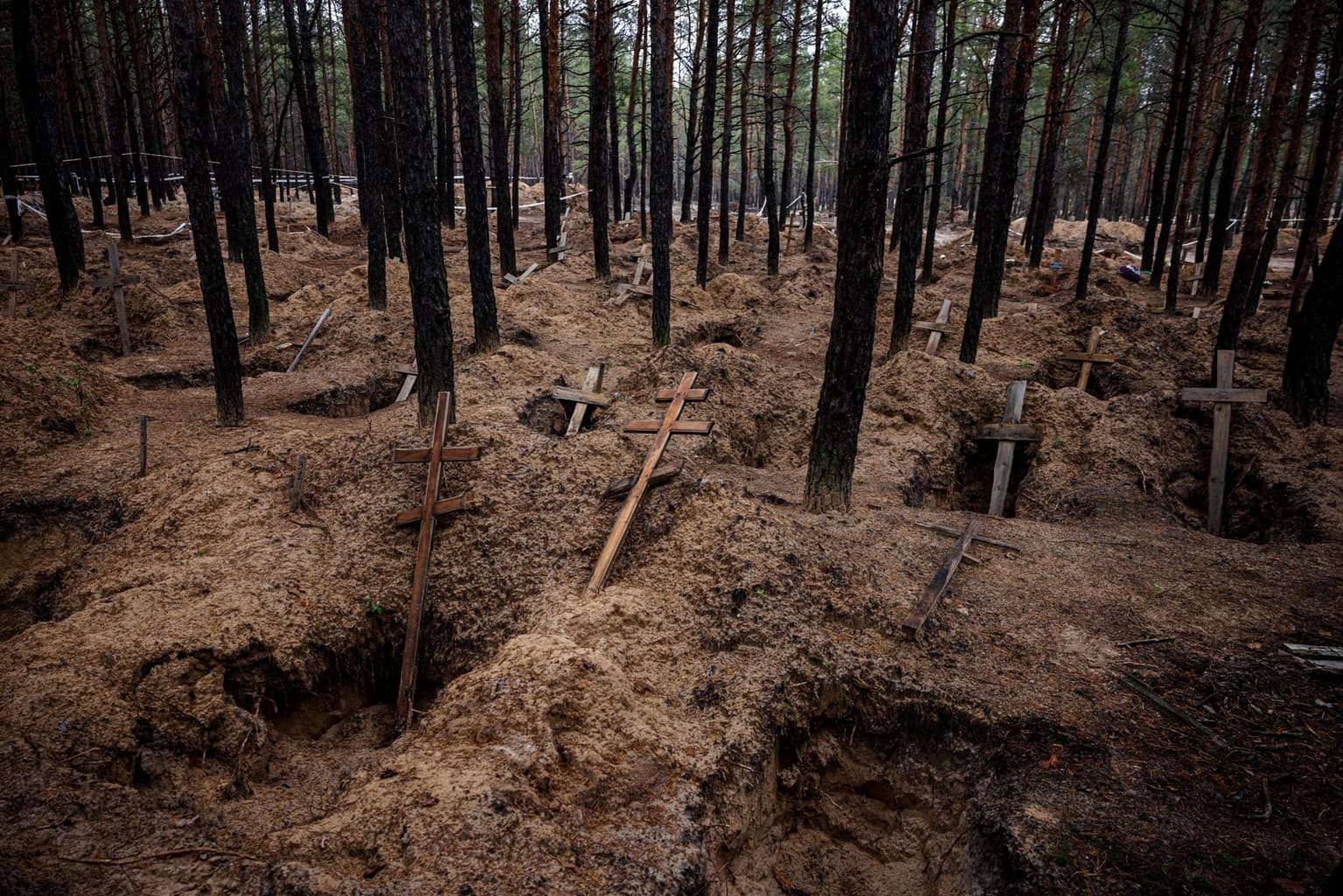
Empty graves after the exhumation of bodies from mass burial sites dug during the Russian occupation of Izium, Kharkiv Oblast, Ukraine, on Nov. 4, 2022. (Dimitar Dilkoff / AFP / Getty Images)
 on Google
A U.S.-backed 28-point peace plan leaked last month caused uproar in Ukraine and among its allies, among other reasons, because it contained a controversial point implying, in vague terms, a "full amnesty" for acts committed during the war.
While Ukrainian officials later claimed that this clause had since been removed, critics fear that it could still return to the text, bringing with it a culture of impunity for war crimes.
As talks aiming to secure a peace deal continued with a high-level Ukraine-U.S. meeting held in Florida on Nov. 30, the final version of the document remains uncertain, fueling concerns that Russian leaders could walk away without being held accountable for their crimes.
‘Problematic to even have to discuss this’
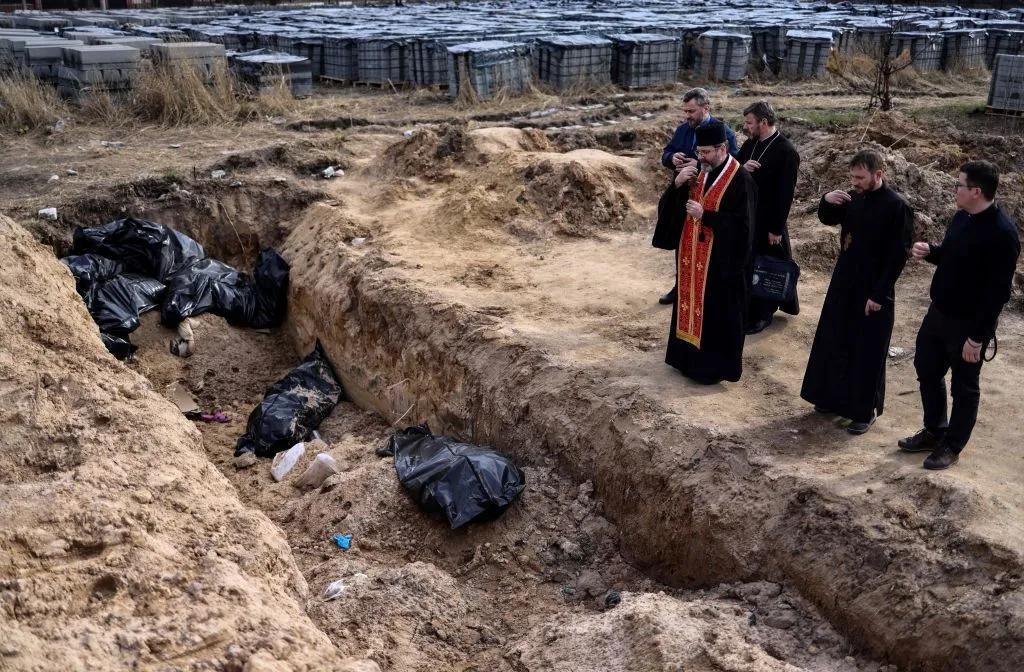
As of November, Ukraine's Prosecutor General's Office recorded 190,000 facts related to war crimes and crimes against humanity committed by Russia and its forces since the start of the full-scale invasion in 2022.
Under current international law standards, there are no exemptions from prosecution of war crimes, as explained by international humanitarian law experts who spoke to the Kyiv Independent. The 28-point peace plan sought to overturn that.
"This provision on full amnesty (in the peace plan) would officially ruin the international world order, which is based on the U.N. charter and international law," said Oleksandra Matviichuk, the head of the Center for Civil Liberties, a Ukrainian NGO that was awarded the Nobel Peace Prize in 2022.
"This will not just be a Ukrainian problem. It will encourage other authoritarian leaders across the world to commit the same war crimes."

A full amnesty would also contravene Ukraine's obligations under international law, as well as all those of other states, according to Kateryna Rashevska, an international justice and legal analysis lead at the Regional Center for Human Rights, a Ukrainian NGO focusing on Russian war crimes.
There are no known precedents of full amnesty principles being applied at the international level, with only partial amnesties enforced following a small number of civil wars and other internal conflicts across the globe, Rashevska explained.
"Peace negotiations are about politics and diplomacy," said Veronika Sentsov-Velch, the director of Amnesty International Ukraine. "They have no relation to international justice and its proceedings. So it is problematic that we are even discussing this issue of amnesty."
Ukrainian courts and principle of universal jurisdiction
Whatever the result of negotiations on amnesty, there is already a solid international infrastructure for the investigation of war crimes committed in Ukraine, which would continue its work regardless of the results of peace talks.
This infrastructure was progressively set up since 2022, among other reasons, to assist the Ukrainian justice system, which would simply not be able to investigate the sheer amount of cases at hand.
"Given the number of proceedings, every (Ukrainian) prosecutor or detective would need to investigate 2,000 cases in parallel. This is impossible," Matviichuk confirmed.
At the international level, the International Criminal Court (ICC) remains the main instance responsible for investigations. In March 2023, the court put out an arrest warrant for Russian President Vladimir Putin and for Russia's children's rights commissioner Maria Lvova-Belova, chiefly for their role in the forced deportation of Ukrainian children into Russia.
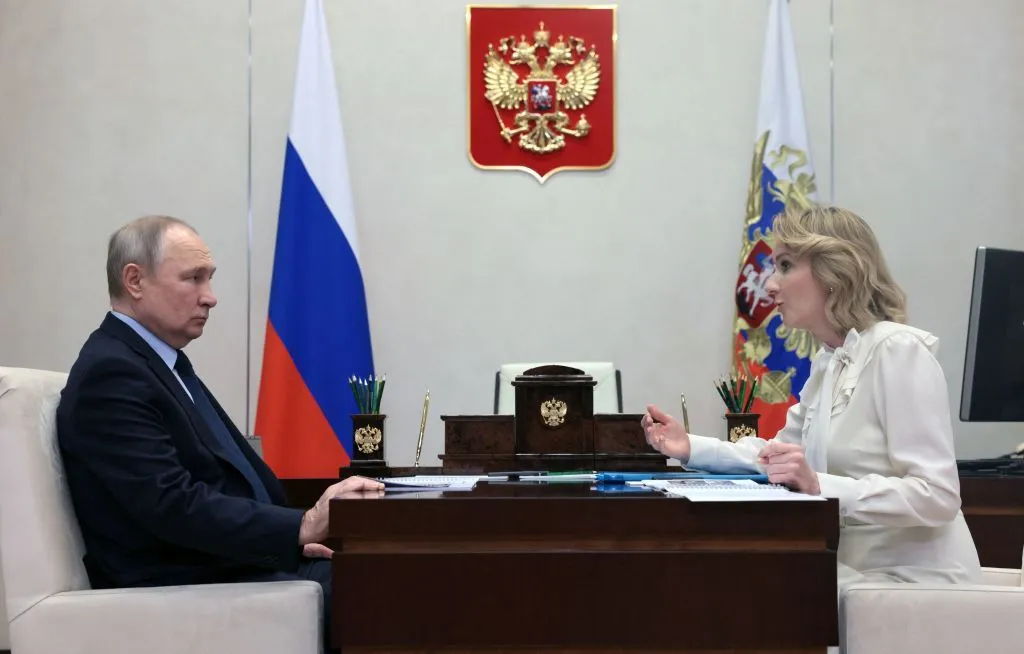
Arrest warrants were later issued for several more individuals, including former Russian Defense Minister Sergei Shoigu and the Chief of Staff of the Russian Armed Forces, Valery Gerasimov.
It remains unclear if and how any of the suspects will eventually be brought before the ICC. The court was also affected by accusations of sexual harassment brought against its chief prosecutor, Karim Khan, in 2024.
"In any case, and regardless of what happens with the peace deal, the arrest warrants (against Putin, Lvova-Belova and others) will remain in place," Sentsov-Velch added.
Rashevska pointed out that the ICC is actively focusing on examining crimes committed in detention, including those against Ukrainian civilians held by Russia and prisoners of war.
Somewhat in reaction to the ICC's crisis, the Council of Europe (CoE) started developing its own special tribunal for the "crime of aggression against Ukraine."
As of November 2025, however, the tribunal has not yet commenced operations, with the most recent step in this direction dating to June this year, when President Volodymyr Zelensky and Alain Berset, the secretary general of the CoE, signed a bilateral agreement on establishing the court.
"War crimes and crimes against humanity have no statute of limitations: this means suspects can be prosecuted at any point in the future."
If and when it is formed, the special tribunal would be responsible for investigations into political and military leaders who planned and carried out the war of aggression against Ukraine.
"Normally, the formation of the court should be concluded by 2026 or 2027, but for now it is difficult to tell when exactly this will happen," Rashevska said.
"The EU has already provided 10 million euros ($11.6 million) to launch this court; we know that it will be located in The Hague, but we do not have much more information at the moment."
However, despite current uncertainties, the process of the court's creation and its future work "cannot be reversed," Rashevska added.
Following its launch, the tribunal would begin by investigating a group of approximately 20 high-ranking Russian officials responsible for the crime of armed aggression, according to Sentsov-Velch.

Aside from these formal instances, there are other paths to international justice.
These include the concept of universal jurisdiction, which allows, in theory, for any country to investigate war crimes, crimes against humanity, genocide, and other breaches, regardless of where the crime was committed, and whether victims have any relation to the country in question.
"As with the ICC, the mandate of courts under universal jurisdiction would remain in place, regardless of any peace deal," Sentsov-Velch said, pointing to Germany and Sweden as countries that had already conducted trials under this principle.

Elizabeth Evenson, who works as International Justice Director at Human Rights Watch, explained that the practice had developed in some European countries, especially since the start of the war in Syria. In this case, investigations for torture and other crimes against humanity were opened against individuals located in European countries.
While the vast majority of Russian war crimes would still need to be tried in Ukraine, universal jurisdiction is important in other ways.
Matviichuk explained that "these proceedings are done in third countries, in the national language and at the national level: this helps spread the information on war crimes in Ukraine internationally."
This kind of jurisdiction can also have a "chilling effect," according to the head of the Center for Civil Liberties, as perpetrators will know that they can be prosecuted at any moment, in any country.
"Practically speaking, for a Russian prison director responsible for torture, this will be a very uncomfortable situation, as they can be tried in Germany, in Argentina, or anywhere else," Matviichuk said.

‘Important to stay optimistic’
While, as of today, few concrete steps have been taken to deliver international justice for the victims of the war in Ukraine, experts explained that there is no reason for this not to happen in the future.
"It is important to remember that war crimes and crimes against humanity have no statute of limitations: this means suspects can be prosecuted at any point in the future," Sentsov-Velch said.
"Even if right now, we have this pessimistic position, that Russia will never be held responsible for its war crimes, it is important to stay optimistic and remember that this situation can change."
Beyond responsibility, accountability for war crimes is also important with regard to the future of the war in Ukraine and the message that impunity would send to perpetrators.
"Amnesty would be very dangerous, and it would have a long-lasting effect," Rashevska argued. "We cannot accept peace without justice. These crimes, which were recognized as terrifying the conscience of humanity, would be recognized as not needing punishment."
"This is not the path to peace," she added. "This is the path to a new war."