The day Russia didn't show up for Iran
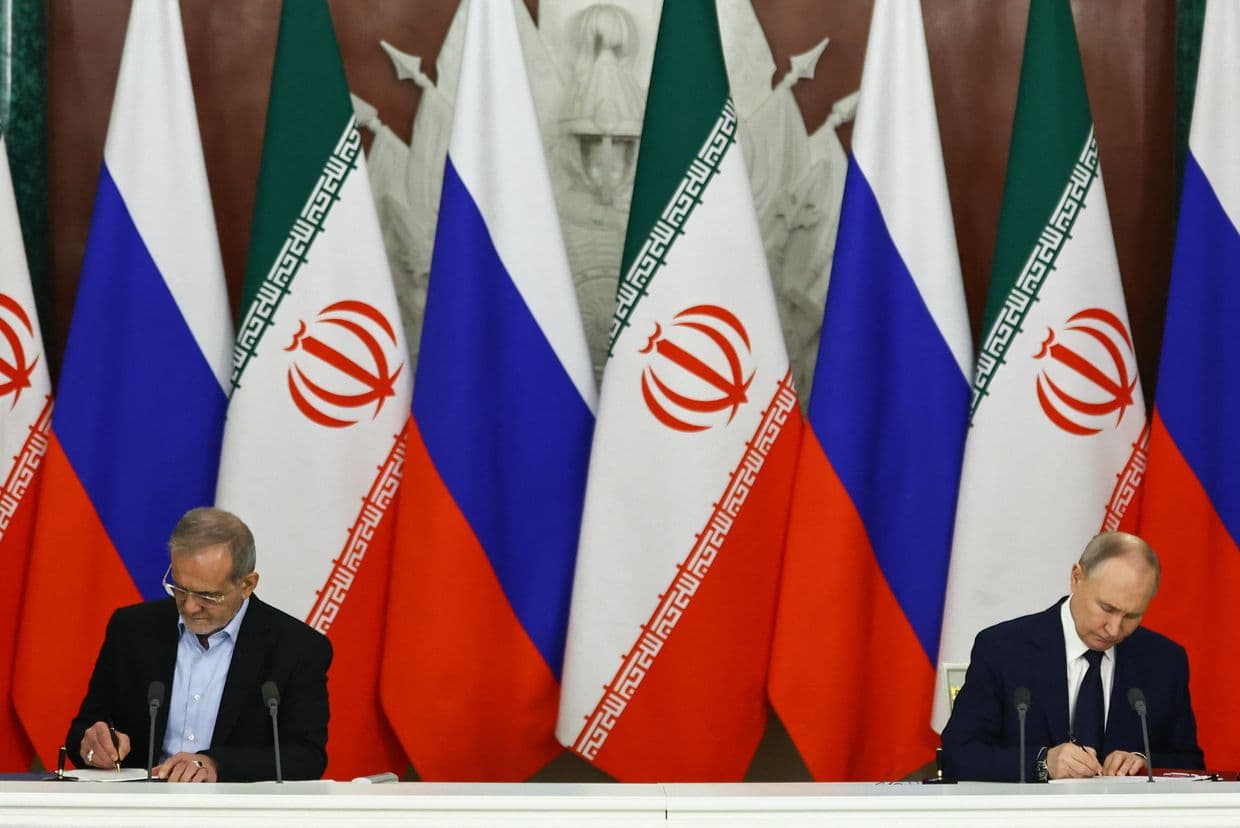
Russian President Vladimir Putin and Iranian President Masoud Pezeshkian sign a strategic partnership treaty during a ceremony following their talks at the Kremlin in Moscow on January 17, 2025. (Evgenia Novozhenina /POOL/AFP via Getty Images)
 on Google
Russia's image as a reliable ally has suffered yet another blow as Supreme Leader Ayatollah Ali Khamenei was killed in joint U.S.–Israeli strikes across Iran on Feb. 28, marking a fresh outbreak of hostilities in the Middle East.
So far, Moscow's response to the U.S.–Israeli bombardment of hundreds of targets in Iran has been limited to diplomatic support for Tehran, even as U.S. President Donald Trump has openly called for a change of regime.
The latest development highlights Iran's junior role in its partnership with unsteady Russia, while Moscow's focus on the war in Ukraine leaves it little means to rush to Tehran's aid.
"I don't really see Russia coming to the rescue of Iran," Olli Ruohomaki, a Middle East expert at the Finnish Institute of International Affairs, told the Kyiv Independent, describing their relationship as largely "transactional."
"Russia is pretty entangled in the Ukrainian war. They are fully committed and already struggling... It's not like Russia has all these resources to fight many fronts."
Although Iran has supplied Russia with drones and other weapons for the war in Ukraine, Moscow now produces its own Shahed-type variants domestically.
And although Russia also gains economically from this relationship, trade with non-sanctioned partners such as China and India remains far more crucial.
Tehran, in turn, has increasingly leaned on Moscow for security and economic needs amid mounting U.S. pressure and domestic unrest, reinforcing the relationship's asymmetry.
Limits of military ties
The two countries have deepened military cooperation since the outbreak of the war in Ukraine, evident in mounting cases of dark port calls and military transport flights.
While Tehran has supplied Russia with drones, missiles, and ammunition, Iran has reportedly filed orders for Russian Mi-28 helicopters and Su-35 fighter jets. The cooperation has also been underlined in recent military drills.
Iran again turned to Russia after its air defenses were decimated in the twelve-day war with Israel in June 2025.
In December, Iran reportedly signed a deal to purchase 500 Russian "Verba" man-portable launchers and 2,500 surface-to-air missiles to patch up its sky shield.
But the military support has its limits.
Moscow has stood by during Iran's war with Israel last year, as well as during U.S. attacks on the country's nuclear facilities in June 2025.
"The relationship is not a defensive alliance: it is exceedingly unlikely Russia will come to save Iran if push comes to shove in an existential sense," said Julian G. Waller, a lecturer in political science at George Washington University.
Ryhor Nizhnikau, a Russia expert at the Finnish Institute of International Affairs, nevertheless adds that "if Tehran is able to take the U.S. into a long protracted conflict, Moscow's ability to help will increase."
Aid in crushing dissent
Russia's role as a security partner has been more apparent in another sphere.
"Moscow has become the primary guarantor of the regime's internal stability, even if it remains a hesitant partner in Iran's external regional wars," says Arash Beidollahkhani, an expert in Middle Eastern politics at the University of Manchester's Global Development Institute and the Hannah Arendt Institute for Totalitarianism Studies
While Iran has chiefly provided Russia with weapons for its war against Ukraine, Tehran's main benefit has been Moscow's tools and know-how for quashing domestic dissent.
"The Russian footprint was everywhere in the shadows" during the winter crackdown on anti-regime protests, Beidollahkhani says, pointing to the total internet blackout and the jamming of GPS and Starlink as "hallmarks of Russian electronic warfare doctrine."
Since the 2010s, Russia has provided Iran with communication interception systems, monitoring tools, and training for suppressing unrest, fearing for the regime's stability after a wave of "color revolutions."
Waller adds that the scale of violence — which left at least 7,000 people dead and tens of thousands injured, according to human rights groups — was far harsher than the standing Russian tactic, suggesting the approach was "indigenous rather than something cooked up in Moscow."
Sanctions busting and energy
Two of the world's most heavily sanctioned, oil-rich states, Russia and Iran, have worked together to circumvent Western restrictions by operating a large "shadow fleet," allowing them to sustain vital oil revenues despite mounting economic isolation.
Moscow has also sought to shield Tehran from further international pressure.
Russia and China attempted — without success — to delay the "snapback" U.N. sanctions last fall, a mechanism that was part of the now-terminated Iran nuclear deal.
The economic ties were further cemented in a strategic partnership agreement signed by Russian President Vladimir Putin and his Iranian counterpart, Masoud Pezeshkian, last January.
The wide-ranging agreement covered cooperation across the energy, finance, transportation, agriculture, culture, science, technology, and counterterrorism spheres.
After a series of blackouts amid a summer heatwave and Israeli strikes on oil facilities in 2025, Tehran has increasingly leaned on Moscow and Beijing to stabilize its energy sector.
Russia's nuclear energy company Rosatom, which built Iran's only operational nuclear power plant in Bushehr, signed a memorandum in September 2025 to build eight smaller nuclear power plants, as Iran aims to reach 20 gigawatts (GW) of nuclear capacity by 2040.
Dependence concerns
Publicly, the Iranian regime has lauded its deepening partnership with Russia — even denouncing former officials who drew attention to historical tensions.
But experts say there is no consensus on how deep this relationship should be, or on how reliable it is.
Moscow's muted response not only to attacks against Iran, but also to the fall of its allies in Venezuela and Syria, underscores that Russia's strategic priorities do not always align with those of local elites.
Richard Betts, professor emeritus of war and peace studies at Columbia University, suggests that Putin has kept support for Iran "low-key" to avoid "annoying Trump," who has been seeking to broker a peace deal between Russia and Ukraine.
"Many Iranian regime elites remain mistrustful of Russia and are hesitant to further expand ties more than they already have," Waller comments.
According to Beidollahkhani, anti-regime protesters and organized opposition have also begun to view the late Khamenei "not as a sovereign leader, but as a puppet of Beijing and Moscow."
As the relationship becomes increasingly asymmetrical, opponents are bound to increasingly associate Russia with the unpopular regime and its policies.
As Beidollahkhani emphasizes, it is in Russia's interest to sustain Iran's internationally isolated regime.
Rapprochement between energy-rich Tehran and the West would be a "death blow to Moscow's leverage over Europe," he says.
"In a post-sanctions environment, Iran could easily, within a short-to-medium-term window, replace Russia as the primary energy provider for the European market."
Oleg Sukhov has contributed reporting.
Note from the author:
Hi, this is Martin, the author of this article.
The Kyiv Independent has no paywall, no wealthy owner – our work is driven by readers like you. If you want to keep seeing us deliver reporting on the latest news shaping global politics, please consider supporting us by joining our community of paying members.
Thank you!