As Russian losses in Ukraine mount, the Kremlin strains to avoid full mobilization
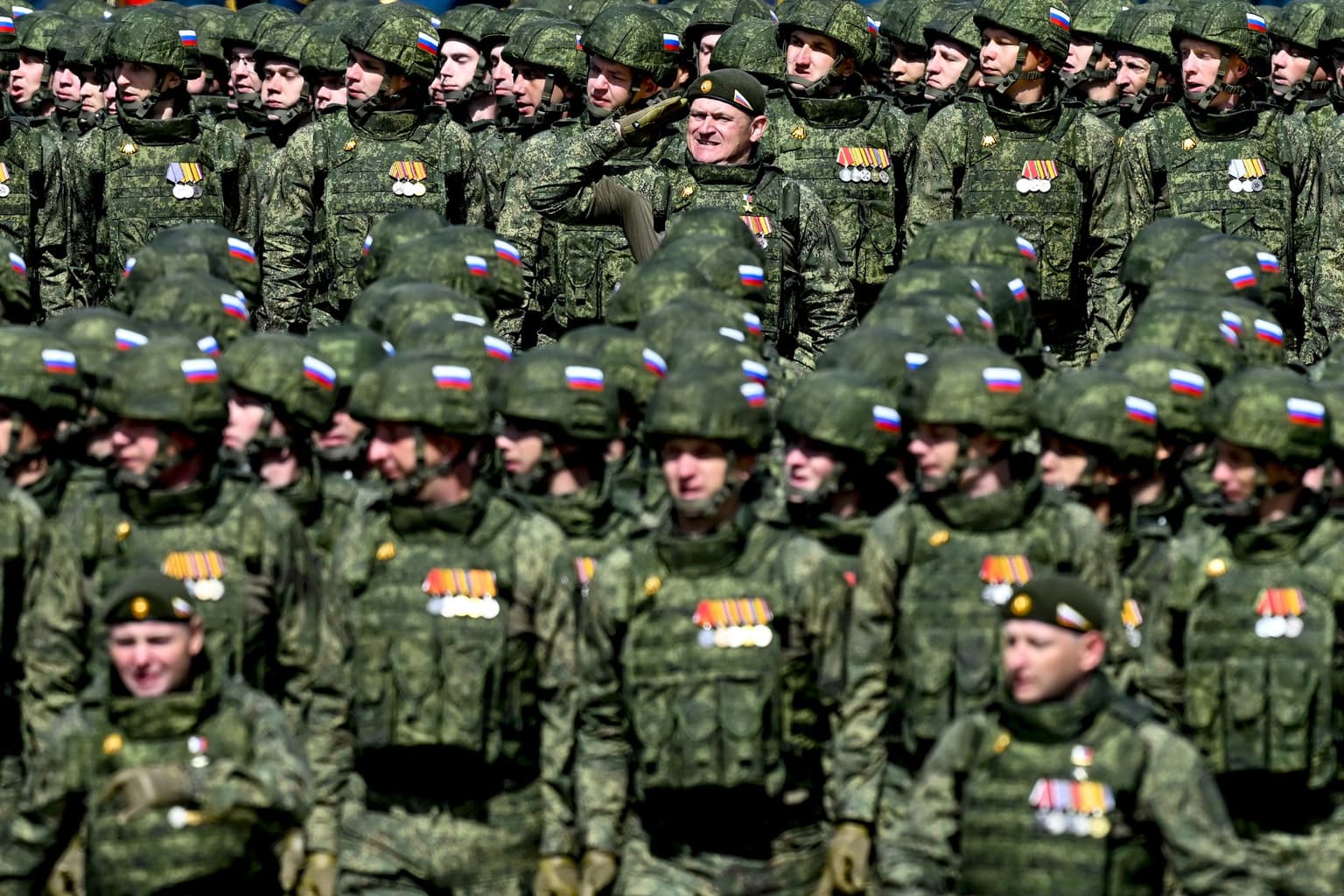
A military parade takes place on Red Square in Moscow, Russia, on May 9, 2025. (Sefa Karacan / Anadolu via Getty Images)
 on Google
As casualties in Ukraine continue to mount, the Kremlin is seeking new sources of manpower while trying to avoid the political shock of full mobilization.
Just days before the New Year, Russian leader Vladimir Putin signed laws expanding military conscription. The changes allow year-round drafting and authorize the use of reservists to guard critical infrastructure.
At the same time, a growing trend is drawing attention — the share of ethnic Russians among the dead is rising, as is the number of recruits and casualties linked to Moscow and St. Petersburg — cities the Kremlin has long tried to shield from the trauma of front-line losses.
"The Kremlin would not mobilize men in its biggest cities. It’s the capitals where revolutions may happen. They don’t want to disturb people or bring the war closer to their everyday lives," Ilya Ponomarev, a former Russian lawmaker now living in exile, told the Kyiv Independent.
Russia’s partial mobilization in 2022, the first since World War II, triggered nationwide protests and the exodus of more than 261,000 men. This raises the question of where and how Russia is finding new manpower in 2026, while avoiding both full mobilization and the risk of a mass public backlash.
Contracts and coercion
Russia effectively operates with two armies: a conscript force and a contract force.
Conscripts are aged 18–30 and serve a mandatory 12-month period of active duty within Russia's borders, and cannot be sent abroad.
Russia's war in Ukraine has instead relied on contract soldiers — paid volunteers who sign contracts and can be deployed to combat zones.
Moscow's fighting force in Ukraine depends on the ability to sign up more soldiers than it loses — currently around 30-35,000 a month, with Ukraine aiming to raise that to 50,000 this year.


In December 2025, Russian losses for the first time exceeded the number of newly recruited contract soldiers. Russia added 27,400 contract soldiers that month, while its losses reached 33,200 killed and wounded.
In previous months, the balance was more favorable for the Kremlin. In November 2025, losses amounted to about 31,000, while more than 33,300 people were recruited on contract. In October, the figures stood at 31,500 losses versus 35,600 new contract soldiers.
"Because of a lack of human bodies, the Kremlin is tapping into another subscription channel — reservists," Ponomarev said.
"This new law is a sign of a lack of human bodies."
In December 2025, Putin authorized the deployment of reservists — those who have already completed their mandatory year's service and are held in reserve — to protect critical infrastructure. Officially, these troops won't be sent to the front.
But in practice, the Kremlin is expected to pressure reservists into signing contracts and quietly transfer them into combat roles.
"Of course, they will try to convince them. They'll use tricks — offer them incentives, or simply mislead them — to get more people to the front line," Ponomarev said.
The Kremlin has been offering one-time bonuses worth millions of rubles to attract contract soldiers — up to 2.6 million rubles ($34,000) in Kursk, 2.3 million ($30,165) in Moscow, and 2.1 million ($27,500) in St. Petersburg, HUR claimed in November 2025 at the international Crimea Global conference.
But Russia's war budget is not bottomless.
"I believe that due to the budget crisis and lack of funds for large contract payments, the authorities will increasingly rely on deception and coercion," Maria Vyushkova, a researcher tracking war casualties among ethnic minorities, told the Kyiv Independent.
"Conscripts, reservists, and even people facing criminal charges will be pressured into signing military contracts — in some cases, before a trial even begins."
HUR says Russia has systematically expanded so-called "special contingents" used to replenish the army.
In 2025, the category was broadened to include not only prisoners and people under criminal investigation, but also individuals with unpaid financial debts, including outstanding loans.
Foreign fighters
Russia has also increased the recruitment of foreign citizens and stateless persons into its armed forces under contract, opening yet another channel to replenish its ranks without resorting to mass mobilization.
According to HUR, Russia is actively recruiting foreign nationals, particularly from countries it considers "friendly," including states in Africa and South America. Potential recruits are lured — and in many cases deceived — with promises of significant financial rewards or citizenship.
Unlike Russian citizens, foreign recruits cost the state less. Moscow can avoid long-term social obligations, limit compensation for families of those killed, and exploit the recruits' legal and economic vulnerability.
HUR estimates that more than 18,000 foreign nationals from 128 countries and unrecognized territories have fought for Russia since the start of the full-scale invasion, compared to none in 2022. Of them, at least 3,388 have reportedly been killed.
The largest group of foreign recruits comes from African states, accounting for 1,436 fighters, while more than 10,000 others were recruited elsewhere, often through deception, coercion, or economic desperation.
"The Kremlin sees the North Caucasus as potentially unstable. They're afraid of what might happen if too many trained men with weapons and fresh combat experience return home."
At the same time, Russia continues to forcibly conscript Ukrainian citizens in occupied territories. As of November 2025, at least 46,327 Ukrainians had been drafted into the Russian military, according to Ukrainian authorities.


Given the recruitment channels currently available to the Kremlin, HUR estimates that Russia's annual contract recruitment — no fewer than 400,000 soldiers per year — is sufficient to replenish battlefield losses and maintain force levels.
At the same time, HUR noted that Russia's mobilization system remains fully prepared to carry out a wider call-up should a political decision be made.
Full mobilization?
While Moscow Oblast ranks high in absolute war deaths, its large population keeps per capita losses relatively low. Much of Moscow’s contribution to the war effort comes from migrants and men who moved from poorer regions, rather than native Muscovites, Ponomarev said.
Experts say this allows the Kremlin to avoid a politically dangerous mass protest, at least for now, and in 2026, the burden of the war is likely to continue falling on Russia's provinces.
"The main human resource of Russia's military machine will remain ethnic Russians from the regions," Vyushkova said.
Casualty rates
While the total number of confirmed Russian deaths is highest among those from larger regions like Bashkortostan, Tatarstan, and Moscow Oblast, the losses per capita tell a different story.
When adjusted for population size, some small and poor republics, especially in Siberia and the Russian Far East, are paying a much heavier price.
"Some Indigenous groups, like Tuvans, Chukchi, and Nenets, have some of the highest per capita death rates. But their populations are tiny, often under 15,000 people, so this doesn't affect the overall numbers," Vyushkova said.
Other high-casualty regions include Sverdlovsk, Chelyabinsk, Saratov, Perm, and Volgograd, as well as Krasnodar Krai. These are mostly industrial or economically struggling regions with little public visibility, making them easier to draw from without political backlash.
In contrast, regions like Chechnya and Dagestan show very low casualty rates.
"The Kremlin sees the North Caucasus as potentially unstable. They're afraid of what might happen if too many trained men with weapons and fresh combat experience return home," Vyushkova said.