Art of the (peace) deal: Ukraine teases $800 billion economic peace plan to keep Trump on side
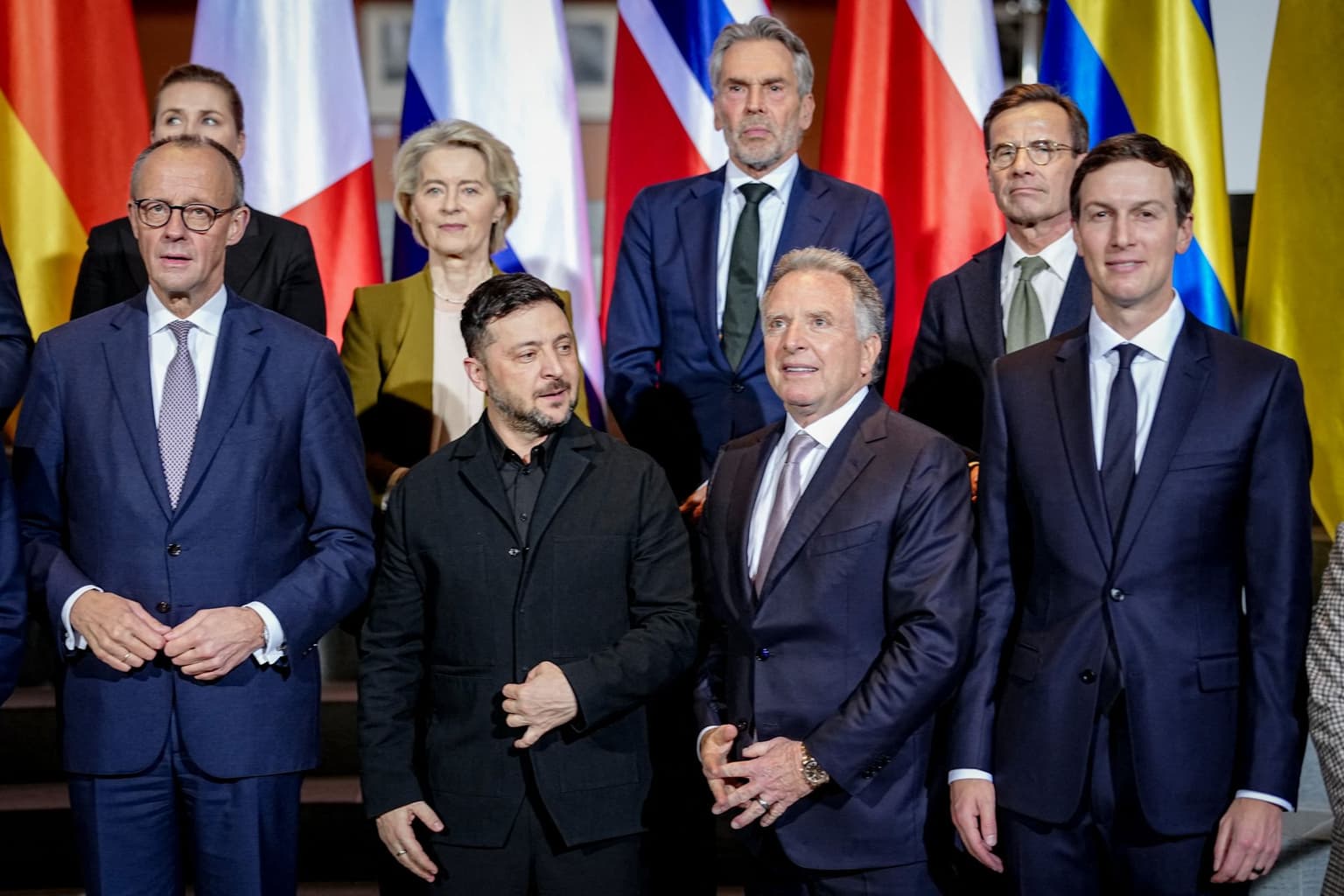
(Front row L-R) German Chancellor Friedrich Merz, President Volodymyr Zelensky, U.S. special envoy Steve Witkoff, and Jared Kushner with European leaders at the Chancellery in Berlin, Germany, on Dec. 15, 2025. (Kay Nietfeld / Pool / AFP via Getty Images)
 on Google
Behind closed doors, Ukraine and its allies are discussing the war-torn country’s economic recovery alongside a potential peace deal.
At the heart of these conversations is the new so-called Economic Prosperity Plan — a package "for economic recovery, restoring jobs, and bringing life back to Ukraine," President Volodymyr Zelensky told reporters on Dec. 30.
Ukrainian officials say rebuilding the country and jump-starting long-term growth will require as much as $800 billion over 10 years — roughly four times its prewar domestic gross product — an estimate that has surfaced in the latest round of negotiations on a 20-point peace plan
While details of the "prosperity plan" remain scarce, official statements describe a 10-year framework involving Ukraine, the U.S., EU, and G7 partners aimed at mobilizing that $800 billion through a mix of public and private investment.
The plan will rely on financial tools such as guarantees, risk-sharing, and blended public-private financing, Economy Minister Oleksii Sobolev said on Jan 3. Priority sectors include energy, infrastructure, industry, and human capital, all of which have been hard hit by Russia’s war.
At the last count, Russia’s full-scale invasion has caused over $176 billion in direct damages, based on an assessment by the World Bank, Kyiv, the United Nations, and the European Commission last year. The assessment put reconstruction and recovery costs at $524 billion, with energy, mining, industry, and agriculture being the most affected sectors.
Ukraine’s war-ravaged economy, which plummeted by 30% in 2022, can only rebound with a strong peace deal, Kyiv says. By tying foreign investment to postwar reconstruction, Ukraine is seeking to keep Washington engaged in peace talks — and more inclined to offer security guarantees — by linking them to commercial projects known to resonate with U.S. President Donald Trump's administration.
Kyiv’s economic prosperity plan gambit appears to build on that logic, drawing on the earlier success of the so-called "minerals deal," a 2025 agreement that gave preferential access to U.S. investors through a U.S.-Ukraine reconstruction fund. After months of preparation, the fund became operational late last year and on Jan. 7 launched an online portal to begin accepting project proposals.

The new prosperity plan has emerged from weeks of talks between Ukraine and its partners, including the World Bank, BlackRock CEO Larry Fink, and Jared Kushner, Trump's son-in-law.
But with little publicly available beyond buzzwords and official statements, Ukraine’s economic minds say they can’t yet properly assess the plan.
"I cannot understand whether this is something substantive or a repackaging of existing programs seemingly tailored for Trump, with unclear or unproven impact," Hlib Vyshlinsky, director of the Center for Economic Strategy, a Kyiv-based think tank, told the Kyiv Independent.
One obvious snag, though, is the $800 billion goal, Serhii Fursa, deputy head of Ukrainian investment firm Dragon Capital, told the Kyiv Independent. Ukraine simply cannot swallow that much investment over a decade. The figure may instead be a starting point for negotiations, he said.
Neither does the involvement of BlackRock inspire much hope after the firm backtracked on a much-hyped $15 billion recovery fund registered in 2024, Fursa said. The company halted the fund following Trump’s election victory due to a lack of interest and uncertainty for Ukraine’s future, according to Bloomberg's reporting.
In response to inquiries from the Kyiv Independent, BlackRock and the U.S. State Department declined to comment on the current Economic Prosperity Plan.
An economic peace plan takes shape
The new plan first surfaced after a meeting between top Ukrainian and American officials, including U.S. Treasury Secretary Scott Bessent, Kushner, and Fink, on Dec. 10
"We discussed key elements for recovery, various mechanisms, and visions for reconstruction," Zelensky said afterwards, without elaborating.
Days later, Prime Minister Yulia Svyrydenko announced a joint working group following an online meeting with Kushner, U.S. Special Envoy Steve Witkoff, World Bank President Ajay Banga, and BlackRock’s Fink.
"The Ukrainian team is ready to work as intensively as our American partners are ready to work. Economic plans have every chance of successful implementation if ironclad security guarantees work, as U.S. envoys stated at the meeting," she wrote on Telegram.
By Dec. 27, Zelensky had announced that Ukraine and the U.S. were working together on a "roadmap to prosperity" to partially fund the $800 billion goal by 2040. As part of a "common vision" with America, Zelensky said, there will be a smorgasbord of funds for Ukraine’s recovery, including a sovereign investment platform.
This roadmap will address Ukraine’s pressing issues, Zelensky said, like the return of some 5-6 million refugees abroad to counter the debilitating demographic crisis, and bolster job growth and GDP per capita.
The following day, Zelensky met Trump in Florida to nail down the final disputes over Kyiv’s 20-point peace plan. While the anticlimactic meeting failed to yield any tangible peace agreements, Zelensky later told reporters in Ukraine that Kyiv and the U.S. were preparing several documents under the "prosperity package."

But for the plan to come to life, the war would need to end first, Zelensky stressed, cautioning that there wouldn’t be an influx of investment immediately after the guns stop firing. Zelensky said American and European businesses could invest under "special conditions" that governments would agree upon first.
On Jan. 3, Sobolev and Svyrydenko presented the prosperity plan to European, NATO, and G7 allies during the first of a series of planned consultations. The plan will rebuild and modernize Ukraine’s economy "so that Ukraine has a strong competitive economy, social stability, and high defense capabilities," Sobolev said in a statement published on the ministry's website.
Ukraine and its partners will continue to meet in the coming weeks across Europe to structure the workings of the plan, Svyrydenko said on Jan. 3. The most recent talks took place in Paris on Jan. 6, with Witkoff writing on X that "significant progress" was made on the prosperity plan and security guarantee framework.
"We are hopeful to achieve additional positive momentum in the near future," he wrote.
In response to inquiries from the Kyiv Independent, the ministry said that all current information on the plan is published in its online statement. The European Commission did not respond by the time of publication.