Tired, scared, or deliberately obstructive: Why Ukrainian lawmakers refuse to vote for reforms
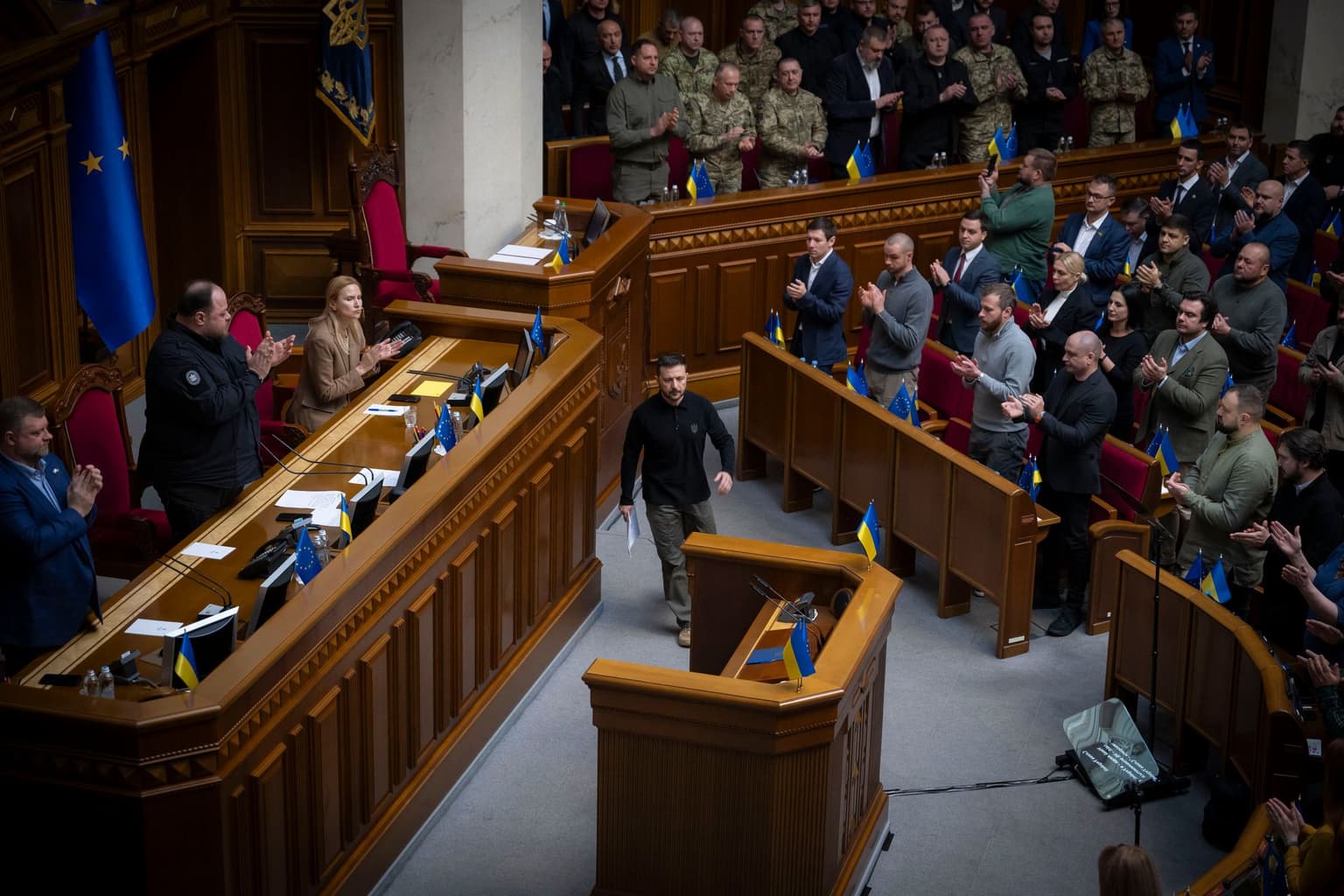
President Volodymyr Zelensky arrives to speak to parliamentarians at the Verkhovna Rada in Kyiv, Ukraine, on Oct. 16, 2024. (Press Service of the President of Ukraine / AP)
 on Google
Tetiana Shevchuk
International relations head at the Anti-Corruption Action Center
As Ukraine's Verkhovna Rada enters its seventh year without a general election, a troubling narrative has taken hold in Kyiv's political circles that parliament is broken, paralyzed, and incapable of delivering the reforms Ukraine's international partners require.
MPs and governmental officials are giving two explanations for this supposed dysfunction: personal exhaustion and fear of anti-corruption investigations. Neither holds up to scrutiny.
The crisis may be real, but it originates not in the parliament chamber but in the President's Office. President Volodymyr Zelensky has the tools to resolve it and has chosen not to use them.
The first narrative, that MPs have simply grown weary after years in office under martial law, without elections to renew their mandate, has a kernel of truth and a fatal flaw.
Yes, there is a cohort of lawmakers who arrived in 2019 with reformist energy and now feel politically stranded, unable to leave and unwilling to engage. Collectively, that fatigue may be real. But in a country at war, the argument collapses the moment it is stated aloud.
The soldiers in the trenches of the Zaporizhzhia and Donetsk oblasts are the ones who are really tired, but they cannot stop fighting. Ukrainian MPs drawing state salaries, enjoying Kyiv offices, and holding institutional power are not entitled to cite exhaustion as grounds for legislative inaction.

If anything, the wartime context makes the obligation to legislate more acute, not less.
The more recent excuse is that MPs are paralysed by fear of prosecution. MPs claim that the National Anti-Corruption Bureau (NABU) and the Specialised Anti-Corruption Prosecutor's Office (SAPO) are weaponizing investigations to intimidate the legislature following the July 2025 debacle, when parliament first voted to gut NABU's and SAPO's independence and then reversed course within a week under street pressure.
However, NABU and SAPO do not and cannot prosecute MPs for how they vote; this is legally impossible and fundamentally contrary to how anti-corruption institutions operate.
Roughly 5% of currently serving MPs face active NABU suspicions, the majority related to bribery, embezzlement, and illicit enrichment rather than their legislative positions.
Blaming anti-corruption bodies for parliamentary inaction is an attack on anti-corruption institutions that the EU explicitly requires Ukraine to strengthen, and it should be called what it is: an attempt to shift blame.
Furthermore, data compiled by opposition MP Yaroslav Zhelezniak, Deputy Head of the Committee on Financial, Tax, and Customs policy, demonstrates clearly that parliament is not paralyzed. Head of Anti-Corruption Committee, Anastasiia Radina, confirmed that every plenary week, bills routinely pass with close to 300 votes.
It should be noted that the 2026 state budget sailed through without difficulty and notably included an increase in the discretionary MP fund to Hr 200,000 (roughly $4,500) per month. Defense and social legislation also pass regularly. Attendance and voting records show lawmakers are present and functional when they choose to be.
What Parliament refuses to vote on is a specific and telling category: legislation drafted by the Cabinet of Ministers and politically inconvenient enough that no one wants to own it. The Cabinet, for its part, is happy to leave it that way. It is either submitting bills it knows will stall or not submitting them at all, then pointing at the Rada when international partners ask why commitments are not being met.
The genuine crisis is an internal breakdown of trust between the Office of the President and the Servant of the People faction.
Damaged by the "Mindichgate" corruption scandal, the faction has used the collapse of the informal "envelope" incentive system — whereby MPs were paid in cash for their votes — as a convenient excuse to withhold votes on politically costly legislation.

MPs call for adequate political compensation and sharing responsibility between the executive and legislative branches.
The pattern becomes even harder to ignore when one looks at what the executive is not submitting to Parliament at all. Reform of the State Bureau of Investigations (SBI) is a concrete requirement under Ukraine's EU integration commitments, included in the so-called Kachka-Kos plan.
President Zelensky personally instructed that a draft law on the SBI reform be submitted to parliament by the end of January this year. That deadline has passed, but the bill has not appeared. What has appeared instead are populist proposals, cashback schemes, and budget handouts for which, by the government's own figures, there is no fiscal benefit.
President Zelensky is the only person who possesses the tools to resolve this.
For instance, he could start direct engagement with the faction (his last meeting with the faction took place in November 2025 in the midst of the "Mindchgate"), use public pressure, or increase personal involvement in the legislative agenda.
None of these has been deployed in any sustained way. His threat on March 15 to conscript non-voting MPs generated public amusement, but it was fundamentally evasive. It should be perceived as a piece of political theatre that deflects attention from his own responsibility for managing his own political party.
A weakened, discredited Parliament is objectively convenient for the presidential vertical. It cannot generate independent political authority, cannot be held accountable for specific votes it never takes, and can always be presented to international partners as the reason reform commitments go unmet, even when the bills in question were never formally submitted to the Rada in the first place.
Ukraine's EU accession process and its relationships with the IMF and other donors are anchored in specific legislative benchmarks.
When those benchmarks slip, it is not because Parliament is broken. It is because no one with the authority to deliver the votes has been asked to do so. Exhaustion and fear are convenient fictions. The parliamentary crisis is a managed condition, and the person managing it, whether through inaction or deliberate calculation, is President Zelensky.
Editor's note: The opinions expressed in the op-ed section are those of the authors and do not purport to reflect the views of the Kyiv Independent.