The political chess behind Poland’s military spending
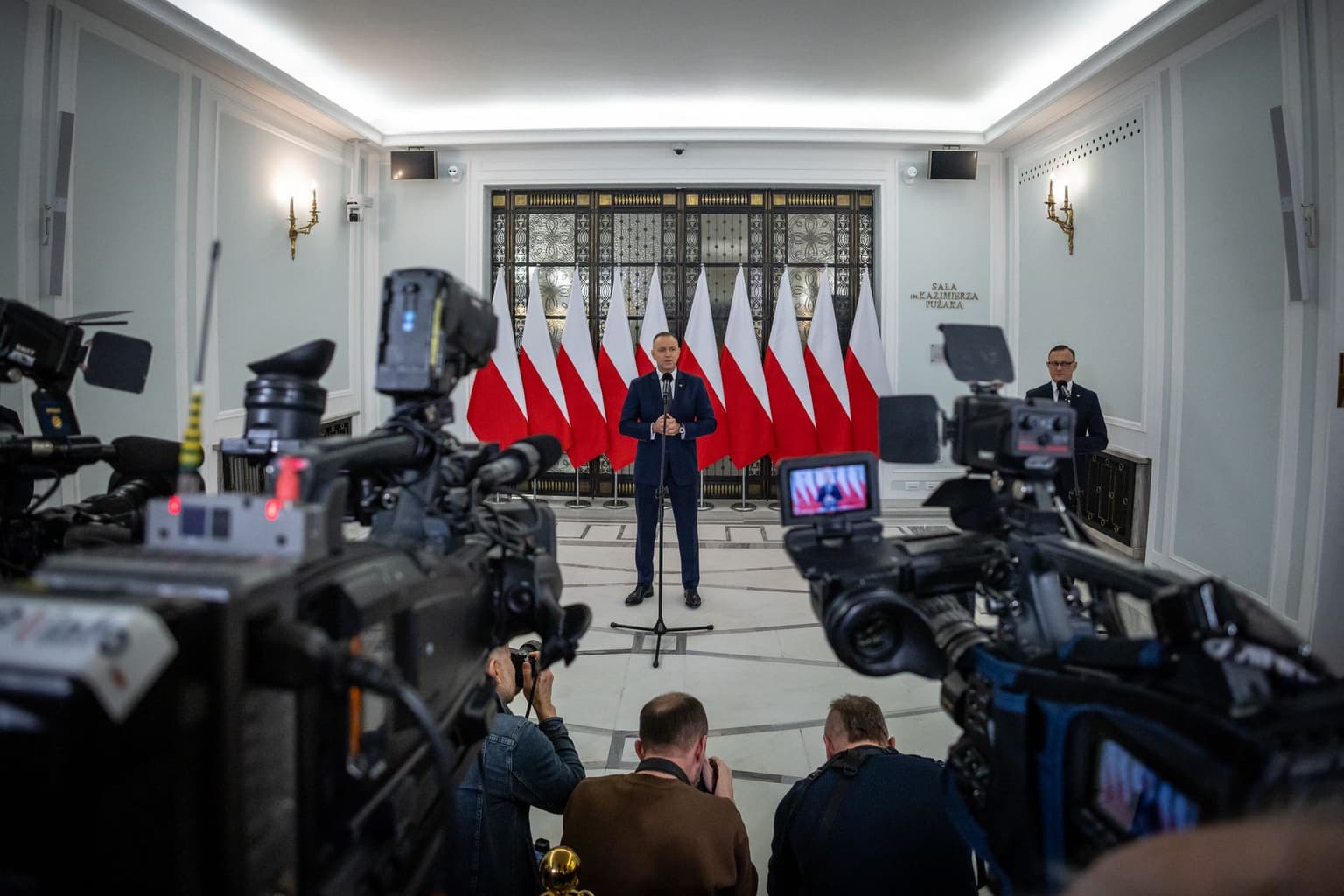
President Karol Nawrocki speaks during a press conference following a parliamentary session in Warsaw, Poland, on Feb. 26, 2026. (Wojtek Radwanski / AFP / Getty Images)
 on Google
Poland, one of the largest countries on the EU’s eastern flank, has sharply ramped up its military spending since 2022, with defense expenses reaching 4.5% of GDP in 2025 — among the highest in the European Union.
Investment in the military is also exceptionally popular: 67% of Poles support further increases in defense budgets, according to recent local polls.
Yet despite this strong backing, a political clash has put the funding strategy in the spotlight.
President Karol Nawrocki recently vetoed a government-backed bill to accept an EU loan for national defense, sparking a heated debate between the right-wing opposition and the liberal government.
While the tone of the debate points to deep divisions between the two camps, Polish analysts who spoke to the Kyiv Independent suggest political infighting will go hand-in-hand with an increase in military spending — a policy that both camps ultimately support.
European SAFE initiative
Approved in May 2025, the Security Action for Europe (SAFE) initiative was designed as an instrument for the European Commission to provide loans to member states for defense spending.
Instead of borrowing on their own, EU countries can submit national defense projects to the EC, which will provide the necessary funding. For most member states, this makes defense spending cheaper, as the EC enjoys a flawless credit rating, thereby lowering interest rates.
With a total budget of 150 billion euros ($173 billion), SAFE would be a significant investment for European defense,with all funds expected to be spent between 2026 and 2030. Poland — which submitted projects worth approximately 44 billion euros ($50 billion) — would have been by far the biggest beneficiary of the funding.
Other major contenders for EU loans include Romania ($20 billion) and Italy ($18 billion). France and Hungary, whose national spending plans have not yet been approved by the European Commission, have also requested $19 billion in funding each.

Presidential veto
While Poland has for years been at the forefront of EU defense spending, and the Commission's SAFE initiative was set to lend a hand to Warsaw, the initiative became a victim of Polish domestic political infighting.
“To put it very generally, the bill on SAFE did not pass because neither side of the political spectrum can accept the idea of a compromise with the other side, even on the most basic mental level,” said Piotr Skwieciński, a Polish political commentator and former diplomat.
“Politicians on both sides think mainly about their most fanatic supporters, for these people any kind of compromise means treason.”
On the right, the SAFE initiative was generally labelled as a project serving “German interests,” with the main opposition party Law and Justice (PiS) rallying supporters against a loan which would supposedly increase Poland’s dependency on Brussels.
“Deep down, many right-wing politicians in Poland may have this sentiment that Germany was somehow waiting for a Russian victory parade in Kyiv (in 2022),” said Witold Jurasz, a political commentator and former diplomat, attempting to explain the anti-EU and anti-German sentiment among the Polish far-right.
“Even if this opinion can be justified, this does not change the fact that today, Europe is helping Ukraine much more than the U.S. is under (President Donald) Trump. And Polish right-wing politicians refuse to notice this.”
The liberal government led by the pro-European Civic Coalition (KO) opposed all claims of “German influence,” arguing that SAFE funds would be overwhelmingly invested in Poland’s own defense industry.
Poland’s opposition also sought to portray the EU’s initiative as an issue for the country's relations with the United States, given that under SAFE funds would need to be spent mainly in Europe, potentially resulting in lost opportunities for the U.S. defense sector.
According to Jurasz, many in Poland believe that the Trump-appointed U.S. Ambassador to Poland, Tom Rose, used these arguments to actively lobby against SAFE with Nawrocki and, more widely, with PiS politicians. This would be linked to the Trump administration’s agenda to “undermine the EU from within,” according to the former Polish diplomat.

President Nawrocki, an ally of the Law and Justice party, has effectively supported this sentiment with his veto.
The decision to veto SAFE was “just another occasion” for PiS and the far-right to attack the government for supposedly agreeing to a “German loan,” argues Michał Kacewicz, the editor-in-chief of news website Centrum Europy.
“This was mainly just about discrediting political opponents,” Skwieciński agreed.
Limited practical consequences
While Poland’s military would have theoretically lost enormous funds due to Nawrocki’s veto, it soon became clear that this would not be the case.
On March 13, immediately after the president’s decision, the pro-European government led by Prime Minister Donald Tusk adopted a decree that would, in practice, secure most of the EU funds for Poland.
“Nawrocki knew that Poland would receive the SAFE loans in any case, his veto was basically just political cynicism on his part,” Jurasz argued. “This decision did not really change anything, because the loans will just be accepted by government ordinance, not through a law voted in parliament.”
In practice, though, adopting the SAFE loan by ordinance narrows the areas in which money can be spent, limiting them strictly to military spending due to legal constraints. While the EU loans were mainly supposed to support the military, parts of the funds were also supposed to go to related issues, such as police forces and improving road infrastructure.
However, non-military spending was “not a significant part” of the overall SAFE budget, Jurasz said.
While the EU loan program was ultimately saved, the rejection of the government's bill will create additional administrative burdens, Kacewicz said, explaining that spending projects will now have to be amended and budgets redrawn.
“180 billion zloty ($50 billion) is a big investment into the Polish army,” Jurasz said. “But this is still not enough, as we are dealing with an aggressive, imperialist, and fascist Russia.”