'Structural shift'— EU ban on Russian gas set to harm Moscow long term, despite loopholes
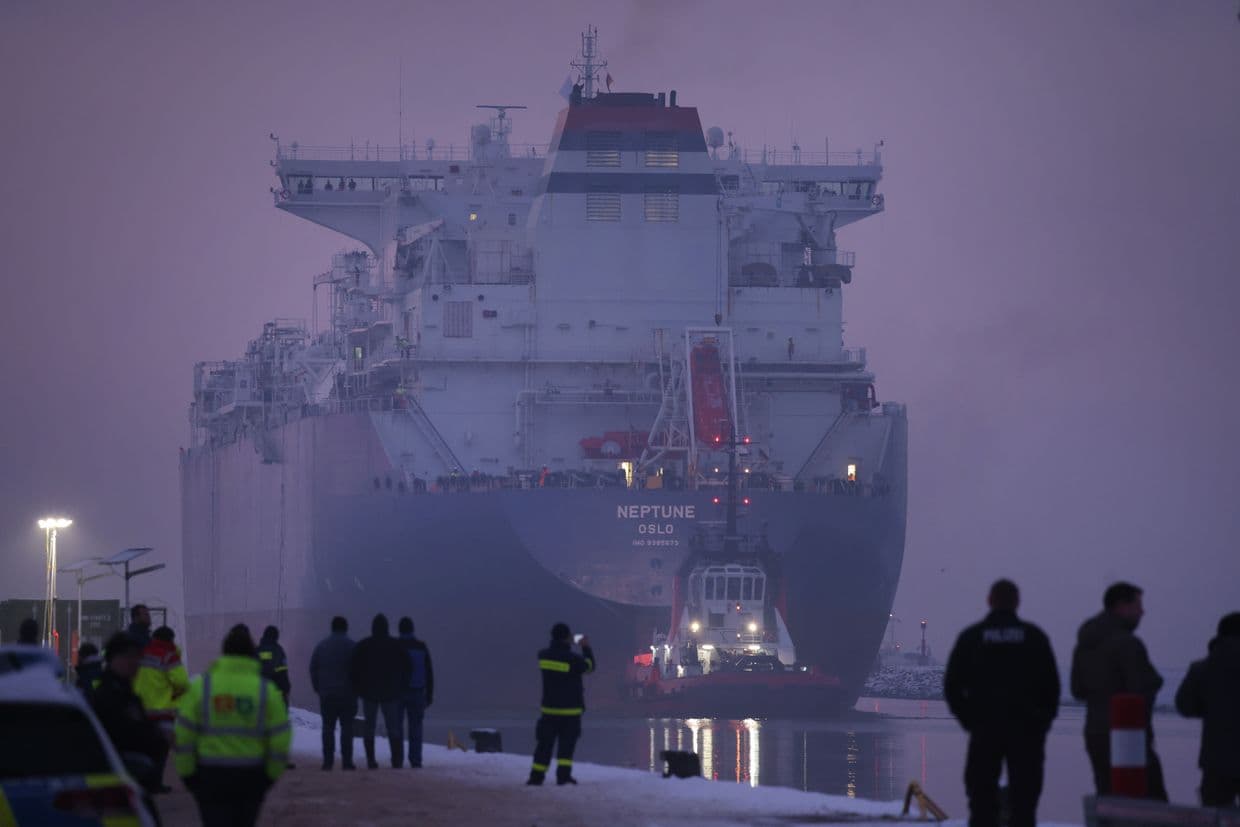
Police watch as the FSRU ship Neptune is pulled into Lubmin Port for LNG import at a new terminal in Lubmin, Germany, on Dec. 15, 2022. (Sean Gallup / Getty Images)
 on Google
The European Union has approved a long-promised ban on Russian gas imports, a measure meant to lock in the bloc’s shift away from Moscow’s energy supplies nearly four years into Russia's full-scale war against Ukraine.
Still, the new ban contains major loopholes, meaning that without full commitment by EU member states, some Russian gas will likely continue to flow into the EU, according to sector experts who spoke to the Kyiv Independent.
What exactly is banned and how
The decision on Jan. 26 came as the final step in regulations that the EU developed throughout 2025.
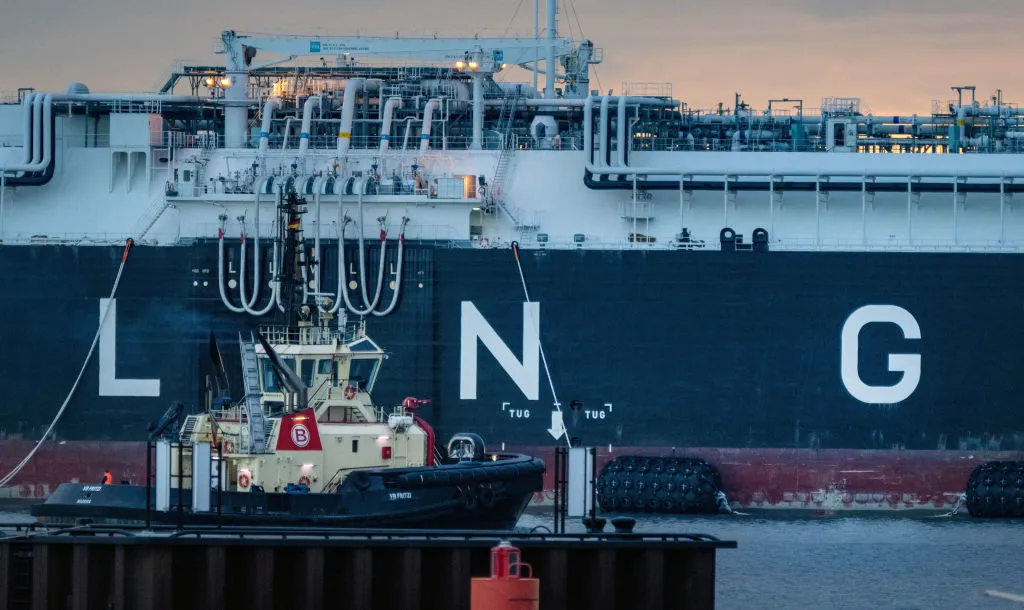
These were proposed following a surprise comeback of Russian gas imports over the previous year: while Moscow supplied Europe with almost half of its gas consumption up until 2022, this share plummeted to less than one-fifth by 2023, but rose again by 18% in 2024, largely thanks to increases in Russian LNG supplies.
To circumvent a likely veto by Hungary and Slovakia, the EU's Russian gas ban was adopted not as a sanction against Russia, but as a trade regulation — this allowed the text to be adopted by a qualified majority of member states, not by unanimity.
The procedure and the wording of the regulation showed that the EU is "serious" about banning Russian pipeline gas and LNG, according to Natasha Fielding, head of gas and LNG pricing at Argus Media, a news outlet that specializes in commodity markets.
However, before the ban comes into force, it will face legal challenges.
Immediately after its adoption, Hungary and Slovakia argued that the measure was a "legal trick" because, in practice, it amounted to sanctioning Russian gas, and filed a lawsuit against it at the Court of Justice of the European Union.
Even if the ban is not canceled or overturned in court, the phase-out process will be slow.
By March this year, EU member states are expected to enact national plans to eliminate Russian gas, with short-term supply contracts expected to expire by June. Overall, LNG from Russia would in theory be fully banned by January 2027, while pipeline gas will still be able to flow until September of that year. In practice, even after this date many exceptions could limit the scope of the ban.

"First of all, Hungary, Slovakia and other countries can activate a security supply clause, which means that if they say that there is a significant risk to the energy security of their countries, the ban on Russian gas needs to be postponed," said Martin Vladimirov, director of the Energy and Climate Program at the Center for the Study of Democracy, a European public policy institute.
"Second of all, the gas phase-out and the oil phase-out as well, depend on the passing and the approval of a national phase-out plan by each country, and these can be not implemented on time."
Potential loopholes
One issue is exceptions foreseen by the EU ban itself, another are gaps in the regulation that could be exploited by countries and traders interested in purchasing Russian gas.
According to Vladimirov, one of the most obvious paths is "laundering" gas through Turkey.
"Azerbaijan and Russia, for instance, already have mechanisms for swapping gas," Vladimirov said.
"We know that Azerbaijan doesn't have additional quantities of gas to sell to Europe, so even now some of the imported Azeri gas is likely Russian. But (on paper) this is Azeri gas. It’s technically possible to investigate the origin, but customs authorities don’t usually have the capacity for this, and gas traders can easily obfuscate documents."

Aside from Russian gas labeled as Azeri, gas imports to the Western Balkans are another gray zone that could be used to smuggle Russian fuel into the EU — companies from Serbia, for example, can buy gas supposedly for local consumption but later resell the fuel to Hungary, Slovakia and other countries, Vladimirov argued.
Identifying the physical origin of gas molecules is "practically impossible," said Olena Lapenko from DIXI Group, a Kyiv-based think tank focusing on the geopolitics of energy.
"What matters is contractual origin and delivery point. If Russian gas is first imported into a non‑EU country and then sold on a hub via a non‑Russian counterparty, it becomes very hard to distinguish (this gas) from any other volume unless the regulation explicitly targets such indirect flows."
On top of this, the ban will contain an exception for countries where the EU considers the risk of Russian gas entering their exports to be low. Gas imported from these countries will not be subject to checks of origin, potentially creating a further loophole for Russian imports.
"The gas trading community is very sophisticated and advanced, and there's lots of layers of trading, so it’s a challenge to really pin down and prevent all Russian gas flow into Europe," Fielding said.
Structural shift translates into serious losses for the Russian budget
While the regulations are far from perfect, they are still "a major step" toward eliminating Russian gas in Europe, Vladimirov said, estimating that over 90% of Russian LNG imports could be eliminated after 2027.
"The ban is less about an overnight collapse in Russian gas revenues and more about cementing a structural shift," Lapenko explained in turn. "Before 2022, the EU was Russia’s most lucrative gas market. The new bans signal that this market is not coming back, and this has long‑term implications for Russia."
Over time, this structural change will erode both revenue quality and geopolitical leverage, Lapenko argued.
Overall oil and gas revenues still account for about 24% of Russia’s budget, translating into 9.5 trillion rubles ($110 billion) of revenue. Even if this profit is mostly made on oil, the potential loss of the EU gas market is not insignificant.
While European imports fell from over 150 billion cubic meters of gas per year in 2021 to around 40 billion in 2025, independent estimates show that the EU is still ahead of China and remains Russia’s biggest customer of LNG and pipeline gas.

The decrease in Russia’s earnings could be felt all the more as gas prices are unlikely to go up soon, with or without the EU’s new restrictive measures. In fact, market analysts have forecast an "LNG glut" for 2026, which could further bring down prices.
"Any price impact (of the EU ban) will likely be limited and short‑term, for three reasons," Lapenko said. "First of all, because Russian pipeline gas is already marginal in the EU, secondly, because the market has largely rebalanced around LNG, Norwegian pipeline gas, North African supplies, and demand reduction. Thirdly, markets have been pricing in the risk of further restrictions on Russian gas for some time."
As such, while new EU regulations will not fully block the entry of Russian gas, they are set to have a deep, long-term effect on Russia’s ability to freely sell its fossil fuels.
"Russia is losing a high‑value diversified market," Lapenko concluded. "It is becoming more reliant on fewer buyers and more constrained export routes: over time, that erodes both revenue quality and Moscow’s geopolitical leverage."
read also
 Tim Zadorozhnyy
 Martin Fornusek
 Luca Léry Moffat